JTET 2026 Exam Pattern: Marks, Sections, Negative Marking
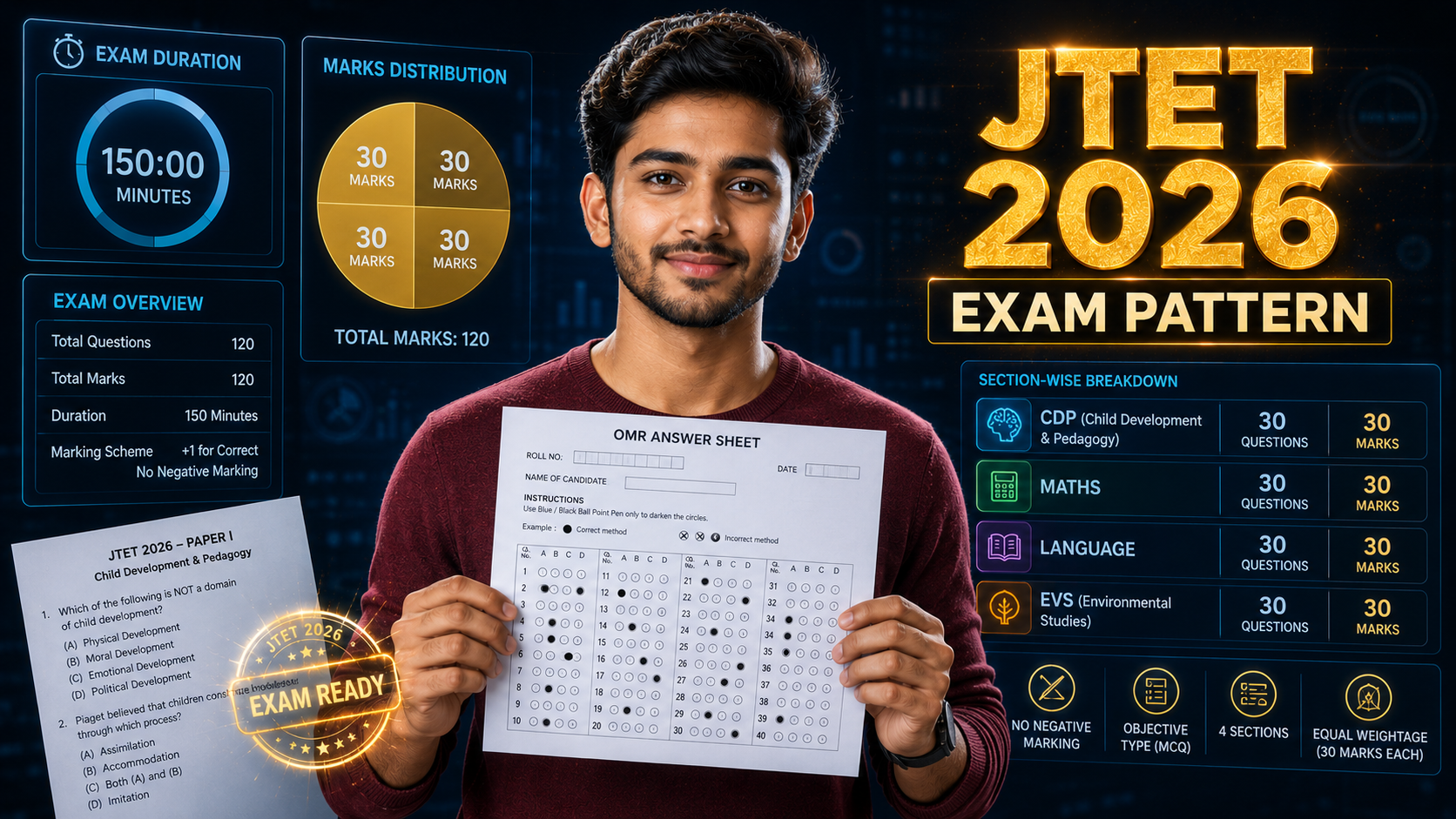
JAC released the JTET 2026 Exam Pattern on 28 March 2026, alongside Notification No. 487. The headline numbers stay the same as previous cycles: 150 questions in 150 minutes, no negative marking, OMR-based offline mode. The change is in how Paper 2 now treats Computer Education as a third subject option (unique to JTET), which shifts how serious aspirants pick their stream.
This is the full JTET 2026 Exam Pattern in plain detail: marks per section, time per section, question types, qualifying cut-offs, and the section-wise time allocation that actually works in the exam hall. No filler.
| Field | Detail |
|---|---|
| Conducting body | Jharkhand Academic Council (JAC), Ranchi |
| Exam | Jharkhand Teacher Eligibility Test (JTET) 2026 |
| Papers | Paper 1 (Class 1–5), Paper 2 (Class 6–8) |
| Total questions | 150 per paper |
| Total marks | 150 per paper |
| Marks per question | 1 |
| Negative marking | None |
| Duration | 2 hours 30 minutes (150 minutes) |
| Mode | Offline, OMR-based MCQ |
| Question language | Bilingual (Hindi + English) |
| Sections in Paper 1 | 5 (CDP, Language I, Language II, Maths, EVS) |
| Sections in Paper 2 | 4 (CDP, Language I, Language II, Subject Block) |
| Qualifying marks (General) | 60% (90/150) |
| Official website | jac.jharkhand.gov.in |
Three concrete shifts compared to the 2016 and 2024 cycles.
The headline marks structure stays the same: 150 questions, 150 marks, 150 minutes, no negative marking. JAC has not tinkered with the macro pattern.
Paper 2 now offers Computer Education as a third subject option (60 marks). Earlier cycles had only Mathematics & Science or Social Studies. This makes JTET the only state TET in India with Computer Education as a Paper 2 subject. If you have a computer background, the option is statistically scoring because content is concrete and PYQ competition is lower.
The 4-Block ELPS approach (Experience, Language, Pictures, Symbols) is now explicitly named in pedagogy sections across CDP, Maths, Language and EVS. This affects question composition, not the macro pattern, but the framework matters for prep prioritisation.
| Event | Date |
|---|---|
| Notification + Pattern released | 28 March 2026 |
| Online application start | 21 April 2026 |
| Application last date | 21 May 2026 |
| Admit card | 7–10 days before exam (tentative) |
| Exam date | To be announced |
For Paper 1: Senior Secondary with 45% marks + 2-year D.El.Ed (or equivalent). For Paper 2: Graduation + B.Ed or 4-year B.El.Ed. Minimum age 21 years as on 01 August 2026. No upper age limit. Full eligibility detail in our JTET 2026 Notification blog.
Paper 1 is for candidates aspiring to teach Class 1 to Class 5 in Jharkhand government primary schools. It has five sections, each carrying equal marks.
| Section | Questions | Marks |
|---|---|---|
| Child Development & Pedagogy (CDP) | 30 | 30 |
| Language I (Hindi or Urdu) | 30 | 30 |
| Language II (regional, chosen from 14 options) | 30 | 30 |
| Mathematics | 30 | 30 |
| Environmental Studies (EVS) | 30 | 30 |
| Total | 150 | 150 |
The exam gives 150 minutes total for 150 questions. That averages to 1 minute per question, but the sections do not need equal time. Based on PYQ difficulty distribution:
| Section | Recommended Time | Why |
|---|---|---|
| CDP | 25 minutes | Theory-heavy, scenario-based questions need reading time |
| Language I | 22 minutes | Comprehension passages take time; grammar is fast |
| Language II | 22 minutes | Same as Language I |
| Mathematics | 32 minutes | Calculations need time; do these first if strong in maths |
| EVS | 24 minutes | Quick recall + Jharkhand-specific GK |
| Buffer / OMR review | 25 minutes | Critical for last-minute corrections |
Aspirants who do not budget the buffer end up with 5–10 unmarked OMR bubbles at submission. The buffer is non-negotiable.
Paper 2 is for candidates aspiring to teach Class 6 to Class 8 in Jharkhand upper-primary schools. It has only four sections because the subject block at the end carries 60 marks instead of two separate 30-mark blocks.
| Section | Questions | Marks |
|---|---|---|
| Child Development & Pedagogy (CDP) | 30 | 30 |
| Language I | 30 | 30 |
| Language II | 30 | 30 |
| Subject Block (one of three options) | 60 | 60 |
| Total | 150 | 150 |
You choose one of these three options based on your teaching specialisation:
- Mathematics & Science (60 marks) for Maths and Science teachers. This is the most popular option.
- Social Studies (60 marks) for Social Studies teachers. Covers History, Geography, Civics and Economics.
- Computer Education (60 marks). JTET-unique option. Covers MS Office, internet basics, JHARKHAND-GURUJI, NISHTHA, DIKSHA, PM e-Vidya, and ICT/AI integration in teaching.
| Section | Recommended Time | Notes |
|---|---|---|
| CDP | 25 minutes | Same as Paper 1, framework-anchored questions |
| Language I | 22 minutes | Grammar + comprehension |
| Language II | 22 minutes | Grammar + comprehension |
| Subject Block (60 marks) | 56 minutes | Higher weight, plan more time |
| Buffer / OMR review | 25 minutes | Last-pass correction time |
The 60-mark subject block is where exam time discipline breaks down for most candidates. Setting a 56-minute cap saves 15 to 20 marks across sections you would otherwise rush.
The marking scheme is the simplest among Indian government exams.
| Aspect | Rule |
|---|---|
| Correct answer | +1 mark |
| Incorrect answer | 0 mark (no penalty) |
| Unattempted question | 0 mark |
| Multiple options bubbled | Treated as incorrect (0 mark) |
No. JTET 2026 has zero negative marking. Each correct answer carries 1 mark, and incorrect or unattempted answers carry 0. This is officially confirmed in Notification 487/2026.
What this means for strategy: never leave a question blank. Even informed guessing has positive expected value. A clean OMR sheet with all 150 questions attempted is the floor strategy, not the ceiling.
JTET 2026 is a qualifying exam, not a ranking exam. You need to clear the category-wise cut-off to earn the certificate.
| Category | Qualifying % | Marks (out of 150) |
|---|---|---|
| General / EWS | 60% | 90 |
| BC (Backward Class) | 55% | 83 |
| SC, ST, SEBC, PH / Divyang | 52% | 78 |
Candidates who clear the cut-off get the JTET certificate, valid for lifetime per NCTE 2021 amendment.
JTET 2026 offers 14 language options for Language II, the largest pool of any state TET. The Language I choice is Hindi or Urdu (depending on the assistant teacher post applied for). Language II must be different from Language I.
| Type | Languages |
|---|---|
| Standard (4) | Hindi, English, Urdu, Sanskrit |
| Tribal (6, script: Devanagari) | Kuduk (Kurukh), Mundari, Ho, Khadia (Kharia), Santhali, Bhumij |
| Regional (6) | Nagpuri, Panchpargania, Bangla (Bangla script), Odia (Devanagari for JTET), Khortha, Kurmali |
The question paper itself is bilingual (Hindi + English), so even if your Language sections are in regional scripts, the CDP, Maths and EVS questions appear in both Hindi and English on the same OMR sheet.
All questions are objective-type multiple-choice with four options. There is no descriptive, no audio-visual, no case-study format. The complexity comes from:
-
Scenario-based CDP questions. A short classroom situation is described and you must identify the correct teaching response. These take 60–90 seconds to read and answer.
-
Comprehension passages. Both Language sections have one or two unseen passages followed by 5–7 questions. Speed reading matters more than vocabulary depth.
-
Pedagogy questions. Across Hindi, English, Maths, EVS, Science, Social Studies, there are questions on how to teach each subject. The answers are often counter-intuitive (the "modern" choice over the "traditional" choice).
-
Direct recall questions. Around 20% of Paper 1 and 25% of Paper 2 are direct knowledge: RTE sections, NEP 2020 stages, Birsa Munda dates, Maths formulas, Science facts.
-
Application questions. Especially in Maths and Science, where you apply a formula or concept to a numeric or experimental setup.
JTET is purely a qualifying eligibility test. Qualifying gets you the JTET certificate, valid for lifetime per the NCTE 2021 amendment. Actual teacher recruitment in Jharkhand happens through JSSC Primary Teacher and Sahayak Acharya recruitment, separately notified. The certificate alone does not give a job; it makes you eligible to apply.
For a JTET-qualified candidate who clears the JSSC Primary Teacher or Sahayak Acharya recruitment, the in-hand monthly salary is approximately ₹50,000 to ₹57,000 under Pay Level 6 of the 7th Pay Commission. Para Teacher honorarium is lower: ₹23,530 to ₹25,200 per month. Full breakdown in our salary blog.
A 90-day plan that respects the marks distribution of JTET 2026.
Weeks 1–3: CDP (30 marks). This is your single highest-yield section by ROI. Build a framework of Piaget, Vygotsky, Bruner, Bandura, Kohlberg, Erikson, then map each to NCF-FS Panchakosha and the NEP 5+3+3+4 structure. Read RTE Act 2009 once. Daily 2 hours.
Weeks 4–6: Languages (60 marks combined). Hindi grammar drills. English comprehension speed work. Pedagogy of language teaching with the 4-Block ELPS lens. Daily 2 hours.
Weeks 7–9: Subject block. Paper 1: Maths and EVS, both at NCERT Class 3–5 level. Paper 2: pick Maths-Science, Social Studies, or Computer Education and drill to NCERT Class 6–8 level.
Weeks 10–12: Mocks and revision. Full-length mock every Sunday with the 150-minute clock running. Revise CDP framework and Jharkhand-specific GK in the last two weeks.
Books that actually work: Lucent's CTET & TET practice books (Hindi and English both), NCERT Class 1–8 textbooks, Disha Publication JTET solved papers, and the official JAC notification document itself for pattern alignment.
Section-wise observations from the last regular cycles, useful for time allocation in the actual exam.
| Section | Average Answer Time (PYQ analysis) | Typical Score (qualified candidates) |
|---|---|---|
| CDP | 50–70 seconds per question | 20–24 out of 30 |
| Language I (Hindi) | 35–45 seconds per question | 22–26 out of 30 |
| Language II (English) | 40–55 seconds per question | 18–24 out of 30 |
| Mathematics (Paper 1) | 60–80 seconds per question | 17–22 out of 30 |
| EVS | 35–45 seconds per question | 22–26 out of 30 |
CDP and Maths together consume more than 50% of the available time in Paper 1. Aspirants who treat all five sections as equal time blocks tend to leave 8–12 Maths questions unattempted in the last 10 minutes.
-
Start with the section you are strongest in. The OMR allows out-of-order attempt. If you are strong in EVS, do EVS first to bank confident marks. CDP scenarios eat time even when you know the theory.
-
Maths is non-negotiable for Paper 1. Many aspirants concede maths thinking the other 120 marks will save them. The qualifying cut-off (90 for General) almost always demands at least 18 of 30 maths marks.
-
Attempt every question, no exception. Zero negative marking means an unattempted question is a lost mark. Even a 25% educated guess has +0.25 expected value.
-
Bubble the OMR as you go, not at the end. Aspirants who batch-bubble in the last 15 minutes lose 4–8 marks to misalignment errors every cycle.
-
For Paper 2 Computer Education option, JHARKHAND-GURUJI, NISHTHA and DIKSHA are tested every cycle. Three to four questions are essentially free if you have read the platform names once.
-
Carry only the admit card, a valid photo ID and a blue or black ballpoint pen. JAC has cancelled candidatures for smartwatches in the past.
-
Language II selection matters more than aspirants realise. If you are weak in your chosen Language II, your overall paper score takes a 12–15 mark hit. Pick the language you actively study, not the one you assume you know.
Plan: 1 mock per week for the first 8 weeks, then 2 per week for the final 4 weeks. Every mock should use the actual 150-minute clock, OMR-style answer sheet, and section-wise time discipline.
After every mock, analyse for 60 minutes:
- Section-wise accuracy (target 70% per section)
- Time spent per section (compare to recommended allocation above)
- Which question type cost the most time (scenario-based, comprehension, application)
- Wrong answer pattern (was it a knowledge gap, calculation slip, or misreading?)
ExamAtlas has a free JTET 2026 mock test series with AI analytics that splits time spent by section and accuracy by sub-topic. Useful to see whether your Maths is failing on number system or on geometry, not just "Maths".
JTET 2026 has 150 multiple-choice questions for 150 marks, completed in 150 minutes. Paper 1 (Class 1–5) has five sections of 30 marks each: CDP, Language I, Language II, Mathematics, EVS. Paper 2 (Class 6–8) has four sections: CDP, Language I and Language II of 30 marks each, plus a 60-mark subject block.
No. JTET 2026 has no negative marking. Each correct answer carries 1 mark; wrong and unattempted answers carry 0. This makes attempting all 150 questions a basic strategy with positive expected value.
In Paper 1, each of the five sections (CDP, Language I, Language II, Mathematics, EVS) carries 30 marks. In Paper 2, CDP, Language I and Language II carry 30 marks each, while the chosen subject block (Maths-Science, Social Studies, or Computer Education) carries 60 marks.
JTET 2026 qualifying marks are 60% (90/150) for General and EWS, 55% for BC, and 52% for SC, ST, SEBC, and PH candidates. Candidates clearing the cut-off receive the JTET certificate with lifetime validity per NCTE 2021.
The duration is 2 hours 30 minutes (150 minutes) for both Paper 1 and Paper 2. Each paper has 150 questions, giving roughly 60 seconds per question, including OMR bubbling time. There is no sectional time limit; you can allocate time across sections as you choose.
JTET 2026 is offline. Candidates receive a printed question paper and an OMR answer sheet. Answers are marked by darkening bubbles with a blue or black ballpoint pen. There is no computer-based testing for JTET.
Yes, if you meet eligibility for both. JAC schedules Paper 1 and Paper 2 in separate shifts on the same exam day. Combined application fee is approximately ₹1,500 for General category. Most aspirants who hold both D.El.Ed and B.Ed take both papers.
The best option depends on your background. Maths and Science is most popular and has the largest study material pool. Social Studies suits those with humanities background. Computer Education is the JTET-unique option, statistically scoring for candidates with even basic computer familiarity because content is concrete and PYQ competition is low.
Yes. Each question in CDP, Maths, EVS, Science and Social Studies is printed in both Hindi and English. Language I and Language II sections appear only in the chosen language script (Hindi, Urdu, Sanskrit, English, Bangla, Devanagari for tribal languages, etc).
The 2026 pattern is steady at the macro level (150 questions, 150 minutes, no negative marking) and shifts only at the Paper 2 subject block where Computer Education has appeared as a third option. Build your prep around the actual marks distribution: CDP carries 30 marks but maps to 35 marks of question impact because pedagogy ideas show up in every other section. Languages together carry 60 marks. The subject block in Paper 2 carries 60 marks alone.
One honest caveat: the official notification does not specify time allocation by section. The recommendations above are built from 2016 and 2024 PYQ analysis; treat them as a working framework, not a rule. For a free 60-minute JTET 2026 sectional with the actual pattern simulated (150 questions, OMR-style interface, section-wise time tracking), the ExamAtlas JTET test series has the format already set up.