JTET 2026 Syllabus: Paper 1 & Paper 2 Topic-Wise PDF
JAC released the JTET 2026 syllabus on 28 March 2026 alongside Notification No. 487. The shape looks familiar at first glance, but three things have shifted under the surface: CDP is now streamlined to 10 NEP-anchored concepts, Paper 2 includes Computer Education as a separate option (unique to JTET, not in CTET or BTET), and the 4-Block ELPS approach now shows up in every subject's pedagogy.
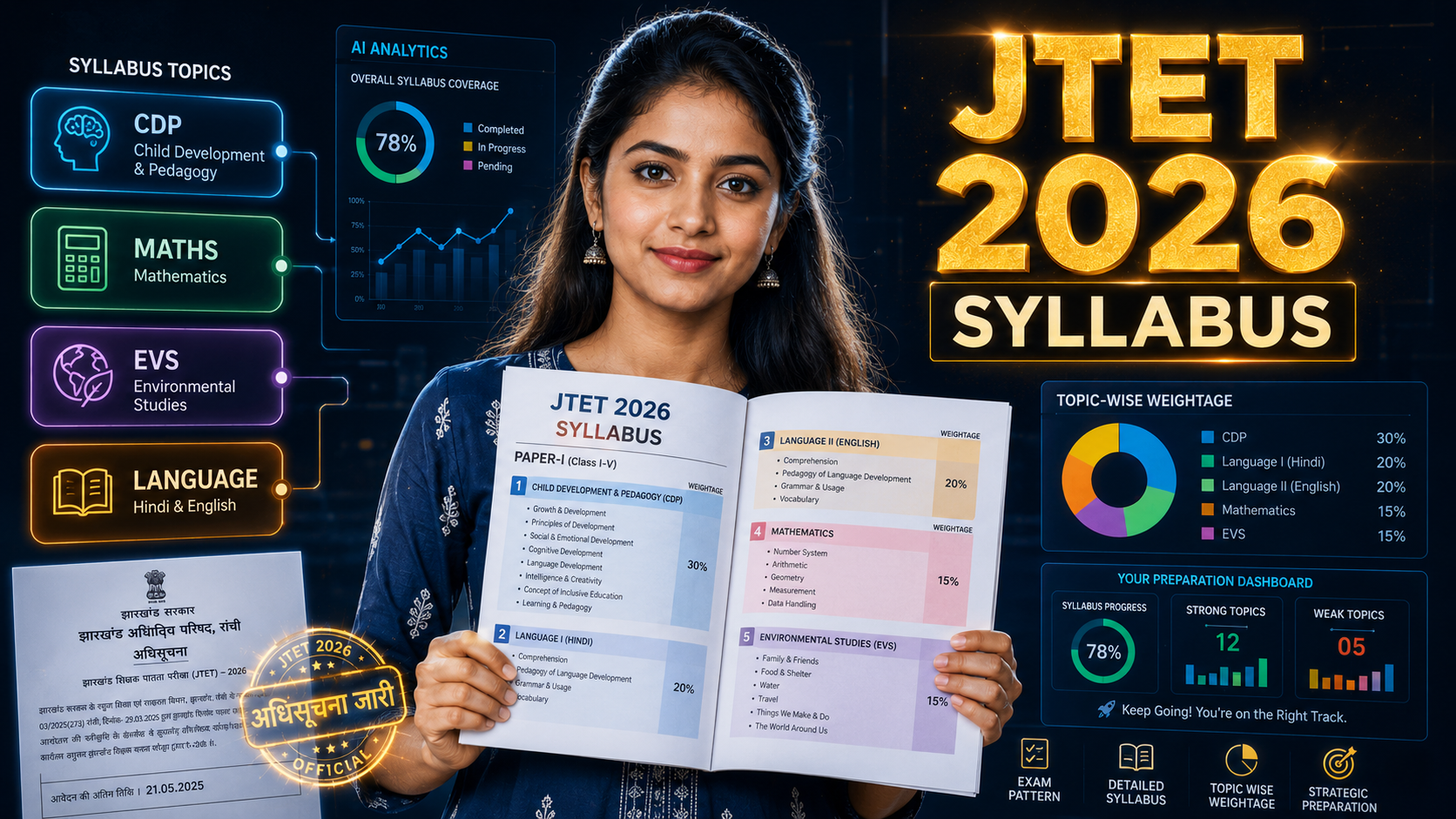
Here is the full JTET 2026 Syllabus, topic by topic, with marks weightage for both Paper 1 (Class 1–5) and Paper 2 (Class 6–8). Section-wise PYQ trends included. PDF download link at the end.
Overview Table
| Field | Detail |
|---|---|
| Conducting body | Jharkhand Academic Council (JAC), Ranchi |
| Exam | Jharkhand Teacher Eligibility Test (JTET) 2026 |
| Papers | Paper 1 (Class 1–5), Paper 2 (Class 6–8) |
| Total questions | 150 per paper |
| Total marks | 150 per paper |
| Duration | 2 hours 30 minutes |
| Negative marking | None |
| Mode | Offline, OMR-based MCQ |
| Languages | Bilingual paper (Hindi + English); Language II from 14 options |
| Syllabus PDF | jac.jharkhand.gov.in |
What Changed in JTET 2026 Syllabus
Three concrete shifts compared to the 2016 and 2024 cycles:
The CDP section is dramatically tighter. The official 2026 syllabus lists only 10 specific concepts under "Concepts" and "Learning & Pedagogy", all explicitly anchored in NEP 2020, NCF-FS 2022, and NCF-SE 2023. Older theorists like Piaget, Vygotsky, Bandura still appear in PYQs, but the framing has shifted from "Who proposed X?" to "Apply X to an NCF-FS Panchakosha classroom".
Computer Education has been added as a Paper 2 subject option. This is JTET-specific and not present in CTET, BTET, or UPTET. Topics include MS Office, internet basics, JHARKHAND-GURUJI platform, NISHTHA, DIKSHA, PM e-Vidya, and an introduction to ICT and AI integration in teaching.
The 4-Block ELPS approach (Experience, Language, Pictures, Symbols) is now explicitly named in the pedagogy section of Hindi, English, Mathematics, EVS, and Sanskrit. Direct questions on ELPS appear in CDP, Maths pedagogy, and language pedagogy across both papers.
Important Dates
| Event | Date |
|---|---|
| Notification + Syllabus released | 28 March 2026 |
| Online application start | 21 April 2026 |
| Application last date | 21 May 2026 |
| Admit card | 7–10 days before exam (tentative) |
| Exam date | To be announced |
JTET 2026 Exam Pattern
Paper 1 (Class 1–5)
| Section | Questions | Marks |
|---|---|---|
| Child Development & Pedagogy | 30 | 30 |
| Language I (Hindi / Urdu) | 30 | 30 |
| Language II (regional) | 30 | 30 |
| Mathematics | 30 | 30 |
| Environmental Studies (EVS) | 30 | 30 |
| Total | 150 | 150 |
Paper 2 (Class 6–8)
| Section | Questions | Marks |
|---|---|---|
| Child Development & Pedagogy | 30 | 30 |
| Language I | 30 | 30 |
| Language II | 30 | 30 |
| Mathematics & Science / Social Studies / Computer Education | 60 | 60 |
| Total | 150 | 150 |
Both papers are 2 hours 30 minutes, offline, OMR-based, with no negative marking. One mark per correct answer.
JTET 2026 Syllabus: Paper 1 (Class 1–5)
Section A: Child Development & Pedagogy (30 marks)
The 2026 official CDP syllabus is identical for Paper 1 and Paper 2. It lists 10 concepts in two blocks.
Block A: Concepts (6 topics)
- Concept of development and its relation to learning
- Theories and stages of child development, anchored in NEP 2020, NCF-FS, NCF-SE (this is where Piaget, Vygotsky, Kohlberg and Erikson appear, framed through NCF-FS Panchakosha and the NEP 5+3+3+4 structure)
- Child-centred education and innovative teaching methods
- Individual differences among learners
- Continuous & Comprehensive Evaluation (CCE), the NEP 2020 Holistic Progress Card (HPC), and Bloom's Taxonomy
- Equitable and inclusive education, plus Children with Special Needs (CWSN), RPwD Act 2016, dyslexia, dyscalculia, ADHD, autism
Block B: Learning & Pedagogy (4 topics)
- How children think and learn (Piaget stages, Vygotsky ZPD and scaffolding, Bruner modes, Skinner reinforcement, Bandura modelling)
- Basic processes of teaching-learning
- Motivation and learning (cognitive, emotional, moral development; Maslow, McClelland, Kohlberg, Gilligan)
- Digital Pedagogy and ICT integration (this is new and JTET-specific)
Question distribution (30 marks):
| Type | Questions |
|---|---|
| Framework-anchored (NEP 2020, NCF-FS, NCF-SE, RTE, CCE, HPC, Bloom's, Digital Pedagogy) | 12–15 |
| Classical theorists applied to NCF-FS scenarios | 10–12 |
| Inclusive education / CWSN / RPwD Act 2016 | 4–6 |
| State-specific (multilingual classroom with tribal home languages) | 1–3 |
Section B: Language I (Hindi or Urdu, 30 marks)
Hindi topics: unseen prose and poetry passages; vyakaran (varnа vichar, sangya, sarvanaam, visheshan, ling, vachan, kriya, kaarak, kaal, upsarg, pratyay, paryayvachi, vipreetarthak, shrut-sambhinnarthak shabd, muhavre, lokoktiyan).
Hindi pedagogy: principles and methods of language teaching, language skills, communication skill development, remedial teaching, NEP 2020's 4-Block ELPS approach (Experience, Language, Pictures, Symbols).
Urdu (for Urdu medium): poetry (Firaq Gorakhpuri, Akhtar Sheerani, Iqbal, Ismael Merathi, Akbar Allahabadi); ghazal (Wali Dakni, Shad Azimabadi); afsana (Rajendra Singh Bedi, Saadat Hasan Manto); essays (Sir Syed Ahmad Khan, Aslam Pervez). Grammar covers Sarf-o-Nahw, ism, fail, harf, zameer, jins, wahid-jama, muhavre and zarbul amsal.
Section C: Language II (30 marks)
JTET supports 14 language options for Language II, the largest pool of any state TET. Choose one different from Language I.
Standard (4): Hindi, English, Urdu, Sanskrit Tribal (6, script: Devanagari for all): Kuduk (Kurukh), Mundari, Ho, Khadia (Kharia), Santhali, Bhumij Regional (6, script: Devanagari except Bangla): Nagpuri, Panchpargania, Bangla (Bangla script), Odia (Devanagari for JTET), Khortha, Kurmali
For tribal and regional language papers, the syllabus emphasises basic vocabulary (family, body, home, village, nature, agriculture, animals, numbers, colours), basic grammar (sangya, sarvanaam, visheshan, kriya, ling, vachan, kaal, kaarak, upsarg, pratyay), folk songs, folk tales, riddles, proverbs, plus NEP 2020 provisions for tribal-language mother-tongue education. The NEP-tribal-language question appears in every tribal language paper.
Section D: Mathematics (30 marks)
Content topics: numbers and operations, geometry and spatial understanding (2D and 3D shapes, symmetry), measurement and units (length, mass, volume, time), practical and commercial maths (money, profit-loss, simple interest, mensuration, percentage, fractions), data handling, patterns.
Maths pedagogy: nature of mathematics, methods of teaching maths, problems and challenges in maths teaching, diagnostic and remedial teaching, CCE and HPC, NEP 2020 4-Block ELPS approach for primary maths.
Section E: Environmental Studies (30 marks)
Six NCERT themes (content):
- Family and neighbourhood
- Food (food from plants and animals, cooking, eating, animal diets)
- Shelter (types of shelter, household plants and pets, hygiene)
- Water (sources, storage, scarcity, flow, water for plants and animals)
- Travel and communication
- Things we make and do
Jharkhand-specific EVS content (high-yield, 4–6 marks per cycle): Birsa Munda (1875–1900) and Ulgulan movement, Tana Bhagat movement, Santhal Hul (1855), tribal communities (Santal, Munda, Oraon/Kurukh, Ho, Kharia, Bhumij, Birhor), state tree Sal, festivals (Sarhul, Karma, Tusu, Sohrai), rivers (Subarnarekha, Damodar, North Koel), forests (Saranda, Betla, Palamu), Parasnath Hills, Hundru and Dassam falls.
EVS pedagogy: nature and significance of EVS, activities and project-based work, CCE and competency-based assessment per NEP 2020.
JTET 2026 Syllabus: Paper 2 (Class 6–8)
Paper 2 has the same CDP, Language I and Language II structure as Paper 1. The difference is the 60-mark subject block at the end. Candidates choose one of three options.
Subject Option I: Mathematics & Science (60 marks, for Maths/Science teachers)
Mathematics (Class 6–8 scope): number system, integers, exponents, negative numbers, fractions, squares and square roots, cubes and cube roots, HCF and LCM; algebra (variables, constants, algebraic expressions, identities); arithmetic (ratio-proportion, unitary method, percentage, profit-loss, simple and compound interest, time-distance, time-work); geometry (2D and 3D shapes, symmetry); mensuration (perimeter, area, volume); data handling (graphs, bar charts, pie charts).
Maths pedagogy: mathematical and logical thinking; methods of teaching; diagnostic and remedial teaching; CCE / HPC; NEP 2020 4-Block ELPS approach.
Science (Class 6–8 scope): food sources and nutrition, health and hygiene; materials around us, types of substances, separation, acids-bases-salts; living world classification, plant and animal structure and function, biodiversity, respiration-digestion-excretion; measurement, motion, force, friction, sound; electric current and circuits, magnets, light, heat and temperature; natural phenomena, energy sources; forest products, greenhouse effect, ozone layer, pollution, waste management.
Science pedagogy: nature and structure of science; aims of science teaching;
STEAM-based teaching (Science-Tech-Engineering-Arts-Mathematics); observation, experiment and inquiry-based teaching; remedial teaching; CCE and HPC.
Subject Option II: Social Studies (60 marks)
History: sources of history; early society (agriculture, pastoralism, urbanisation); early states and the first empire (Ashoka, Mauryan administration); Mughal Empire; cities, trade and craftsmen; cultural evolution; 18th century political structures; rise of Company rule in India; colonialism; tribal society and Santhal revolt; Revolt of 1857; British rule and education; women's reform; National Movement 1885–1947; post-Independence India.
Geography: solar system, atmosphere, hydrosphere, Earth and its motions, internal structure of Earth; physical environment and climate; tropical, sub-tropical and temperate regions; deserts; natural resources (land, soil, minerals, vegetation); human resources; agriculture; industry; position and size of India and Jharkhand.
Social and Political Life: diversity; Constitution; fundamental rights and duties; state government; local government; equality in democracy; parliamentary government.
Economics: livelihood, occupational activity, money and exchange; population growth in India and Jharkhand context; PDS; food and commercial crops; cooperatives; market; economic and social values; financial literacy (newly added focus).
Social Studies pedagogy: nature and concept; teaching methods; project work; problems; CCE and competency-based assessment; critical thinking under NEP 2020.
Subject Option III: Computer Education (60 marks, JTET-unique)
This option does not exist in CTET, BTET, or UPTET. Topics include: introduction to computers and generations; computer parts and functions; keyboard and mouse; Paint, MS Word, MS Excel, MS PowerPoint; desktop and file system; input/output devices; internet, web browser, search engine, email; online class tools (Google Meet, Zoom); cyber safety and netiquettes; digital platforms: NISHTHA, DIKSHA, PM e-Vidya, JHARKHAND-GURUJI; introduction to ICT and AI integration in teaching-learning.
If you have a computer background, Option III is statistically the highest-scoring choice. The PYQ count is lower (less competition for past-paper material), and the content is concrete rather than interpretive.
Selection Process
JTET is purely a qualifying eligibility test. Qualifying gets you the JTET certificate, valid for lifetime per the NCTE 2021 amendment. Actual teacher recruitment happens through JSSC Primary Teacher and Sahayak Acharya recruitment, separately notified. For full notification details, application steps and fee, read our JTET 2026 Notification guide.
Salary and Job Profile (Brief)
Post-recruitment salary for primary teachers under Pay Level 6 of the 7th Pay Commission is approximately ₹50,000 to ₹57,000 in-hand per month. Sahayak Adhyapak (para teacher) honorarium is lower at ₹23,530 to ₹25,200 per month. Full breakdown in our salary blog.
Preparation Strategy by Syllabus Section
A 90-day plan that respects the actual weightage of each section:
Weeks 1–3: CDP foundation (highest ROI). Read RTE Act 2009 once, marking sections 12, 21, 22, 23, 29. Read the NEP 2020 school-education chapter. Lay down the Piaget-Vygotsky-Bruner-Bandura grid, then map each theorist to NCF-FS Panchakosha and the 5+3+3+4 stages. Add CCE, HPC and Bloom's Taxonomy. Daily 2 hours.
Weeks 4–6: Languages. Hindi vyakaran (sandhi, samaas, alankaar). English comprehension speed drills. Both languages' pedagogy with the 4-Block ELPS lens.
Weeks 7–9: Subject section. Paper 1: Maths and EVS, both anchored to NCERT Class 3–5. Paper 2: choose Maths-Science, Social Studies, or Computer Education and drill to NCERT Class 6–8 level.
Weeks 10–12: Mocks and revision. Full-length mock every Sunday. Last two weeks: revise CDP framework and Jharkhand-specific EVS / Social Science GK.
Books that actually work for JTET 2026: Lucent's CTET & TET practice books (Hindi and English both), NCERT Class 1–8 textbooks for content, Disha Publication Jharkhand TET solved papers, NEP 2020 official document (free PDF on MoE website), and the JAC syllabus PDF itself.
Previous Year Trends: Section-wise PYQ Weightage
Approximate question counts based on 2016 and 2024 papers, useful for prep prioritisation:
| Topic / Sub-topic | Paper 1 | Paper 2 |
|---|---|---|
| RTE Act 2009 | 4–5 Q | 4–5 Q |
| NEP 2020 framework (newly heavier) | 3–4 Q | 3–4 Q |
| Piaget cognitive stages | 2–3 Q | 2–3 Q |
| Vygotsky ZPD, scaffolding | 2 Q | 2 Q |
| Inclusive education / CWSN | 2–3 Q | 2–3 Q |
| Hindi vyakaran | 8–10 Q | 8–10 Q |
| Hindi pedagogy | 6–8 Q | 6–8 Q |
| English grammar | 8–10 Q | 8–10 Q |
| Maths number system | 6–8 Q | 8–10 Q |
| Maths pedagogy | 4–5 Q | 4–5 Q |
| EVS Jharkhand-specific | 4–6 Q | – |
| Birsa Munda / Santhal revolt | – | 3–4 Q |
| Jharkhand geography | – | 3–4 Q |
One honest line about the syllabus PDF: JAC's official document does not include weightage by sub-topic. The table above is constructed from PYQ analysis of the 2016 and 2024 cycles, so treat it as a guide rather than gospel.
Important Tips for JTET 2026 Syllabus Coverage
- Download the official JTET 2026 syllabus PDF from jac.jharkhand.gov.in. Print it. Tick each topic as you cover it. The act of physically ticking removes prep anxiety better than any motivational video.
- CDP is 30 marks but maps to roughly 35 marks of question impact, because pedagogy-flavoured questions in Hindi, English, Maths and EVS sections also test CDP-style thinking.
- The 4-Block ELPS approach is the single most-tested NEP concept in 2026 PYQs. Memorise the four blocks (Experience, Language, Pictures, Symbols) and one classroom example per block.
- For Paper 2 Computer Education aspirants: focus on JHARKHAND-GURUJI, NISHTHA, DIKSHA, and PM e-Vidya. These are the JTET-specific topics that JSSC has historically included with 3–4 marks weight.
- Jharkhand-specific EVS GK is 4–6 sure marks if you spend one focused evening. Birsa Munda (1875–1900), Sarhul, Karma, Subarnarekha, Saranda, Parasnath, CNT Act 1908, SPT Act 1949. Five sure marks for one evening of effort.
- Do not study the syllabus alone. Pair every syllabus topic with the corresponding PYQs from 2016 and 2024 cycles. The PYQ tells you the actual depth at which a topic is tested.
- For Language II, picking your weakest available option is a contrarian but high-reward strategy. Most aspirants pick their strongest, then prep less. If you actively prep your weak side, you outperform.
Mock Test and Practice Strategy
The JTET 2026 syllabus is broad enough that random topic-by-topic practice leaves blind spots. Plan: 1 mock per week for the first 8 weeks, then 2 per week for the final 4 weeks. After every mock, log:
- Section-wise accuracy (target 70%+ per section)
- Time spent per section (target under 25 minutes for CDP, under 25 for each language, under 30 for maths, under 25 for EVS in Paper 1)
- Which sub-topic dropped accuracy below 60%
ExamAtlas has a free JTET 2026 mock test series with AI analytics that breaks accuracy down by sub-topic (Piaget vs Vygotsky vs Bruner vs Bandura, for instance, not just "CDP"). That granularity tells you exactly which syllabus section to re-read.
FAQs
Where can I download the JTET 2026 syllabus PDF?
The official JTET 2026 syllabus PDF is available on jac.jharkhand.gov.in under the JTET 2026 notification section. JAC released it on 28 March 2026 along with Notification No. 487. Do not trust third-party PDFs claiming to be "official"; download only from the JAC portal.
Is JTET 2026 syllabus the same for Paper 1 and Paper 2?
CDP, Language I and Language II have the same official syllabus structure across both papers. The subject block differs: Paper 1 has Mathematics + EVS (30 marks each, separate), while Paper 2 has a single 60-mark block where you choose Mathematics & Science, Social Studies, or Computer Education.
What is the 4-Block ELPS approach in JTET 2026 syllabus?
The 4-Block ELPS approach (Experience, Language, Pictures, Symbols) is an NEP 2020 pedagogy framework that appears explicitly in JTET 2026 for Hindi, English, Maths, EVS and Sanskrit teaching. Direct questions on ELPS appear in CDP and subject-pedagogy sections of both papers.
Is Computer Education a separate subject in JTET 2026 Paper 2?
Yes. JTET 2026 Paper 2 offers three subject options: Mathematics & Science, Social Studies, or Computer Education. Computer Education is unique to JTET and not available in CTET, BTET, or UPTET. Topics include MS Office, internet basics, JHARKHAND-GURUJI, NISHTHA, DIKSHA, and an introduction to AI in teaching.
How many language options are there in JTET 2026?
JTET 2026 supports 14 language options for Language II: 4 standard (Hindi, English, Urdu, Sanskrit), 6 tribal (Kuduk, Mundari, Ho, Kharia, Santhali, Bhumij), and 6 regional (Nagpuri, Panchpargania, Bangla, Odia, Khortha, Kurmali). This is the largest language pool of any state TET in India.
What is the JTET 2026 CDP syllabus weightage?
CDP carries 30 marks in both Paper 1 and Paper 2. The 2026 official syllabus has streamlined CDP to 10 specific concepts under "Concepts" and "Learning & Pedagogy" blocks, all anchored in NEP 2020, NCF-FS 2022, and NCF-SE 2023. Framework-anchored questions now carry roughly 12–15 of the 30 marks.
Are NCERT books enough for the JTET 2026 syllabus?
NCERT Class 1–8 textbooks cover roughly 70% of the JTET 2026 content syllabus, especially for Maths, EVS, Science and Social Studies. For CDP and pedagogy sections, NCERT is not enough; you need NEP 2020, NCF-FS 2022, and a standard teacher-training reference like Lucent's CTET & TET series. For Jharkhand-specific GK, NCERT does not cover state content; use JCERT material.
Is there negative marking in the JTET 2026 syllabus exam?
There is no negative marking in JTET 2026. Each correct answer carries 1 mark; wrong answers carry 0. Attempting all 150 questions is the basic floor strategy. The syllabus does not specify any partial-marking rule.