
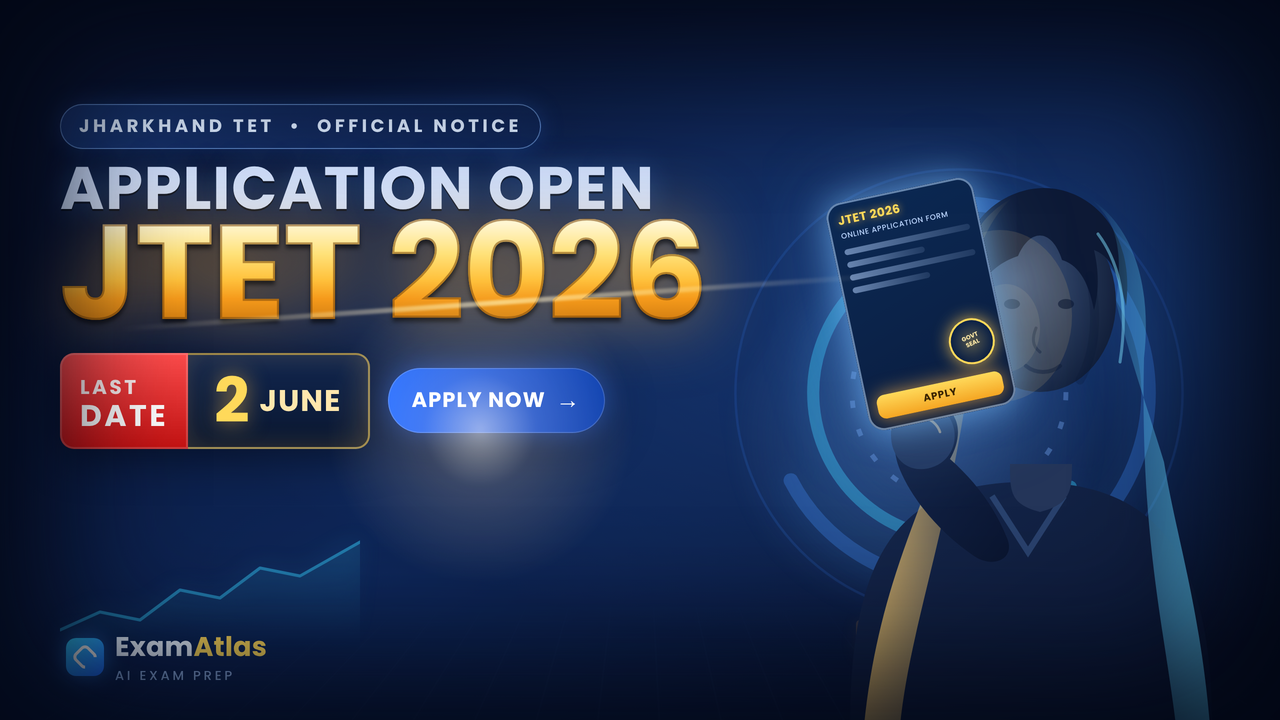
JTET 2026 Notification: Last Date Extended to 2 June, Full Details
JAC has pushed the JTET 2026 application deadline from 21 May to 2 June 2026. The order came through Web-Notice 18/2026 dated 20 May 2026 (Ref No. JAC/JTET/2406/24/Secy/418/26), so if you missed the earlier date, you have a real second window now.
Overview Table
Detail Information Conducting Body Jharkhand Academic Council (JAC), Ranchi Exam Name Jharkhand Teacher Eligibility Test (JTET) 2026 Notification Released 28 March 2026 Application Start 21 April 2026 Application Last Date 2 June 2026 (extended from 21 May) Papers Paper 1 (Class 1–5), Paper 2 (Class 6–8) Total Questions / Marks 150 / 150 Negative Marking None Mode Offline, MCQ Validity Lifetime, no limit on attempts Official Website jac.jharkhand.gov.in
| Detail | Information |
|---|---|
| Conducting Body | Jharkhand Academic Council (JAC), Ranchi |
| Exam Name | Jharkhand Teacher Eligibility Test (JTET) 2026 |
| Notification Released | 28 March 2026 |
| Application Start | 21 April 2026 |
| Application Last Date | 2 June 2026 (extended from 21 May) |
| Papers | Paper 1 (Class 1–5), Paper 2 (Class 6–8) |
| Total Questions / Marks | 150 / 150 |
| Negative Marking | None |
| Mode | Offline, MCQ |
| Validity | Lifetime, no limit on attempts |
| Official Website | jac.jharkhand.gov.in |
Latest Updates
The headline change is the deadline. JAC extended the last date to submit the JTET 2026 online form to 2 June 2026. The application window opened on 21 April and was originally set to close on 21 May.
There is a second point worth reading twice. Candidates who had applied in the 2024 cycle can reapply or even change their exam level (Paper 1 to Paper 2 or the other way) without paying the fee again. If that is you, do not start a fresh paid application by mistake.
JTET is a qualifying eligibility test only. Clearing it does not hand you a teaching job. It makes you eligible to apply when JAC or JSSC opens teacher recruitment. The certificate, once earned, is valid for life, and there is no cap on the number of attempts.
The exam date has not been announced yet. JAC usually releases it a few days before the test, and Paper 1 and Paper 2 are likely to run the same day in different shifts.
Important Dates
Event Date Notification Released 28 March 2026 Application Start 21 April 2026 Last Date to Apply 2 June 2026 Last Date for Fee Payment 2 June 2026 (as per notice) Form Correction Window Cancel and re-apply before last date Admit Card Few days before exam (tentative) Exam Date To be announced Result To be announced
| Event | Date |
|---|---|
| Notification Released | 28 March 2026 |
| Application Start | 21 April 2026 |
| Last Date to Apply | 2 June 2026 |
| Last Date for Fee Payment | 2 June 2026 (as per notice) |
| Form Correction Window | Cancel and re-apply before last date |
| Admit Card | Few days before exam (tentative) |
| Exam Date | To be announced |
| Result | To be announced |
The exam, admit card, and result dates are not out.
Eligibility Criteria
Educational Qualification
You qualify based on the level you want to teach.
For Paper 1 (Class 1–5): Senior Secondary (or equivalent) with at least 50% marks plus a 2-year D.El.Ed / JBT, or a recognised B.El.Ed, or D.Ed (Special Education). Final-year students of these courses can usually apply, subject to the notification's wording.
For Paper 2 (Class 6–8): Graduation with the relevant teacher-training qualification (B.Ed or the equivalent diploma combinations the notification lists). Read the official PDF for the exact percentage relaxations for reserved categories.
If you want eligibility for both levels, apply for both papers. They are assessed separately.
Age Limit (with relaxation)
JTET carries a candidate-friendly age rule this cycle. JAC has allowed a special one-time age relaxation based on the gap between the previous and the current JTET exam, which helps people who crossed the normal limit because the exam cycle was delayed.
| Category | Relaxation (as per notification) |
|---|---|
| General | As per JAC rule |
| OBC / EBC | Additional years per Jharkhand norms |
| SC / ST | Additional years per Jharkhand norms |
| PwD / Women | As specified in the official notice |
Exact upper-age numbers and category years are listed in the notification.
Nationality / Other Requirements
You should hold the qualifications from a government-recognised institution or university. Domicile and reservation benefits follow Jharkhand state rules. Keep your photograph, signature, and certificate scans ready in the prescribed size before you log in.
Exam Pattern
Both papers follow the same shape. 150 multiple-choice questions, 150 marks, one mark each, and no negative marking. Duration is 2 hours 30 minutes. Since there is no penalty for a wrong answer, attempt every question.
Paper 1 (Class 1–5)
| Section | Questions | Marks |
|---|---|---|
| Child Development & Pedagogy | 30 | 30 |
| Language I (Hindi / Urdu) | 30 | 30 |
| Language II (English / Regional) | 30 | 30 |
| Mathematics | 30 | 30 |
| Environmental Studies (EVS) | 30 | 30 |
| Total | 150 | 150 |
Paper 2 (Class 6–8)
| Section | Questions | Marks |
|---|---|---|
| Child Development & Pedagogy | 30 | 30 |
| Language I | 30 | 30 |
| Language II | 30 | 30 |
| Maths & Science OR Social Studies | 60 | 60 |
| Total | 150 | 150 |
The 60-mark subject block in Paper 2 is where most of your score is won or lost, so plan your prep around it.
Syllabus
The whole syllabus sits at the NCERT level for Classes 1 to 8. You do not need thick competitive books. Solid NCERT plus pedagogy is the smarter route.
Child Development & Pedagogy
Development concepts, learning theories (Piaget, Vygotsky, Kohlberg), inclusive education, assessment, and teaching methods. This block repeats in both papers, so it gives the highest return per hour.
Language I & II
Comprehension, grammar, and the pedagogy of language teaching. The pedagogy questions are usually the easy marks people skip.
Mathematics & EVS (Paper 1)
Number system, geometry basics, and the method of teaching maths to young children. EVS covers family, environment, and a fair share of Jharkhand-specific content, so do not ignore the state portion.
Maths-Science / Social Studies (Paper 2)
Pick one stream. Maths and Science draws from NCERT Class 6–8, while Social Studies covers History, Geography, and Civics with their teaching methods.
One honest line the official PDF will not tell you: the paper leans on application and pedagogy, not rote facts, so practising teaching-method questions matters more than memorising definitions.
Selection Process
The process is short because JTET is a single-stage qualifying test. You sit the offline MCQ paper, and JAC declares the result with category-wise qualifying marks.
There is no interview and no second tier. Either you cross the qualifying bar or you do not. The bar is commonly set around 60% for the General category with relaxation for reserved categories, but the exact cut is stated in the notification, so check it rather than trusting a forum post.
Clearing JTET puts your name in the eligible pool. Actual recruitment happens later, through separate JAC or JSSC teacher vacancies.
Salary / Job Profile
Be clear about this. JTET itself pays nothing. It is an eligibility gate, not a job offer.
Once you qualify and get selected in a Jharkhand teacher recruitment drive, a primary teacher's starting pay generally falls in the ₹25,000 to ₹35,000 in-hand range depending on the post and pay level, with DA, HRA, and the usual government benefits on top. Career growth moves from assistant teacher to senior and headmaster roles over time. Treat any specific figure as indicative until the recruitment notification fixes the pay level.
Preparation Strategy
You have a real advantage with the exam date still unannounced. Use the runway.
Week 1 to 2: finish Child Development & Pedagogy first. It carries 30 marks in both papers and is the most predictable scorer. Read NCERT pedagogy notes and the standard theorist material, then solve topic questions.
Week 3 to 4: lock your subject block. Paper 1 aspirants firm up Maths and EVS, including Jharkhand GK. Paper 2 aspirants go deep on the 60-mark Maths-Science or Social Studies stream.
Through all of it, solve previous-year JTET papers in timed mode. The questions repeat in pattern, and a student who has solved old papers is never surprised in the hall. A practical first step for this week: do one full CDP topic and one previous-year paper, nothing fancier.
Previous Year Trends
JTET keeps its 150-mark, no-negative-marking structure steady across cycles, so old papers stay relevant.
| Aspect | Trend |
|---|---|
| Qualifying mark (General) | ~60% as per past notices |
| CDP weightage | Stable at 30 marks both papers |
| Subject block (Paper 2) | 60 marks, decisive section |
| Jharkhand GK in EVS/SST | Consistently present |
The one shift worth noting is the friendlier age relaxation this cycle, which has widened the applicant pool. More applicants usually means the qualifying list gets longer, not that the bar drops.
Important Tips
- Apply well before 2 June. Servers slow down on the last two days, every cycle.
- If you applied in 2024, log in to reapply or change level instead of starting a paid fresh form.
- Attempt all 150 questions. With no negative marking, a blank is a wasted mark.
- Do not skip language pedagogy. Those are among the easiest 10 to 15 marks in the paper.
- Give the Jharkhand-specific EVS and Social Studies portion real time. Many candidates lose easy state-GK marks.
- Solve last 5 years of JTET PYQs in timed mode before your first full mock, not after.
- Keep your document scans in the exact prescribed size to avoid upload rejections.
Mock Test & Practice Strategy
Two full mocks a week is enough while you are still building topics, then move to alternate-day mocks in the final stretch. The analysis matters more than the mock. After each one, list the exact topics where you lost marks and fix those before the next attempt.
ExamAtlas has free JTET-specific mock tests with AI analytics that break your score down topic-wise, which is useful right after a mock to see what is actually leaking marks rather than guessing.
FAQs
What is the JTET 2026 last date?
The last date to submit the JTET 2026 online application is 2 June 2026. JAC extended it from the earlier 21 May 2026 deadline through Web-Notice 18/2026 dated 20 May 2026. Apply at jac.jharkhand.gov.in before the window closes.
Can I apply for both Paper 1 and Paper 2?
Yes. If you meet the eligibility for both levels, you can apply for Paper 1 (Class 1–5) and Paper 2 (Class 6–8) in the same cycle. Both papers are evaluated separately, and each can earn you a separate eligibility certificate.
Is there negative marking in JTET 2026?
No. JTET 2026 has no negative marking. Every correct answer gives one mark and a wrong answer costs nothing. Because of this, you should attempt all 150 questions rather than leaving any blank.
Does clearing JTET guarantee a teaching job?
No. JTET is a qualifying eligibility test. Passing it makes you eligible to apply for Jharkhand government teacher recruitment, but the actual job comes through a separate JAC or JSSC vacancy and selection process.
I applied in 2024. Do I need to pay again?
Candidates who applied in the 2024 cycle can reapply or change their exam level without paying the fee again, as per JAC's notice. Log in with your existing details rather than creating a new paid application.
What is the JTET 2026 exam date?
The JTET 2026 exam date has not been announced yet. JAC typically releases it a few days before the test, and Paper 1 and Paper 2 are expected to be held on the same day in different shifts. Track jac.jharkhand.gov.in for the official date.