
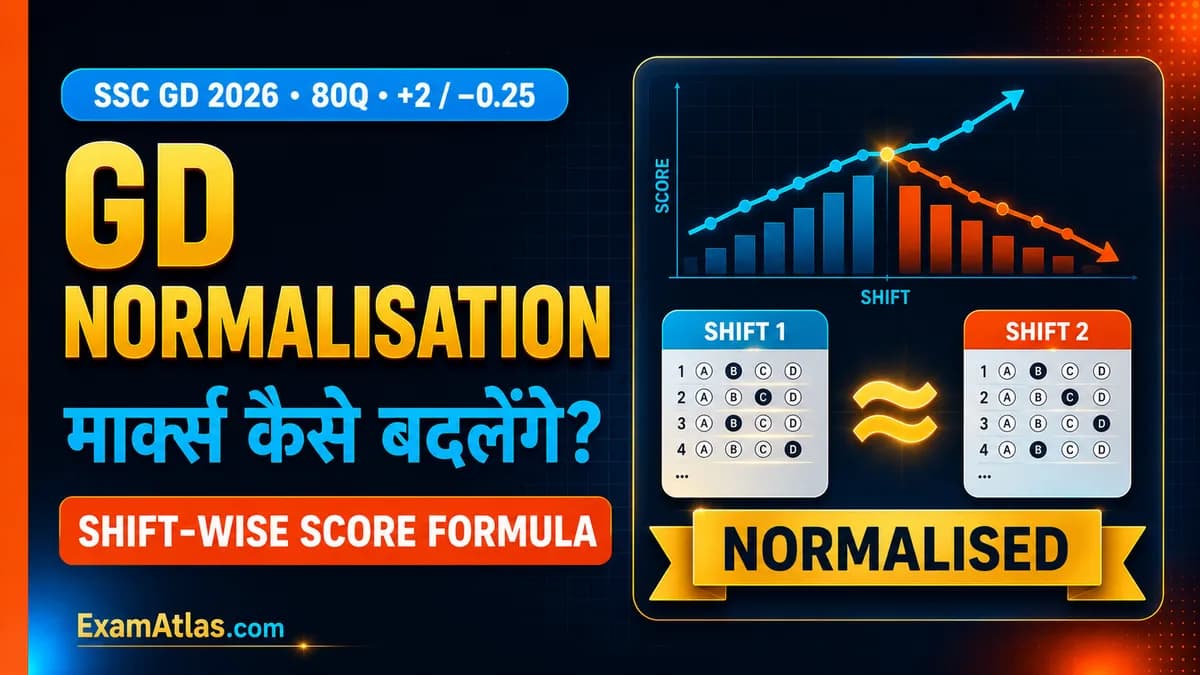
SSC GD Normalisation 2026: How Shift-Wise Marks Are Calculated
SSC GD Normalisation 2026: How Shift-Wise Marks Are Calculated
If your SSC GD raw marks and your final score do not match, normalisation is the reason. The Staff Selection Commission held the SSC GD 2026 Computer-Based Exam from 27 April to 31 May 2026, spread across many days and multiple shifts. Because no two shifts have exactly the same difficulty, SSC does not use your raw marks for the merit list at all. It uses a normalised score, and that score can sit above or below what your answer key shows.
This guide explains SSC GD normalisation 2026 in plain terms: what it is, why SSC uses it, the equipercentile method it now follows, how shift-wise marks are actually calculated, and whether your marks are likely to go up or down. It also clears up the biggest myth candidates believe about how normalisation works.
Overview Table
What Is Normalisation and Why SSC GD Uses It
SSC GD is taken by lakhs of candidates, so the exam cannot run in a single shift on a single day. It runs across many days in multiple shifts, and each shift has a different question paper. However carefully SSC sets those papers, one shift always ends up slightly easier or harder than another.
Normalisation exists to fix that unfairness. If two candidates give the same real performance but one faced a tougher shift, the tougher-shift candidate should not lose out just because their paper was harder. Normalisation adjusts raw scores onto a common scale so that your final marks reflect how well you did relative to your own shift, not the luck of which paper you drew.
The important consequence is simple. SSC does not rank you on your raw marks. It ranks you on your normalised score, and only that normalised score is used to prepare the merit list, decide the cut-off, and shortlist candidates for the Physical Efficiency Test and Physical Standard Test.
The Equipercentile Method: SSC's Current Approach
Here is the update most candidates miss. SSC has moved to the equipercentile method for normalisation. The older approach, which relied on the mean, the standard deviation, and the performance of the top candidates across shifts, has been replaced by this more transparent percentile-based system.
In plain terms, the equipercentile method compares you against the candidates in your own shift, not against the whole exam directly. It looks at where you stand within your shift as a percentile, then asks what that same standing is worth across all shifts on average. A candidate who beats most people in a genuinely tough shift can end up with a higher normalised score than a candidate with more raw marks from an easy shift, because the method rewards relative performance, not the raw number.
How SSC GD Normalisation Is Calculated
The equipercentile method works in a few clear steps. You do not need to compute this yourself, but understanding it removes the mystery.
- Find your percentile within your shift. SSC first works out your standing among everyone who sat your exact shift, expressed as a percentile.
- Map that percentile across all shifts. For that same percentile, SSC finds the equivalent raw score in every other session, so a given standing has a matching mark in each shift.
- Fill the gaps by interpolation. Where a shift has no exact raw score for a percentile, SSC uses linear interpolation to estimate the equivalent score, so every percentile lines up across every shift.
- Average the equivalent scores. SSC averages those equivalent scores across sessions to produce one number.
- That average is your normalised score. This single figure is what enters the merit list.
The takeaway is that your normalised score is really a measure of your rank position within your shift, converted onto a scale that is fair across every shift SSC conducted.
Will Your Marks Increase or Decrease
This is the question everyone asks after the answer key. The honest answer is that it depends on your shift, and there are three possibilities.
If your shift was harder than the overall average, your marks are likely to be adjusted upward, because scoring well against a tough paper counts for more. If your shift was easier than average, your marks may be adjusted slightly downward, since a high raw score against an easy paper is less impressive. If your shift sat close to the average difficulty, your normalised score may barely move from your raw score.
So a candidate who feels their paper was brutal should not despair over a modest raw score, and a candidate who breezed through an easy shift should not assume their raw marks are safe. Normalisation is designed precisely to level that difference.
Common Myths About SSC GD Normalisation
A few beliefs float around every year that are simply wrong, and acting on them leads to bad decisions.
- Myth: normalisation depends on your accuracy. It does not. Normalisation is driven by your shift's overall difficulty and the performance spread across shifts, not by your individual accuracy percentage. Your accuracy affects your raw score, but the adjustment on top of it comes from shift-level data.
- Myth: normalisation always cuts marks. It does not always reduce scores. Marks rise for harder shifts just as often as they fall for easier ones.
- Myth: a higher raw score always means a higher rank. Not across different shifts. A lower raw score from a tough shift can outrank a higher raw score from an easy one once both are normalised.
- Myth: normalisation is unfair or random. It is the opposite. Random shift allotment plus normalisation is what makes a multi-shift exam fair, rather than leaving your result to the luck of your paper.
What Happens After Normalisation
Your normalised CBE score is not always the final word on your merit number. Two things follow.
First, NCC bonus marks are added to the normalised score for eligible candidates: 5 percent of total marks for an NCC 'C' certificate, 3 percent for 'B', and 2 percent for 'A'. Second, the merit list is prepared state-wise and category-wise using this normalised-plus-bonus score.
The Physical Efficiency Test, Physical Standard Test, and medical examination are qualifying stages only. You must clear them, but they carry no marks and do not change your merit position. In short, your rank is decided by your normalised CBE score and any NCC bonus, and everything after that is pass or fail.
SSC GD 2026 Exam Pattern and Marking
To read your score correctly, it helps to know the paper it came from. The SSC GD 2026 CBE is a single objective paper of 80 questions for 160 marks in 60 minutes, with four sections of 20 questions each.
Your raw score is simply correct answers times 2, minus wrong answers times 0.25. Normalisation is then applied to that raw score, and the result is what SSC carries forward.
How to Read Your Score
When your response sheet and answer key are out, calculate your raw marks first, then hold them loosely. Your raw score tells you your ceiling, not your rank. If your shift felt hard, expect a possible upward adjustment, and if it felt easy, expect the reverse. The scorecard SSC releases after the result will show your actual normalised marks, and that is the number that matters for the cut-off.
The practical point is not to celebrate or panic on raw marks alone. Compare how your shift felt against the general chatter about other shifts, keep your NCC certificate ready if you have one, and wait for the official normalised scorecard before drawing conclusions about selection.
FAQs
What is SSC GD normalisation 2026?
SSC GD normalisation 2026 is the process SSC uses to adjust raw marks across shifts, since the exam runs in multiple shifts of differing difficulty. It converts your raw score into a normalised score using the equipercentile method, and only the normalised score is used for the merit list and cut-off.
How is SSC GD shift-wise normalisation calculated in 2026?
SSC finds your percentile within your own shift, maps that percentile to equivalent raw scores across all shifts, fills gaps by linear interpolation, and averages those equivalent scores. That average is your normalised score. It reflects your standing within your shift on a scale that is fair across every shift.
Will my SSC GD 2026 marks increase or decrease after normalisation?
It depends on your shift's difficulty. If your shift was harder than average, your normalised marks are likely to rise. If it was easier, they may fall slightly. If your shift was close to average, your marks may barely change. Normalisation can move your score up, down, or leave it nearly the same.
Is SSC GD normalisation based on accuracy?
No. This is a common misconception. Normalisation is based on the overall difficulty of your shift and the performance spread across shifts, not on your personal accuracy. Your accuracy decides your raw score, while the normalisation adjustment comes from shift-level data.
When will SSC GD 2026 normalised marks be released?
SSC releases normalised marks on the official scorecard, which appears shortly after the main result is declared on ssc.gov.in. The scorecard shows your section-wise and normalised marks, and you access it with your registration number and password.
Does a higher raw score guarantee a better SSC GD rank?
Not across different shifts. Once normalisation is applied, a lower raw score from a tough shift can outrank a higher raw score from an easy shift. Only the normalised score, plus any NCC bonus, decides your rank in the state-wise and category-wise merit list.
Final Conclusion
SSC GD normalisation 2026 comes down to one idea. Because the exam runs across many shifts of unequal difficulty, SSC rewards how well you performed relative to your own shift rather than your raw number, using the equipercentile method to place every candidate on a fair, common scale. Your marks may rise, fall, or hold, depending on whether your paper was harder or easier than average.
So read your answer key, work out your raw marks, and then wait for the official normalised scorecard before you judge your chances. If your shift was tough, that could work in your favour once normalisation is done, and the raw number in front of you is only the starting point, not the verdict.