
SSC CGL 2026 New Changes: Sectional Timing, Tier-2 Paper-III and Everything Different
SSC CGL 2026 New Changes: Sectional Timing, Tier-2 Paper-III and Everything Different
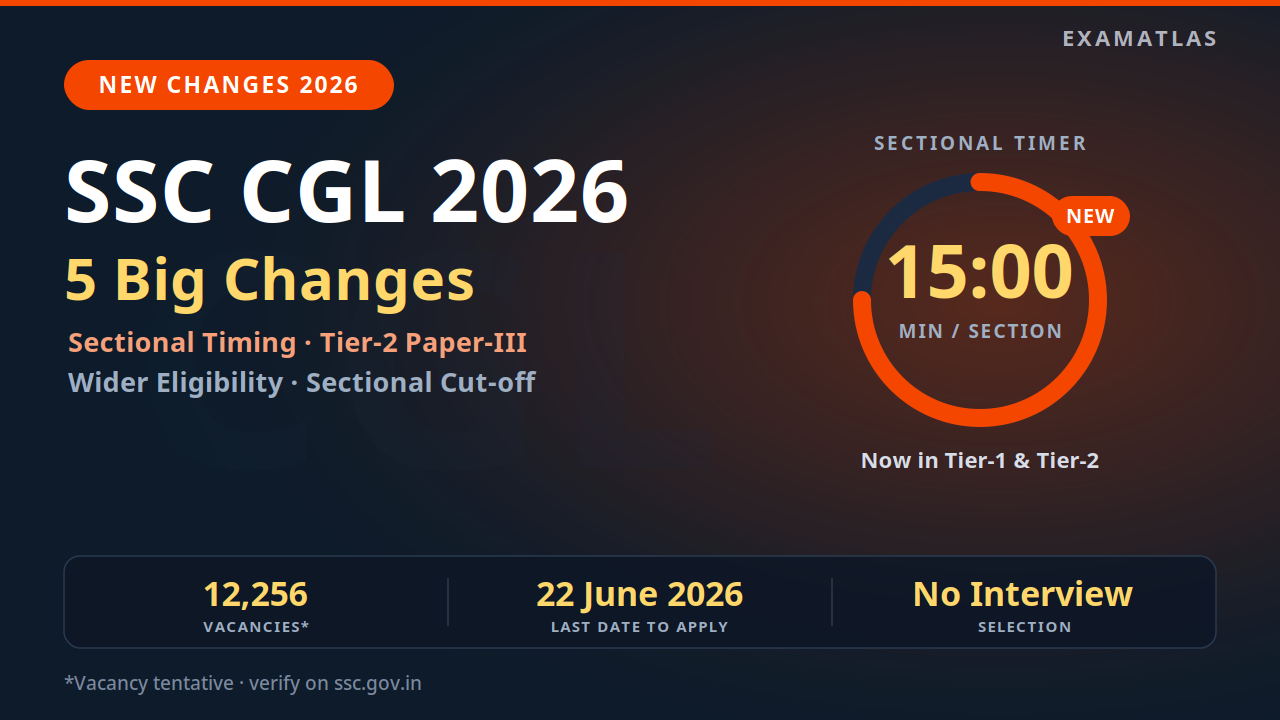
The Staff Selection Commission released the SSC CGL 2026 notification on 21 May 2026 for around 12,256 Group B and Group C posts, with applications open until 22 June 2026. But the headline this year is not the vacancy count. It is the set of rule changes that quietly reshape how you should prepare.
If you built your strategy on the SSC CGL 2025 pattern, read this carefully. Sectional timing, a returning Tier-2 paper, widened eligibility and stricter verification all change the game. Every figure here is from the notification stage, so confirm the final details on ssc.gov.in.
SSC CGL 2026 at a glance
Popular posts under SSC CGL 2026
SSC CGL fills posts across central ministries, departments and constitutional bodies. The most sought-after roles include:
- Assistant Section Officer (ASO) in central ministries.
- Assistant Audit Officer and Assistant Accounts Officer, the highest pay-level posts.
- Income Tax Inspector and Inspector posts under CBIC and CBDT.
- Auditor, Accountant and Junior Statistical Officer.
- Tax Assistant and Sub-Inspector roles in central agencies.
AAO under Pay Level-8 carries the highest salary among these, which is one reason the new Paper-III matters so much for that stream.
What is new in SSC CGL 2026 (quick view)
Five changes matter most this year. Here they are at a glance, before we take each one in detail.
- Sectional timing in both Tier-1 and Tier-2.
- Paper-III returns in Tier-2 for AAO and Assistant Accounts Officer.
- Statistical Investigator Grade-II eligibility widened to include AI, Data Science, IT and Computer Science.
- Clear sectional cut-off in Tier-2 Paper-I.
- Stricter, OTP-based verification at the admit card stage.
Change 1: Sectional timing (the biggest shift)
This is the change every aspirant must internalise. Tier-1 now has a 15-minute timer for each of the four sections. Once 15 minutes are up, that section closes and you move on. You can no longer borrow time from Reasoning to finish Quantitative Aptitude.
Tier-2 Paper-I also moves to subject-wise timers. The effect is simple but harsh: speed and section discipline now matter as much as knowledge. A candidate who knows everything but manages time poorly will drop marks they would have scored last year.
The fix is to practice every mock in the exact sectional format from day one. Train each section to finish inside its window, not just the paper as a whole.
Change 2: Paper-III is back in Tier-2 for AAO
For Assistant Audit Officer and Assistant Accounts Officer aspirants, Tier-2 now includes Paper-III on Finance and Economics, and it counts toward the final merit. This is a big deal, because Paper-III contributes directly to your score rather than acting as a simple qualifying hurdle.
If AAO or Assistant Accounts Officer is your target post, Finance and Economics can no longer be an afterthought. Build it alongside your core Tier-2 preparation, not in the last month.
Change 3: Statistical Investigator eligibility widened
SSC has raised and modernised the qualification for Statistical Investigator Grade-II. Alongside Statistics, the commission now recognises contemporary subjects such as Artificial Intelligence, Data Science, Information Technology and Computer Science.
This opens the post to a larger pool of graduates from tech and data backgrounds, which also means sharper competition for these specialised seats. If you hold one of these degrees, it is a fresh door worth checking against the notification.
Change 4: Sectional cut-off clarity in Tier-2 Paper-I
SSC has spelt out that you must qualify each section of Tier-2 Paper-I separately, with minimum qualifying marks for each. Strong performance in one section will not rescue a weak one.
The takeaway is that balanced preparation now beats lopsided strength. You cannot ride only on Quant if your English or General Awareness slips below the section cut-off.
Change 5: Stricter verification at the admit card stage
SSC has tightened identity and scribe verification. The 2026 process adds OTP verification during admit card generation and a more thorough, technology-based scribe verification system aimed at stopping fake scribes and impersonation.
Practically, keep your registered mobile number active and your details consistent across the form, OTR and admit card. Note also that candidates from the old SSC website must create a fresh OTR on the new portal.
SSC CGL 2026 exam pattern (revised)
Here is the Tier-1 structure as per the 2026 notification.
Tier-1 runs for 60 minutes with a 15-minute timer per section, is qualifying in nature, and carries negative marking of 0.50 per wrong answer.
Tier-2 has Paper-I (compulsory for all), Paper-II (for Junior Statistical Officer and Statistical Investigator), and Paper-III (for AAO and Assistant Accounts Officer). Paper-I covers Mathematical Abilities and Reasoning, English and General Awareness, and a Computer Knowledge module with a Data Entry Speed Test. The final merit rests on Tier-2.
Negative marking in 2026
The penalty structure is worth memorising, because the new timers make blind guessing riskier than before.
- Tier-1: 0.50 marks deducted per wrong answer.
- Tier-2 Paper-I: 1 mark per wrong answer in the main sections.
- Tier-2 Paper-II: 0.50 marks per wrong answer.
With sectional timers added, attempt with accuracy rather than filling the screen with guesses.
How these changes affect your preparation
- Switch to full sectional-timer mocks immediately, since open-time practice no longer mirrors the exam.
- AAO aspirants: start Finance and Economics now, because it is scored.
- Keep all four Tier-1 sections above their cut-off; no section can be sacrificed.
- Drill speed in Quant and Reasoning, since the timer punishes slow solving.
ExamAtlas has free SSC CGL mock tests built in the 2026 sectional-timer format, with AI analytics that show your section-wise accuracy and pace. That is exactly the feedback you need when time, not just knowledge, decides your score.
A simple way to handle the 15-minute timer
Sectional timing sounds intimidating, but a clear plan tames it. A workable approach for Tier-1:
- Reasoning: aim to finish in 10 to 12 minutes, since it is the fastest-scoring section.
- General Awareness: treat it as a 7 to 8 minute sprint, because you either know an answer or you do not.
- Quantitative Aptitude: use close to the full 15 minutes, picking easy questions first and skipping long calculations.
- English: keep a steady pace, since comprehension and grammar reward calm reading over rush.
The key habit is to never freeze on one question. Each section closes on its own, so a single hard question is not worth two lost minutes.
Three mistakes to avoid this year
- Practicing without sectional timers and then meeting them for the first time in the exam hall.
- Leaving Finance and Economics late as an AAO aspirant, now that Paper-III is scored.
- Guessing freely under negative marking, which the timers make even costlier.
Avoid these three and the new pattern stops being a threat and becomes your edge.
FAQs
What is the biggest change in SSC CGL 2026?
Sectional timing in both Tier-1 and Tier-2. Each section now has its own time limit, so the exam tests speed and discipline as much as knowledge.
How many vacancies are in SSC CGL 2026?
Around 12,256 Group B and C posts, with the post-wise breakdown to be released. Confirm the final count on ssc.gov.in.
What is the last date to apply?
22 June 2026, up to 23:00 hours, with fee payment allowed until 23 June. A form correction window runs from 29 June to 1 July 2026. Confirm the dates on ssc.gov.in.
Is there a Paper-III in Tier-2?
Yes. Paper-III on Finance and Economics is back for AAO and Assistant Accounts Officer posts and now counts toward the final merit.
Is there negative marking?
Yes. It is 0.50 in Tier-1, 1 mark in the main sections of Tier-2 Paper-I, and 0.50 in Paper-II.
Is Tier-1 counted in the final merit?
No. Tier-1 is qualifying only. The final selection is based on your Tier-2 performance.
Final word
SSC CGL 2026 is less about a new syllabus and more about a new discipline. Sectional timing rewards speed and balance, Paper-III raises the stakes for AAO aspirants, and tighter verification leaves no room for shortcuts. Move your mocks to the new format today, and the changes start working in your favour rather than against you. The aspirants who adapt early to the timer will quietly open a gap over those who treat 2026 like last year.
The vacancy numbers, dates and fine print here are from the notification stage. Confirm the post-wise vacancy, the exact last date and the final pattern on ssc.gov.in before you rely on them.