
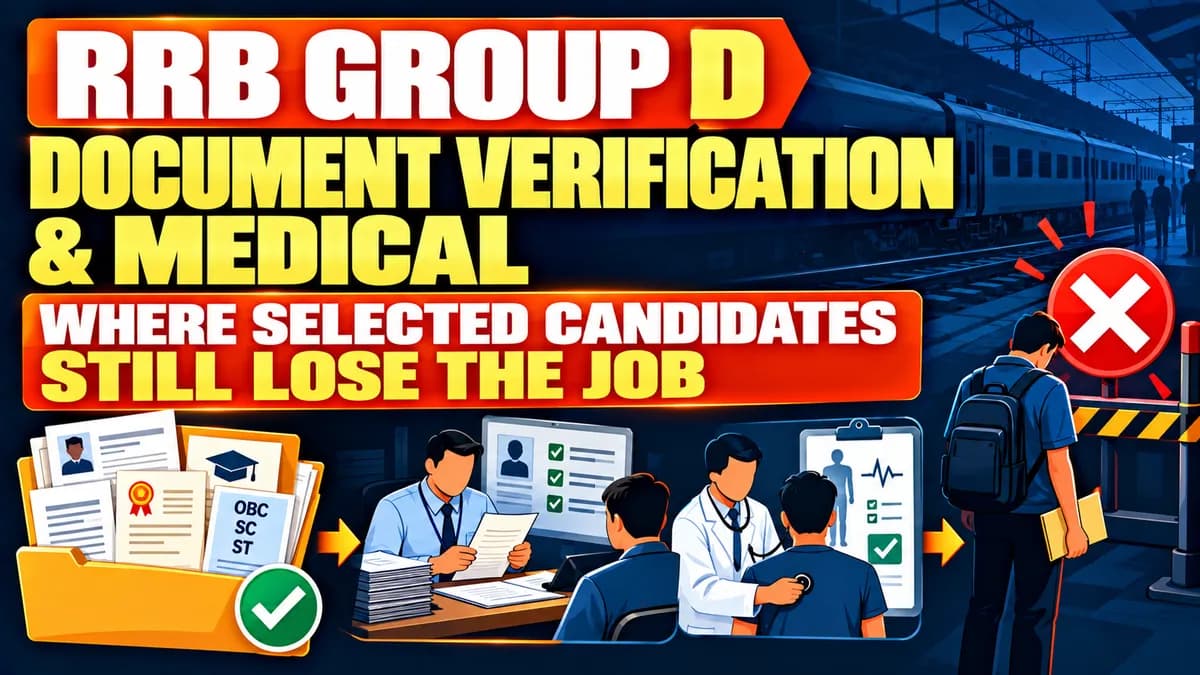
RRB Group D Document Verification and Medical: Where Selected Candidates Still Lose the Job
RRB Group D Document Verification and Medical: Where Selected Candidates Still Lose the Job
You clear a CBT taken by lakhs. You carry 35 kg for 100 metres without setting it down. And then a date of birth that reads 12-05-2003 on your matriculation certificate and 12-05-2004 on your online application takes the job away.
Document Verification and the medical examination are the two stages nobody prepares for, because they feel like formalities. They are not. This is where paperwork and eyesight quietly end candidatures that the exam could not.
Where DV and medical sit in the process
The order for CEN 09/2025 is fixed. CBT, then PET, then Document Verification, then the medical examination, then the final panel. Each stage is a gate, and none of them awards marks that carry forward.
Your rank on the CBT normalised score is what decides selection. DV and medical only decide whether that rank survives.
What you have to produce at DV
Originals are checked and self attested photocopies are retained. Carry more copies than you think you need.
The three mistakes that cost people the seat
Almost every DV rejection traces back to one of these.
- Date of birth mismatch. The matriculation certificate is the only accepted proof of date of birth. If your application says something else, even by a day, you have a problem that cannot be fixed at the counter.
- Category certificate in the wrong format or expired. OBC-NCL certificates have a validity period tied to a financial year, and the railways accept only the prescribed central government format. A state format certificate is the single most common rejection in this group.
- Qualification claimed but not held on the cut off date. The 10th pass, ITI or NAC must have been completed by the date the CEN specifies, not by the date of DV. A result awaited on that date is a rejection.
Check all three this week. Not in the week DV is scheduled, because a corrected certificate from a board or a tehsil office takes longer than that.
How the DV day usually runs
DV is held at the RRB office or a nominated railway venue, zone by zone, with call letters issued on the regional website. Reporting is early and the day is long.
Your originals are checked against the application data on screen, your photograph and signature are matched with the CBT records, and your post preferences are confirmed. Preferences matter more than candidates expect, because the post you are allotted decides the medical class you are examined against.
Think about that preference order before DV day, not while sitting at the counter. Once recorded, it is not casually changed.
The medical examination
The medical is conducted at a railway hospital or a health unit nominated by the railway administration, not at a private clinic of your choosing. A fitness certificate you bring from outside carries no weight.
What is tested includes general physical fitness, height and weight against build, hearing, blood pressure, and vision. Vision is where the surprises live.
Medical classification and what it means for your eyes
Railway posts are grouped into medical classes, and each class carries a different vision standard. The stricter classes exist because the work is safety related.
Colour vision, binocular vision and night vision testing apply to the stricter classes. If you are colour blind, this is the stage that matters most, and it is worth knowing now rather than at the hospital.
An honest caveat on the post wise mapping. Published sources do not agree on which class every Level 1 post falls in. Pointsman-B is consistently listed under the stricter A-2 standard, while Track Maintainer Grade IV appears as B-1 in some listings and A-2 in others. Assistant posts in loco shed, operations and TL and AC are generally shown as B-1.
We are not going to print a mapping we cannot verify. Open your CEN 09/2025 PDF, find the post you applied for, and read the medical classification printed against it. That is the only version that binds you.
If you do not clear the medical
A candidate declared unfit for the classification of the post they were shortlisted against may be considered for an alternative post in a lower medical class, subject to vacancies, merit and the rules in force. This is a provision, not a promise.
There is also a provision for an appeal or a re-examination within a stated period after the result of the medical is communicated. The timeline is short, so read the communication the day you receive it.
What to do before your DV date
- Lay every original out on a table and match each one against your application printout, field by field.
- Get a fresh OBC-NCL or EWS certificate now if yours is close to expiry, in the central government format.
- Get a basic eye test done privately, so an unexpected number is not a shock at the railway hospital.
- Keep the PET call letter and CBT admit card. Stage wise documents are asked for again.
- Read the full stage sequence in our RRB Group D 2026 guide, and the post wise work and pay in the Group D salary and job profile breakdown, because your post preference affects the medical class you face.
- If PET is still ahead of you, the standards and a training plan are in our Group D PET guide.
ExamAtlas keeps a stage wise checklist alongside free Group D practice sets, so the document side is handled while you focus on the parts that need training.
Frequently asked questions
What documents are required at RRB Group D Document Verification?
Matriculation certificate for date of birth, the 10th pass certificate or ITI or NCVT NAC claimed as qualification, marksheets, category or EWS certificate where applicable, disability certificate where applicable, photo identity proof, passport size photographs, and the call letter with the application printout. Originals plus self attested copies.
Is the medical test done at a private hospital?
No. The medical examination is conducted at a railway hospital or a health unit nominated by the railway administration. Certificates obtained from private clinics are not accepted in place of it.
Can I wear glasses and still clear the Group D medical?
It depends on the medical classification of your post. Classes such as A-3, B-1 and B-2 permit glasses, with B-1 specifying a lens power limit of 4D, while A-2 requires the standard to be met without glasses. Check the classification printed against your post in the CEN.
What is the most common reason candidates fail DV?
A mismatch between the date of birth on the matriculation certificate and the date entered in the online application, followed closely by category certificates in the wrong format or past their validity period.
What happens if I am declared medically unfit?
You may be considered for an alternative post falling in a lower medical class, subject to vacancies, merit and the rules in force. There is also a provision to seek a re-examination within the period stated in the communication you receive.
Does DV or medical performance affect my merit rank?
No. Both stages are qualifying. Your rank comes from the CBT normalised score, and DV and medical only determine whether you remain in the selection.
Final word
One practical step, today, that matters more than anything else in this article. Take out your matriculation certificate and your application printout and compare the name spelling, the father's name and the date of birth character by character.
A correction at a board office takes weeks. A DV rejection takes minutes, and it comes after you have already done the hard part.