
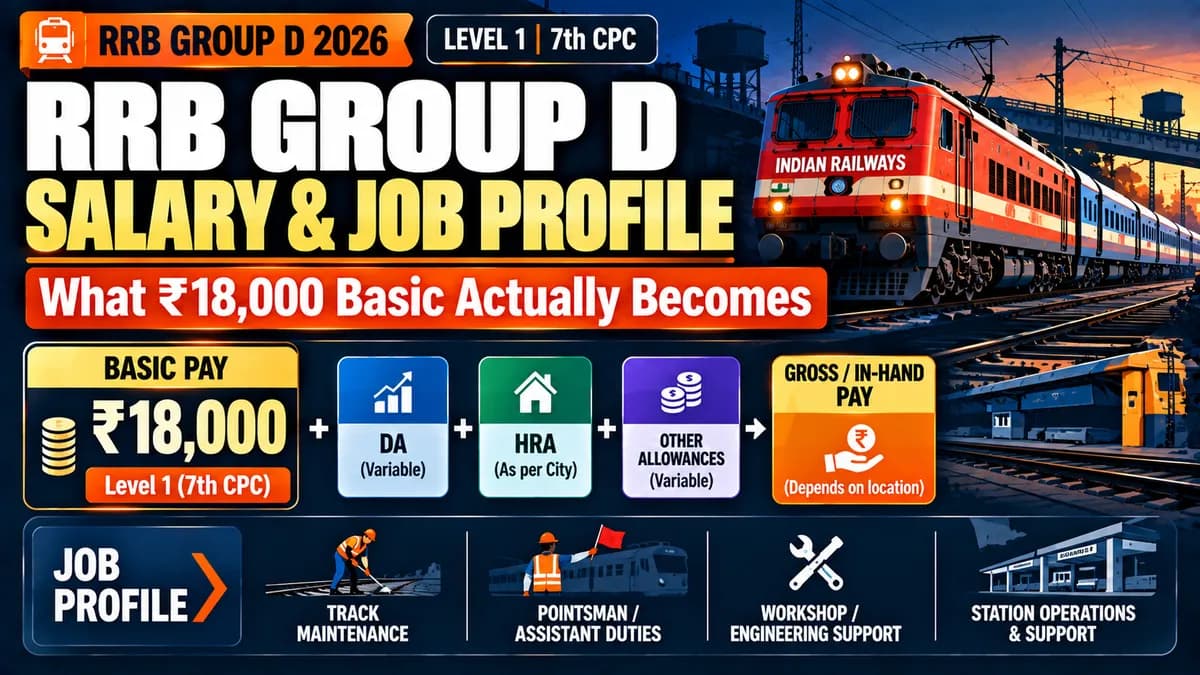
RRB Group D Salary and Job Profile: What ₹18,000 Basic Actually Becomes
RRB Group D Salary and Job Profile: What ₹18,000 Basic Actually Becomes
Pay Level 1 of the 7th CPC matrix. Basic pay ₹18,000 a month. That is the number printed in CEN 09/2025 against all 22,195 posts, and it is the number that misleads candidates the most.
Basic pay is a starting point for a calculation, not a salary. What lands in your account depends on where you are posted, which allowances apply there, and what gets deducted. The second half of this article matters even more, because the five Level 1 posts do very different work for the same pay.
Quick overview
How the salary is actually built
Your pay slip is basic plus a set of allowances, minus a set of deductions. Each line behaves differently.
Two honest caveats. First, the exact DA percentage and HRA slab change with government orders, so verify the current figures before you treat any in hand number as fixed. Second, the approximate ₹25,000 to ₹28,000 range quoted across sources is a reasonable indication for a fresh Level 1 appointee, not a guarantee for your posting.
Why the same post pays differently in two cities
HRA is the reason a friend posted in a metro shows a higher slip than you in a district town, with the identical basic pay.
Cities are classified X, Y and Z, and the HRA percentage falls as you move down that ladder. A Level 1 employee in an X class city can draw noticeably more in HRA alone than one in a Z class posting.
There is a catch that works the other way. Many Level 1 staff are allotted railway quarters, especially track and yard staff who need to live near the section. If you take the quarter, you do not draw HRA. Whether that is a gain or a loss depends entirely on local rent.
The five posts do genuinely different work
This is the section candidates should read before setting post preferences at Document Verification, because that preference stays with you.
An opinion worth stating plainly. Track Maintainer is the toughest of these in daily physical terms and it also has the largest number of vacancies, which means it is where most candidates end up. Going in expecting a desk is how people become unhappy in an otherwise secure job.
Pointsman-B carries the strictest medical standard of the group, and the vision requirement is not something you can prepare for at the last minute. We have set out the classification standards in our Group D document verification and medical guide.
The first posting is rarely the one you pictured
Level 1 vacancies sit where the work sits. That means sections, yards, sheds and depots, and a fair share of them are not in the district headquarters you had in mind.
Your zone is decided by the RRB you applied to, and the division and station within it are allotted by the railway administration against available posts. Candidates often discover this only after joining.
Transfers are possible later through the departmental process, and a request transfer takes time. Plan the first two years assuming you stay where you are placed.
The upside is that housing is usually available near the section, so a posting that looks remote on a map is frequently easier on the monthly budget than a metro posting with market rent.
Growth after joining
Level 1 is an entry grade, not a ceiling. Movement upward happens through two routes that run in parallel.
- Departmental examinations. Serving employees can appear for internal selections to higher grades after completing the prescribed service, which is the faster route for anyone willing to keep studying.
- Seniority based promotion. Slower, but steady, and it runs on its own with time in service.
The annual increment inside Level 1 is worth understanding too. Each year your basic moves one step up the matrix, and because DA and HRA are percentages of basic, every increment quietly lifts the allowances as well.
That compounding is why a Level 1 slip after five years looks materially different from the first month, even before any promotion.
Alongside the pay slip come the things that do not show on it. Railway medical facilities for you and dependants, pass and privilege ticket order facilities for travel, pension under NPS, and job security that very few private jobs at this entry level offer.
If you are still deciding between Level 1 and the other railway exams, the eligibility and pay differences are compared in our Group D vs NTPC vs ALP breakdown, and the full CEN 09/2025 stage sequence sits in the RRB Group D 2026 guide.
ExamAtlas has free Group D practice sets with topic wise accuracy reporting, useful for anyone waiting on this result or planning the next cycle.
Frequently asked questions
What is the basic pay for RRB Group D 2026?
₹18,000 per month, at Pay Level 1 of the 7th CPC Pay Matrix, for all posts notified under CEN 09/2025. Allowances are calculated on top of this figure.
What is the in hand salary of an RRB Group D employee?
Roughly ₹25,000 to ₹28,000 a month for a fresh appointee, depending on the city classification of your posting, the applicable DA and HRA rates, and deductions such as NPS. Verify the current DA and HRA rates before treating any figure as fixed.
Does HRA apply if I am given railway quarters?
No. Employees who accept railway accommodation do not draw House Rent Allowance. Many Level 1 staff, especially track and yard staff posted near their section, are allotted quarters.
Which Group D post has the hardest working conditions?
Track Maintainer Grade IV involves outdoor work on the track in all weather, including night patrolling, and it also carries the largest share of vacancies. Pointsman-B works rotating shifts in the yard and carries the strictest medical standard.
How does promotion work in Railway Group D?
Through departmental examinations open to serving employees after the prescribed service period, and through seniority based promotion. The departmental route is faster for candidates willing to continue studying after joining.
Is the salary the same across all Level 1 posts?
The basic pay and pay level are the same across the posts. What differs is the duty related allowances, the shift pattern, and whether the posting comes with accommodation, so two Level 1 employees can take home slightly different amounts.
Final word
One thing to weigh honestly before you set your preferences. A Level 1 railway job is secure, pensionable and comes with medical cover and travel passes, and for most candidates in this recruitment that is a genuinely good outcome.
It is also physical work on rotating shifts, often at a posting you did not choose, for a first year in hand that sits in the mid twenties. Go in knowing both halves, and the job is far easier to be happy in.