
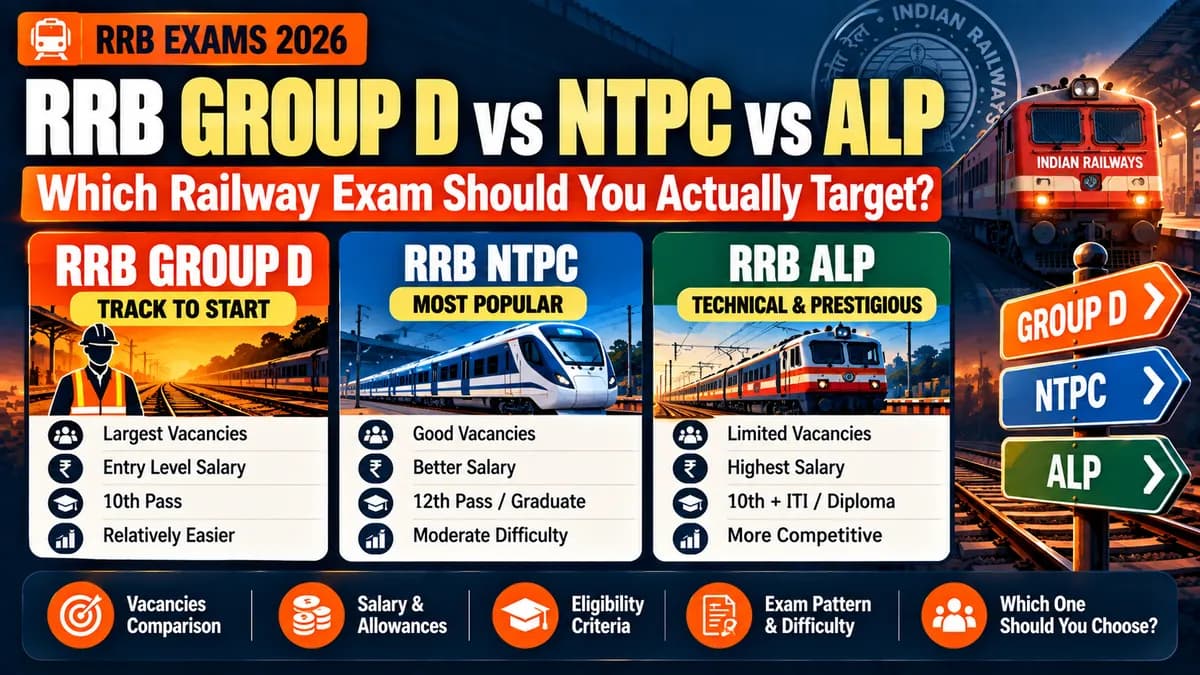
RRB Group D vs NTPC vs ALP: Which Railway Exam Should You Actually Target?
RRB Group D vs NTPC vs ALP: Which Railway Exam Should You Actually Target?
₹18,000 basic at Level 1. ₹19,900 at Level 2. ₹35,400 at Level 6. Three railway recruitments, three different entry points, and a candidate with a 10th pass certificate is eligible for only one of them.
Most aspirants pick by prestige or by whichever notification appeared first. The better question is which one your qualification, your eyesight and your next two years can realistically support.
The three exams side by side
Pay level is the real difference, not the exam name
Group D starts at Level 1 with ₹18,000 basic. ALP starts at Level 2 with ₹19,900. NTPC spans a wide band, because the undergraduate posts such as Junior Clerk cum Typist, Accounts Clerk cum Typist and Trains Clerk sit at Level 2 with ₹19,900, while Commercial cum Ticket Clerk sits at Level 3 with ₹21,700.
The graduate side is where NTPC separates. Traffic Assistant at Level 4 with ₹25,500, Goods Train Manager, Senior Clerk cum Typist and Junior Account Assistant at Level 5 with ₹29,200, and Station Master at Level 6 with ₹35,400.
So a graduate choosing Group D over NTPC is choosing an earlier joining date over roughly double the starting basic. That is a legitimate choice if you need income now, and a poor one if you can afford eighteen more months of preparation. The full Level 1 breakdown, including allowances, is in our Group D salary and job profile guide.
ALP is the one people underestimate
ALP looks attractive because of the pay level and the role, and the eligibility filter is narrower than candidates assume. You need an ITI in a notified trade or a three year engineering diploma, so a plain 10th or 12th pass does not qualify.
The medical filter is stricter still. ALP requires the A-1 standard, which means 6/6 distant vision in both eyes without glasses, along with colour vision and night vision testing. Candidates who have had corrective eye surgery are not eligible.
Our honest read. If you wear glasses, ALP is closed to you regardless of how well you prepare, and finding that out after clearing two CBTs and a CBAT is a painful way to learn it. Check the medical standard before you check the syllabus.
How much does the syllabus actually overlap?
The overlap is large, and it is the strongest argument for preparing seriously rather than picking one exam and ignoring the rest. Mathematics and reasoning transfer almost completely. General science transfers from Group D to ALP CBT 1 with very little extra work.
What does not transfer is the trade paper in ALP CBT 2, the typing and aptitude components in parts of NTPC, and the depth of general awareness that NTPC demands. Budget separate time for those.
The work is different, and that matters more than pay
Pay tables hide the thing you will live with daily. Level 1 work is largely outdoors or in the yard and shed, on rotating shifts, close to the track.
NTPC clerical and commercial posts are station and office based, with counter duty and computer work, and Station Master carries direct operational responsibility for train movement at a station.
ALP puts you in the locomotive cab. It starts with training, moves through assistant duty, and progresses towards becoming a Loco Pilot, with long running duty away from home and night work built into the role.
Ask yourself honestly which of those three days you would rather have at 45, not just at 25. Candidates rarely think that far ahead, and the ones who do tend to stay satisfied longer.
Can one candidate apply for all three?
Yes, if you meet the eligibility for each and the notifications are open. They are separate recruitments with separate applications, separate fees and separate CENs.
The practical limits are not legal, they are calendar limits. Exam dates can clash, and each recruitment runs its own multi stage process over many months. A candidate sitting all three usually finds that the later stages of one collide with the CBT of another.
A simple way to decide
- 10th pass, no ITI, need a job soon. Group D is your realistic target and the shortest route to joining. Start with the Group D syllabus and pattern.
- 10th pass with ITI in a notified trade, good uncorrected eyesight. Prepare for ALP as the primary target and keep Group D as the backup, since the syllabus overlap costs you almost nothing.
- 12th pass, no technical qualification. NTPC undergraduate posts, with Group D as a parallel attempt.
- Graduate. NTPC graduate posts deserve the main effort, because Level 5 and Level 6 entry is not something you can reach from Level 1 for many years.
- Wearing glasses or past corrective surgery. Rule out ALP and put that time into NTPC or Group D.
ExamAtlas has free practice sets for all three recruitments with topic wise accuracy reporting, which makes a shared preparation plan easier to run. The complete Group D stage sequence is in our RRB Group D guide.
Frequently asked questions
Which is better, RRB Group D or NTPC?
NTPC offers higher pay levels, from Level 2 up to Level 6 for Station Master at ₹35,400 basic, but needs 12th pass or graduation. Group D needs only 10th pass or ITI and has a shorter selection process. If you hold the qualification for NTPC, it is the stronger long term option.
Is ALP better than Group D?
ALP starts at Level 2 with ₹19,900 basic against Level 1 at ₹18,000, and the role carries better growth. It also requires an ITI in a notified trade or an engineering diploma and the strict A-1 medical standard, so it is not open to every Group D candidate.
Can I apply for Group D, NTPC and ALP together?
Yes, provided you meet the eligibility conditions for each and the notifications are open. They are separate recruitments with separate applications and fees. The practical difficulty is clashing exam dates across multi stage processes.
How much does the syllabus overlap between the three?
Substantially. Mathematics and general intelligence and reasoning appear in all three, and general science is common to Group D and ALP CBT 1. The trade paper in ALP CBT 2 and the heavier general awareness in NTPC are the parts that need separate preparation.
Which railway exam has the toughest medical standard?
ALP, which requires the A-1 classification with 6/6 distant vision in both eyes without glasses, plus colour and night vision testing. Candidates who have undergone corrective eye surgery are not eligible for it.
Which exam gives the fastest joining?
Group D, because it has a single CBT followed by PET, document verification and medical. NTPC runs two CBTs with skill or aptitude tests, and ALP runs two CBTs plus a CBAT and training, so both take longer.
Final word
A note on the next cycle, since it is the question that arrives in every comment section. Another Level 1 recruitment is expected in due course, and no vacancy figure for it has been confirmed by any official source. Numbers circulating on aggregator sites are not notifications. Wait for the CEN.
Meanwhile the useful move is to prepare the shared core of mathematics, reasoning and general science, which serves all three exams, and to decide the target once you have checked your eligibility and your eyesight rather than the other way round.