
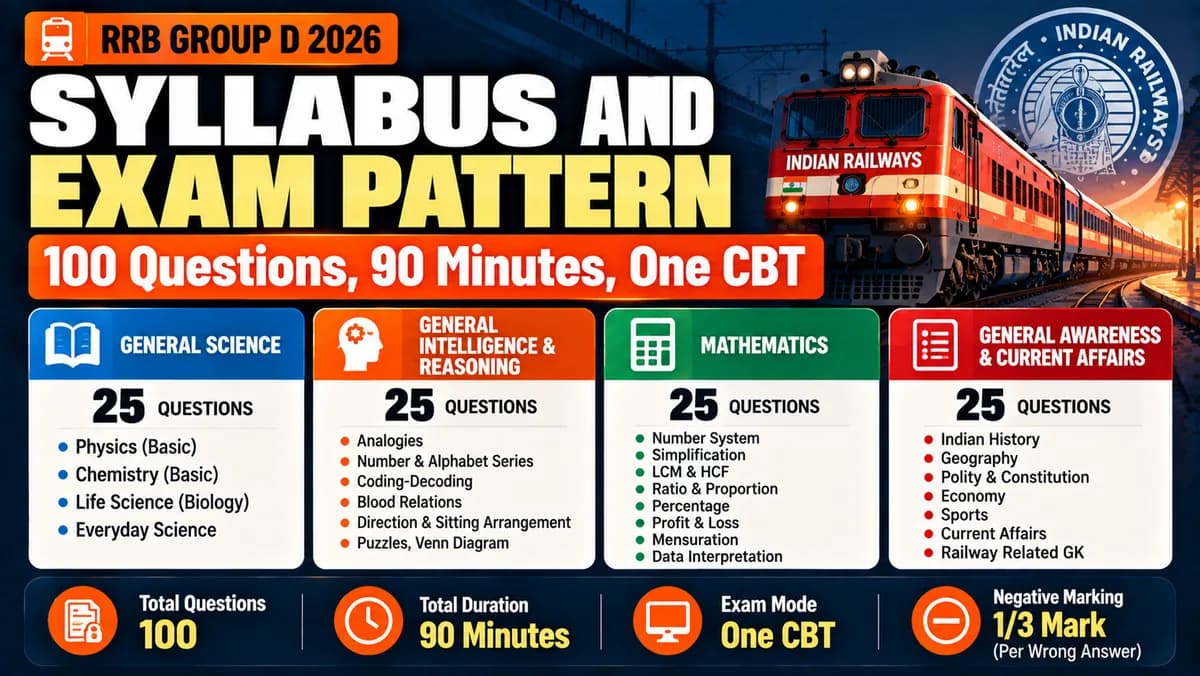
RRB Group D Syllabus and Exam Pattern: 100 Questions, 90 Minutes, One CBT
RRB Group D Syllabus and Exam Pattern: 100 Questions, 90 Minutes, One CBT
One computer based test. 100 questions, 100 marks, 90 minutes, and a third of a mark gone for every wrong answer. Reasoning carries 30 of those marks, which is more than any other section.
That last fact decides how a sensible preparation plan is built, and most candidates get it backwards by starting with General Science. Below is the full pattern, the section wise syllabus, and the order we think you should actually study in.
Exam pattern at a glance
Since the CBT runs across many shifts, your raw marks are converted before ranking. That process is explained in our normalisation guide, and it matters more than candidates assume.
The full syllabus, section by section
Note the General Science line carefully. The prescribed level is Class 10, which means NCERT Class 9 and 10 textbooks cover the ground. Candidates who study from competitive exam compilations often skip the basics those books build, and it shows in the accuracy.
Which section deserves your time first
Work backwards from the marks and from how learnable each section is.
- Reasoning, 30 marks. The largest section, and the most improvable one. Series, coding and decoding, analogies and directions are pattern based, so a candidate with weak school maths can still score heavily here with practice alone.
- Mathematics, 25 marks. Slower to build but stable once built. The arithmetic block of percentages, ratio, time and work, time and distance, and profit and loss carries a large share of the questions.
- General Science, 25 marks. High return for the time spent, because the syllabus is capped at Class 10 and the questions are direct. Physics and chemistry basics repeat across cycles.
- General Awareness and Current Affairs, 20 marks. The hardest to guarantee, because the scope is open. Daily reading gives better returns than last week revision.
An opinion we will defend. If you have three months and weak fundamentals, give reasoning and general science the first six weeks. They convert effort into marks faster than mathematics does, and the 55 marks they carry together decide whether you cross the qualifying floor comfortably.
Where the marks actually sit inside each section
- Mathematics: arithmetic dominates. Number system, percentages, ratio and proportion, time and work, time and distance, profit and loss, and simple and compound interest are the repeat performers. Mensuration and basic geometry follow. Trigonometry appears in a limited, formula based way.
- Reasoning: series, analogy, coding and decoding, classification, directions and blood relations make up the bulk. Syllogism and statement based questions are fewer but very scoreable once the method is fixed.
- General Science: physics topics such as light, sound, motion, work and energy, electricity and magnetism; chemistry topics such as acids and bases, metals and non metals, and the periodic table; life sciences such as human body systems, nutrition, cell biology and diseases.
- General Awareness: current affairs of the last eight to twelve months, static awareness around Indian polity, geography, history and economy, plus sports and awards.
Negative marking changes how you attempt
A third of a mark for every wrong answer sounds small. Across 20 wild guesses it costs you almost seven marks, which in a tight zone is the difference between a call letter and a refresh button.
The sensible rule is to attempt when you have eliminated at least two options, and to leave the question when you have not. Blind guessing is a losing strategy at this ratio.
Speed matters too. 100 questions in 90 minutes gives you 54 seconds per question including reading time, so a plan that involves solving everything carefully is a plan that runs out of clock.
How to spend the 90 minutes on exam day
The absence of a sectional time limit is an advantage most candidates waste by simply starting at question 1 and going forward.
A better approach is three passes. First pass, answer only what you know on sight and keep moving, which should clear roughly half the paper in 30 minutes. Second pass, take the questions that need working, mainly arithmetic and the longer reasoning sets. Third pass, revisit the marked ones with whatever clock is left.
Watch the trap in mathematics. One stubborn question can eat four minutes and still end unsolved, and those four minutes were worth four easy reasoning questions somewhere else in the paper.
A practical study order
- Fix reasoning topic by topic, with timed sets of 30 questions once a topic is learnt.
- Rebuild arithmetic from the number system upward rather than jumping to shortcuts.
- Read NCERT Class 9 and 10 science once properly, then revise through questions rather than rereading.
- Keep current affairs to a short daily habit instead of a monthly pile.
- Move to full 100 question mocks in the last six weeks, at the real 90 minute limit, at the same time of day as your likely shift.
ExamAtlas has free Group D practice sets that report topic wise accuracy after each attempt, which is how you find the four or five topics quietly costing you marks. The full recruitment sequence sits in our RRB Group D guide, and if you are weighing Level 1 against the other railway exams, the comparison is in our Group D vs NTPC vs ALP breakdown.
Appeared in the August 2026 CBT? Track your RRB Group D result status
Frequently asked questions
What is the RRB Group D exam pattern?
A single computer based test with 100 questions for 100 marks in 90 minutes. General Intelligence and Reasoning carries 30 marks, Mathematics 25, General Science 25, and General Awareness and Current Affairs 20. There is no sectional time limit.
Is there negative marking in RRB Group D?
Yes. One third of a mark is deducted for each wrong answer. Unattempted questions carry no penalty, so guessing without eliminating options works against you.
What is the level of the General Science section?
Class 10 standard, covering Physics, Chemistry and Life Sciences. NCERT Class 9 and 10 science textbooks cover the prescribed ground, and studying from them gives better accuracy than working only from exam compilations.
How much time do I get per question?
About 54 seconds on average, since 100 questions have to be attempted in 90 minutes. Eligible candidates using a scribe are allowed 120 minutes.
What are the minimum qualifying marks in the CBT?
40 per cent for UR and EWS candidates and 30 per cent for OBC-NCL, SC and ST candidates. Clearing this floor makes you qualified, but selection depends on where your normalised score falls in your zone's merit list.
Which section should I prepare first?
Reasoning, because it carries the highest marks at 30 and improves fastest with practice. General Science is the next best return since its syllabus is capped at Class 10 level, while General Awareness needs a daily habit rather than a study block.
Final word
One correction to a common belief before you close this. Level 1 is often described as the easy railway exam, and the syllabus does look modest next to NTPC or ALP.
The paper is not what makes it hard. Lakhs of candidates competing for a limited zone wise shortlist is what makes it hard, and against that, the eight or nine marks you leave on the table through careless guessing matter far more than any topic you did not finish.