
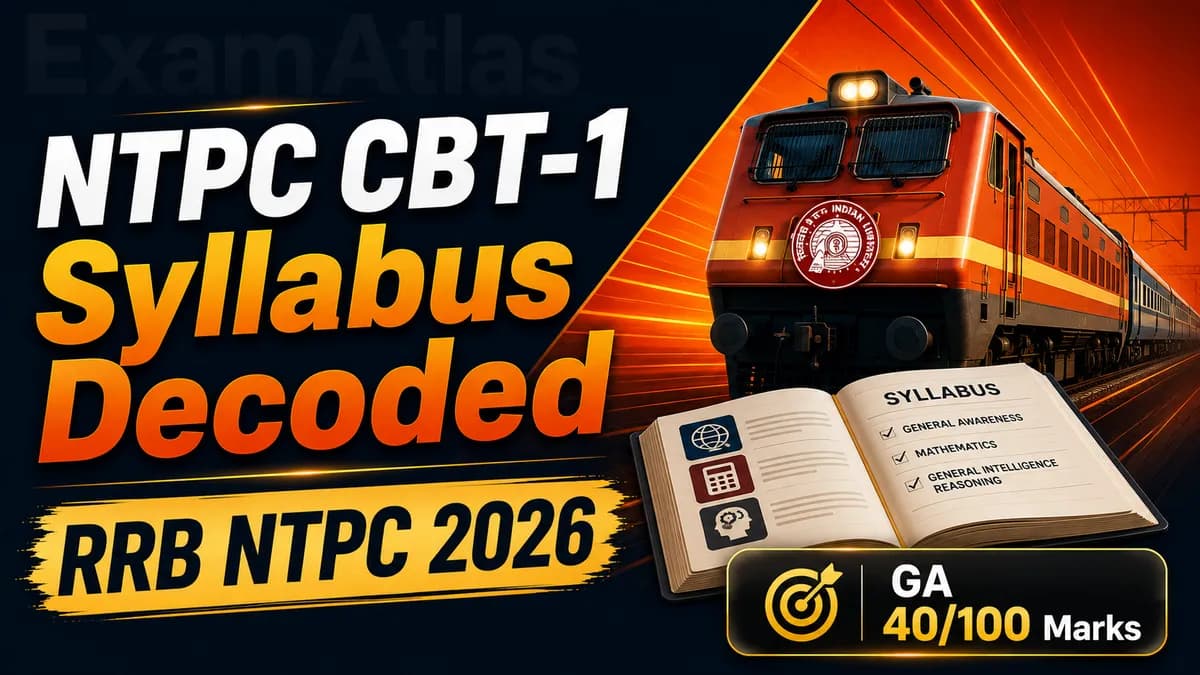
RRB NTPC CBT-1 Syllabus and Section Weightage: The Full Break-up
RRB NTPC CBT-1 Syllabus and Section Weightage: The Full Break-up
100 questions, 90 minutes, three sections. That is the whole of RRB NTPC CBT-1 on paper. In practice, the paper hides a weightage pattern that most aspirants only discover after their first attempt, when it is too late to fix the preparation.
This guide lays out the official CBT-1 structure, the complete syllabus from the CEN annexure, and a chapter-wise weightage analysis built from recent shifts, including the CEN 07/2025 undergraduate cycle whose CBT-1 result came out on 24 August 2026. If you are starting for the next cycle, or moving to CBT-2 and want to know which basics carry forward, read this once and plan around it.
RRB NTPC CBT-1 at a Glance
One line worth reading twice: CBT-1 is a screening test. Its marks do not count in the final merit list. You only need to clear it safely and reach CBT-2, where the real ranking happens.
Section-wise Marks Distribution
The 40-mark GA section is the single biggest reason NTPC feels different from SSC exams. In SSC CGL Tier-1, GK is 25 of 100 marks. Here it is 40. A candidate strong in Maths but weak in GA hits a hard ceiling in NTPC, and the reverse is not true to the same degree.
Qualifying Marks: What You Actually Need
These are eligibility floors, not targets. Actual shortlisting for CBT-2 happens on normalised merit, at a multiple of the vacancies in each post group. Recent CENs have used ratios in the 15-times range, and some coaching sources quote 20 times; the exact ratio for your cycle sits in your CEN PDF, so verify it from the official notification rather than any aggregator page. In the CEN 07/2025 UG cycle, zone-wise cut-offs ran far above the qualifying floor, which is normal when lakhs apply for a few thousand posts.
General Awareness Syllabus (40 Questions)
The official annexure lists these areas:
- Current events of national and international importance
- Games and sports; art and culture of India; Indian literature; monuments and places
- General Science and Life Science (up to Class 10 CBSE level)
- History of India and the freedom struggle
- Physical, social and economic geography of India and the world
- Indian polity and governance: Constitution and political system
- General scientific and technological developments, including space and nuclear programmes
- UN and other important world organisations; environmental issues
- Basics of computers and computer applications; common abbreviations
- Transport systems in India; Indian economy; famous personalities
- Flagship government programmes; flora and fauna of India; important government and PSU organisations
How the 40 GA questions actually split
This split is a trend analysis from recent NTPC shifts, not an official quota, so treat the ranges as planning guides. Two takeaways stand out. First, Current Affairs plus General Science alone decide roughly 16-18 marks; these two areas repay revision better than anything else in the paper. Second, Railway GK (zones, production units, Vande Bharat, Kavach) appears in almost every shift, and most aspirants never prepare it separately. East Central Railway is headquartered at Hajipur in Bihar; if you are preparing from Patna or Muzaffarpur, questions like this are sitting in your backyard.
Mathematics Syllabus (30 Questions)
- Number system, decimals, fractions, LCM and HCF
- Ratio and proportion, percentage, elementary statistics
- Time and work; time, speed and distance; trains and boats
- Simple interest and compound interest; profit and loss
- Mensuration (basic 2D and 3D)
- Elementary algebra; geometry and trigonometry at an elementary level
Where the 30 marks concentrate
NTPC Maths is easier than SSC CGL Maths, and that is not a casual claim: advanced trigonometry, coordinate geometry and quadratic equations barely appear. The paper rewards fast, clean arithmetic. If you can finish a 2-step percentage or SI-CI question in under 50 seconds, you are at the level this section demands.
General Intelligence and Reasoning Syllabus (30 Questions)
- Analogies; completion of number and alphabetical series; coding-decoding
- Mathematical operations; similarities and differences; relationships (blood relations)
- Analytical reasoning; syllogism; jumbling; Venn diagrams
- Puzzle; data sufficiency; statement-conclusion; statement-courses of action
- Decision making; maps; interpretation of graphs
Series, coding-decoding, analogy and blood relations together usually cover 12-15 of the 30 questions. Puzzles stay simple here (single-line seating, small grids), nothing like the layered puzzles of IBPS Clerk. Non-verbal items such as mirror images and paper folding show up in small numbers, and they are free marks with a week of practice.
Why Normalisation Changes Your Target Score
NTPC runs in many shifts across days, and no two shifts are equally difficult. Normalisation converts your raw score into a percentile-anchored score before merit is drawn. A raw 78 in a tough shift can normalise above a raw 84 in an easy one. The practical lesson: do not panic-compare raw scores on Telegram after your shift, and while attempting, prioritise accuracy, because the 1/3 negative marking punishes blind guessing harder than SSC's 0.25 does.
A Working Prep Structure for CBT-1
- Give GA 40% of your daily time. Split it as current affairs (daily, 30 minutes), one static GK block, and one General Science chapter from Class 9-10 NCERT.
- Keep a separate 2-page Railway GK note: 18 zones with headquarters, production units, Vande Bharat routes, Kavach, DFC corridors. Refresh it weekly.
- In Maths, master the arithmetic core before touching mensuration or algebra. 13 of 30 marks live there.
- Alternate full mocks and sectional tests. After every mock, log which GA area cost you marks; the pattern usually stabilises within 5 mocks.
- One honest caveat: this plan assumes your Class 10 Maths basics are intact. If simplification itself feels slow, add two weeks of pure calculation practice before mock-heavy preparation.
ExamAtlas has free NTPC-pattern mock tests with AI analytics that show topic-wise accuracy, so you can see in numbers whether GA current affairs or Maths arithmetic is leaking marks. Pair the mocks with this weightage table and the gaps become obvious within a week.
Related Reading on ExamAtlas
- RRB NTPC UG CBT-1 Result 2026: zone-wise cut-offs
- RRB NTPC UG CBT-2 Exam Date: 17 September plan
- BPSC TRE 4.0 Syllabus level-wise
Frequently Asked Questions
Is there sectional timing in RRB NTPC CBT-1?
No. You get one 90-minute window for all 100 questions and can move between sections freely. Build your own internal timing: many toppers give GA 20-25 minutes because it is memory-based, leaving close to an hour for Maths and Reasoning.
Do CBT-1 marks count in the final merit list?
No. CBT-1 is a screening stage. Final merit is built from CBT-2 (and skill tests or CBAT where the post requires them). Your only job in CBT-1 is to cross the shortlisting cut-off safely.
What is the negative marking in NTPC CBT-1?
One-third of a mark per wrong answer. Attempting 100 blind is a losing strategy; recent qualified candidates typically attempt in the high 80s with 90%+ accuracy rather than a full-paper spray.
Is the CBT-1 syllabus the same for Graduate and Undergraduate posts?
Yes, the CBT-1 pattern and syllabus are the same for both the graduate cycle and the undergraduate cycle. The difficulty and the competition pools differ, and CBT-2 is where levels separate further.
How many candidates are shortlisted for CBT-2?
Shortlisting is a multiple of vacancies per post group, done on normalised CBT-1 scores. Recent cycles have used around 15 times the vacancies, though the exact ratio is set in each CEN. Check the official CEN PDF for your cycle instead of relying on coaching aggregators.
Which books cover the NTPC CBT-1 syllabus?
Class 9-10 NCERT Science for GS, Lucent for static GK, any one arithmetic-focused Maths book (R.S. Aggarwal works), a reasoning practice book, and a monthly current-affairs compilation. Five resources, no more. The syllabus rewards revision depth, not book count.
Final Word
The NTPC CBT-1 paper is not hard question by question; it is unforgiving in aggregate. 54 seconds per question, a 40-mark GA section that cannot be crammed in a month, and normalisation that quietly rewards accuracy over volume. Fix your GA routine today, keep Maths at arithmetic-speed, and let mocks tell you the rest. And whenever a number in this guide matters to your form or your target, cross-check it against the official CEN PDF on your RRB's website, because that document outranks every blog, including this one.