
SSC GD Salary 2027: In-Hand Pay at Level-3, DA at 60%, Allowances and Promotion
SSC GD Salary 2027: In-Hand Pay at Level-3, DA at 60%, Allowances and Promotion
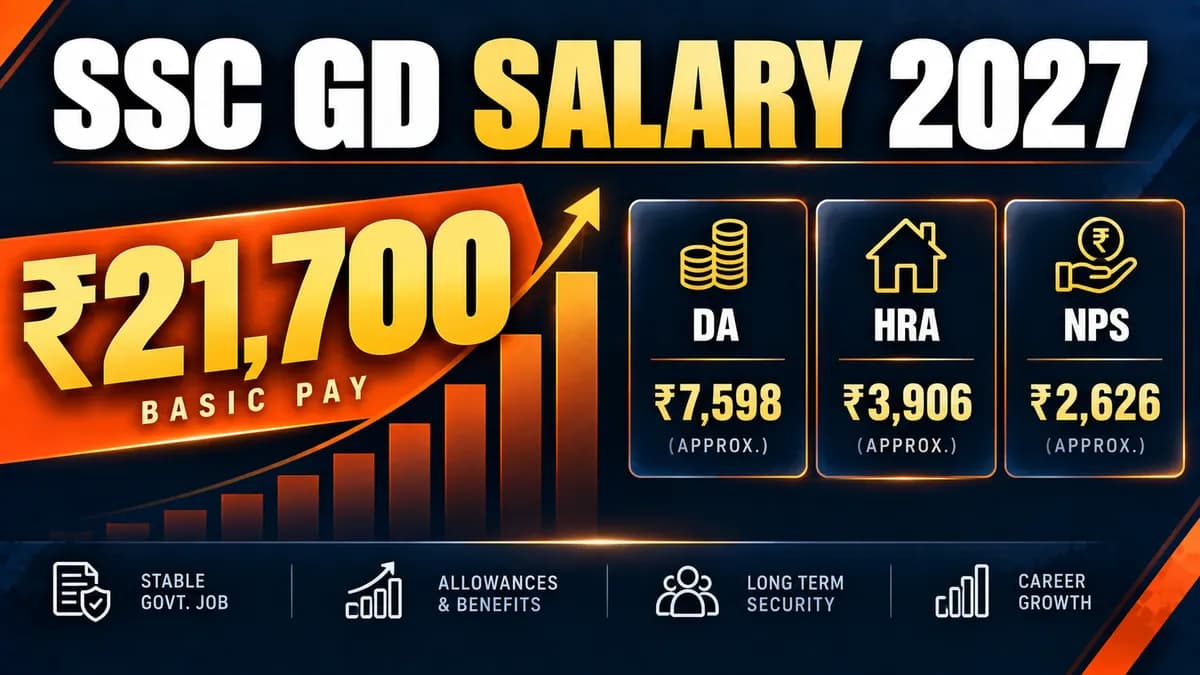
Constable (GD) is Pay Level-3 under the 7th CPC, with a pay matrix running from ₹21,700 to ₹69,100. That first figure is the one aspirants see. The number that actually lands in the account depends on dearness allowance, where you are posted, and whether you live in force accommodation or rent a room.
One correction before the tables. Dearness allowance is now 60% of basic pay, effective 1 January 2026, after the Finance Ministry order issued in April 2026. Any salary calculation you see using 50% or 53% is out of date, and the gap is over ₹1,500 a month at entry level.
Pay structure
What makes up the monthly salary
- Basic pay at Level-3, starting at ₹21,700 and rising with annual increments
- Dearness allowance at 60% of basic, revised periodically
- House Rent Allowance by city classification, at 24% of basic in X cities, 16% in Y cities and 8% in Z cities, when you are not provided government accommodation
- Transport allowance as per the 7th CPC rates for the pay level, with DA applied on it
- Ration money allowance, where free ration is not provided in kind
- Risk and hardship allowance, which depends on the force and the nature of the posting, notified separately by the force
- Dress or uniform allowance, paid annually
- Special allowances for specific areas such as high altitude or difficult postings
Indicative in-hand calculation
Two honest scenarios, because the same rank takes home different amounts depending on posting.
Scenario 1: living in force accommodation with ration provided
Scenario 2: posted in a city, drawing HRA
Add transport allowance and any risk or hardship element applicable to your force, and in-hand for a new Constable commonly sits between ₹30,000 and ₹37,000 a month, with the higher end for city postings with full allowances and the lower end for barrack postings where ration and quarters are provided in kind.
Treat these as indicative. The exact allowance rates and deductions are notified by the concerned force and printed on your pay slip. Nobody on the internet can tell you your exact figure before your posting order.
Why two constables get different salaries
Same rank, same level, different money. The reasons are practical.
- City class. HRA at 24% against 8% is a difference of ₹3,472 a month at entry basic alone.
- Accommodation in kind. A quarter inside the campus replaces HRA, which looks like less cash but usually costs less to live.
- Risk and hardship. A posting in a high altitude area or a difficult zone carries an allowance that a static guard duty posting does not.
- Force and duty type. Allowance patterns differ between forces, which is one reason force preference is worth thinking about rather than filling at random. Profiles are in SSC GD Posts and Forces.
Benefits that do not show on the pay slip
- Free or subsidised ration, where provided in kind
- Family accommodation in force campuses, subject to availability
- Medical cover for self and dependants through the force medical scheme
- Canteen facility
- Leave travel concession as per rules
- Children's education allowance as per government norms
- Group insurance and the NPS corpus with government contribution
- Annual uniform and kit
Add these up honestly and a Level-3 job in a central force compares well with private work paying a similar cash salary, because housing, ration and medical costs are the three that usually eat a young earner's pay.
Increments and how the salary grows
An annual increment of 3% of basic applies, so the basic climbs every July, and the DA percentage is revised periodically by the Finance Ministry. Over a full career the Level-3 matrix runs up to ₹69,100 even before promotion.
Promotion is the bigger lever.
Promotion timelines depend on vacancy position in the force and cadre, so they differ widely between CISF and a smaller force such as SSF. An honest caveat: candidates who plan a fast rise usually do it by clearing departmental examinations rather than by waiting for seniority.
How the salary looks after five and ten years
Nobody stays on entry basic. With a 3% annual increment, the basic at Level-3 moves up every July, and each increment also lifts DA, HRA and the NPS contribution because all three are calculated on basic.
A rough shape, assuming no promotion and DA staying where it is today:
These are indicative figures from the increment pattern, not a guarantee, and a promotion to Head Constable changes the picture faster than any increment does. DA itself has moved several times in the last few years, so treat the DA column as today's snapshot.
Salary during training
Basic training for a new Constable runs for several months at a force training centre, and the salary is paid during training. Accommodation and mess are inside the centre, which means cash in hand during training is usually higher than a candidate expects, since there is very little to spend on.
Practical note from serving personnel. The first posting order, not the offer letter, is what decides your monthly cash. Two candidates from the same batch, one posted to a metro unit and one to a border outpost, will see different HRA, different allowances, and very different living costs.
A word on the numbers floating on social media
Screenshots claiming an SSC GD in-hand of ₹45,000 or ₹50,000 at entry are usually doing one of three things: adding every possible allowance at once, using a metro HRA with a hardship allowance that belongs to a different posting, or quietly skipping the NPS deduction. Read any salary table with those three checks.
The reverse also circulates. Posts claiming ₹21,700 is the take-home ignore DA entirely, which at 60% is over ₹13,000 a month on its own.
Deductions to expect
- NPS employee contribution at 10% of basic plus DA
- Central Government Employees Group Insurance Scheme
- Mess, canteen or welfare fund contributions where applicable
- Income tax, once your total income crosses the exemption threshold under the regime you choose
At entry level with basic pay of ₹21,700, most Constables sit below the tax threshold in the early years, but that changes as DA rises and allowances are added, so keep the pay slip and check it.
Is the money worth the job
An honest answer needs both sides. The pay is stable, the benefits are real, and a 10th-pass candidate from a small town rarely finds another job with this combination of security, pension and medical cover.
The other side is the posting. Central forces move you, and a first posting can be far from home, in a difficult area, on shift duty. Candidates who see only the salary table and not the duty pattern are the ones who resign in the first two years. Read the force profiles before you set your preference order.
Where to go next
Eligibility conditions are in SSC GD Eligibility, force-wise duty and posting patterns in SSC GD Posts and Forces, and the whole recruitment map in the SSC GD complete guide.
FAQs
What is the basic pay of an SSC GD Constable?
₹21,700 at entry, under Pay Level-3 of the 7th CPC, with the level running up to ₹69,100.
What is the in-hand salary of an SSC GD Constable?
Commonly between ₹30,000 and ₹37,000 a month, depending on city class, whether quarters and ration are provided, and force-specific allowances.
What is the current DA percentage?
60% of basic pay, effective 1 January 2026, as ordered by the Finance Ministry in April 2026.
How much HRA does a Constable get?
24% of basic in X class cities, 16% in Y class and 8% in Z class, when government accommodation is not provided.
Is there a pension in SSC GD?
The post falls under NPS, with an employee contribution of 10% of basic plus DA and a government contribution to the corpus.
Do all forces pay the same salary?
Basic pay and DA are the same at Level-3, but risk and hardship allowances and posting-linked allowances differ by force and location.
What is the promotion path for a Constable?
Constable to Head Constable to Assistant Sub-Inspector to Sub-Inspector, through departmental promotion and, in many forces, limited departmental competitive examinations.
Does the salary increase every year?
Yes, through an annual increment of 3% of basic pay, along with periodic revisions in the DA percentage.