
SSC GD Exam Pattern 2027: CBE Structure, Marking, Normalisation and Selection Process
SSC GD Exam Pattern 2027: CBE Structure, Marking, Normalisation and Selection Process
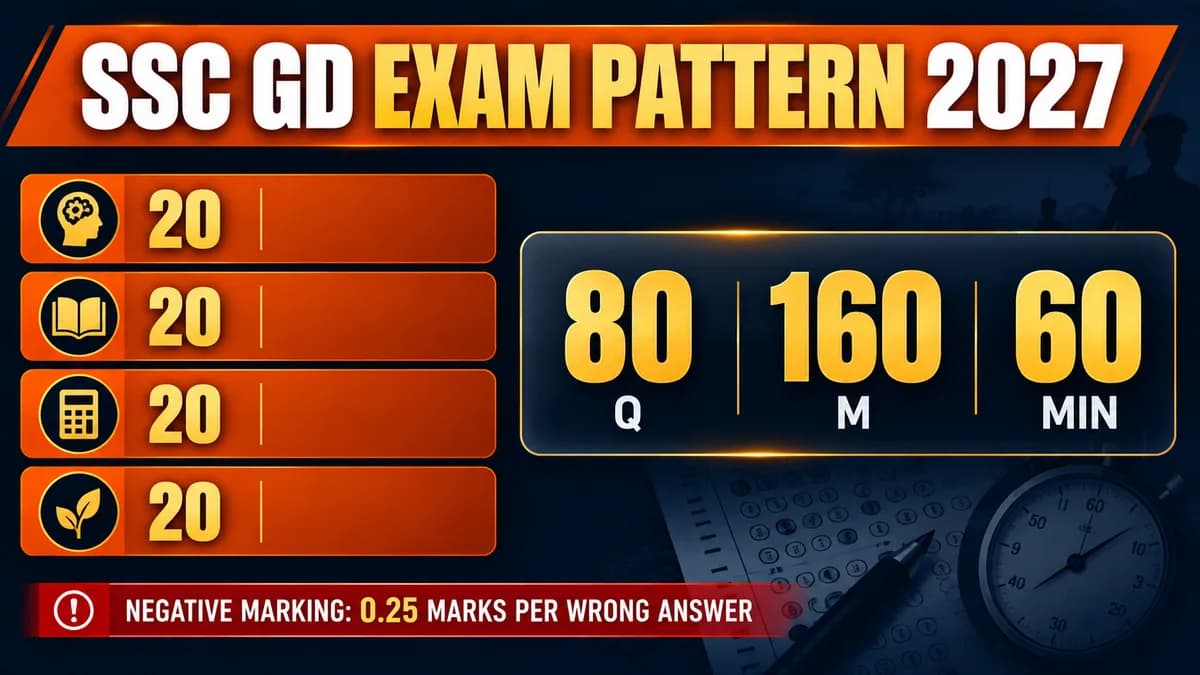
80 questions. 160 marks. 60 minutes. That is 45 seconds per question, and it is the only stage of SSC GD where your marks actually count for anything.
Everything after the Computer Based Examination is pass or fail. The race does not add marks, the measurements do not add marks, the medical does not add marks. Your entire merit position is decided in that one hour, then adjusted for shift difficulty through normalisation.
CBE structure
Key rules from the notification:
- Objective, multiple choice, computer based
- +2 for every correct answer
- 0.25 deducted for every wrong answer
- Duration 60 minutes, with extra time for eligible scribe cases
- No sectional timing, so you move between parts freely
- No sectional cut-off, only the overall qualifying mark
- Bilingual paper, and Part D lets you choose English or Hindi
Qualifying marks
Clearing the qualifying percentage does not mean selection. It only means your paper is considered.
Look at the difference between qualifying and selection. The 2026 qualifying mark for UR is 30% of 160, which is 48 marks. The 2025 final UR cut-off in Haryana for a general-area male candidate was above 144. Qualifying is a floor you have to step over. The cut-off is a wall.
The maths of negative marking
Eight wrong answers wipe out one correct answer. That single sentence should govern how you guess.
Work it through. If you attempt 70 questions and get 60 right, you score 120, then lose 2.5 for the 10 wrong, giving 117.5. If you attempt all 80 and get the same 60 right, you score 120 and lose 5 for the 20 wrong, giving 115.
So blind guessing costs you. But over-caution costs more, because unattempted questions earn nothing at all. The workable rule is to answer when you have eliminated two options, and to leave the question when you are staring at four options that all look possible.
Good attempts in the 2026 cycle settled around 62 to 68 questions for a competitive score. That is a target, not a rule.
Why normalisation exists and how it changes your score
SSC GD runs across many shifts and several days. In the 2025 cycle the CBE ran from 4 to 25 February 2025. Some shifts get a harder Maths set, some get an easier GK set. Comparing raw marks across those shifts would be unfair, so SSC applies normalisation.
The formula is published, not invented per cycle. The 2025 final result states that marks were normalised using the formula published by the Commission through notice No. 1-1/2018-P&P-I dated 07-02-2019, and that NCC bonus marks were added to the normalised scores before merit was drawn.
Three consequences that matter to you:
- Merit is built on normalised marks, not raw marks. The score you calculate from the answer key is not the score that decides your rank.
- Normalised marks can go up or down. A tough shift usually gains, an easy shift usually loses.
- Cut-offs are published to five decimal places. In the 2025 final result the NCB male UR cut-off was 152.04221 and the SSF male UR cut-off was 150.75218.
Five decimals exist because lakhs of candidates sit this exam and ties have to break somewhere. The mechanics are explained in SSC GD Normalisation, and the wider comparison across exams in exam normalisation explained.
Tie-break rules
When two candidates finish on the same score including NCC bonus, the notice applies these in order until the tie breaks:
- Marks in Part A of the CBE
- Marks in Part B of the CBE
- Date of birth, with the older candidate placed higher
- Alphabetical order of names
Read that list again. Reasoning and General Awareness are the first two tie-breakers, which quietly makes them more valuable than their 40 marks suggest. A candidate who farms easy Maths questions and treats GK as optional is choosing to lose ties.
The full selection process
Four stages, one scoring stage.
Stage 1: Computer Based Examination
The only stage whose marks matter. Everyone shortlisted from here goes forward on merit and preference.
Stage 2: PET and PST
Male candidates run 5 km in 24 minutes, female candidates 1.6 km in 8 minutes 30 seconds, with separate Ladakh standards. PST measures height and, for men, chest with a minimum 5 cm expansion. Ex-servicemen are exempt from PET but attend PST.
The filter here is brutal. In the 2025 cycle, 3,94,121 candidates were shortlisted for PET/PST and only 95,575 came out of it into the medical stage. Roughly three out of four went home at the ground. Standards and a practice plan are in SSC GD Physical Test PET PST.
Stage 3: DME and RME
Detailed Medical Examination, followed by Review Medical Examination for anyone declared unfit. RME is held in continuation of DME, preferably the next day, and consent has to be submitted within 24 hours of being told you are unfit. Standards are in SSC GD Medical Standards.
Stage 4: Document Verification
Originals are checked. A failed category claim here pushes you to UR standard, which in most states is the end of the road.
Who conducts what
This is the single most misunderstood fact about SSC GD, so it gets its own heading.
SSC conducts the CBE and declares results. PET, PST, DME and RME are conducted by the CAPFs under a nodal force, which was CRPF in the 2025 cycle. The 2026 notification puts it in writing: conduct of PET/PST and DME/RME is the sole responsibility of the CAPFs, and the Commission will not entertain any representation, appeal, RTI application or CPGRAMS complaint against the decision of those boards.
Practical translation. If the measuring tape reads 169.4 cm, your dispute is with the CAPF board on the spot, not with SSC by email three weeks later.
How long the whole cycle takes
The 2025 cycle gives you a realistic timeline, all dates from the official final result.
Eleven months from paper to final list. Plan your backup exams around that, because a GD candidate who stops preparing after the CBE loses almost a year.
Section-wise strategy inside the 60 minutes
A workable division of the hour, tested by candidates who cleared with comfortable margins:
- General Awareness first, 8 to 10 minutes. You either know it or you do not, so bank the marks and move.
- Reasoning next, 13 to 15 minutes. Highest accuracy per minute for most candidates, and it is the first tie-breaker.
- Maths third, 20 to 22 minutes. Leave any question that needs more than 90 seconds.
- English or Hindi last, 10 to 12 minutes. Grammar and vocabulary questions are quick for prepared candidates.
- Keep 4 minutes for the marked-for-review list.
This order is a suggestion, not scripture. What matters is that you fix an order before the exam instead of deciding at the terminal.
The topic list under each part is in SSC GD Syllabus, cut-off trends in SSC GD Cut Off, and the study plan in SSC GD Preparation Strategy.
Practise on the real pattern, not an approximation
A 60-minute paper punishes candidates who have only practised untimed. ExamAtlas has free SSC GD mock tests for 2027-28 built on the exact 80-question, 160-mark, negative-marking pattern, with topic-wise accuracy analytics so you can see whether your Maths accuracy or your attempt count is the real problem.
One more thing about the pattern that gets forgotten. Since the paper is bilingual, translation quality can vary on a stray question. If an English sentence reads oddly, switch that question to Hindi and read it again before you answer.
FAQs
How many questions are asked in SSC GD?
80 questions for 160 marks in 60 minutes, split into four parts of 20 questions each.
Is there negative marking in SSC GD?
Yes. Each correct answer gives 2 marks and 0.25 is deducted for each wrong answer.
Is there any sectional cut-off in SSC GD?
No. There is no sectional cut-off and no sectional timing, only an overall qualifying percentage by category.
Are PET and PST marks added to the merit list?
No. Both are qualifying stages. Merit is prepared from normalised CBE marks plus NCC bonus where applicable.
What are the minimum qualifying marks in SSC GD?
In the 2026 cycle they were 30% for UR, 25% for OBC and EWS, and 20% for all other categories.
Is merit made on raw marks or normalised marks?
Normalised marks. SSC uses the formula published through notice No. 1-1/2018-P&P-I dated 07-02-2019, and cut-offs are published to five decimal places.
Who conducts the physical and medical tests?
The CAPFs, under a nodal force. SSC does not entertain appeals against PET, PST or medical board decisions.
What happens if two candidates score the same marks?
The tie breaks on Part A marks, then Part B marks, then date of birth with the older candidate higher, then alphabetical order of names.