
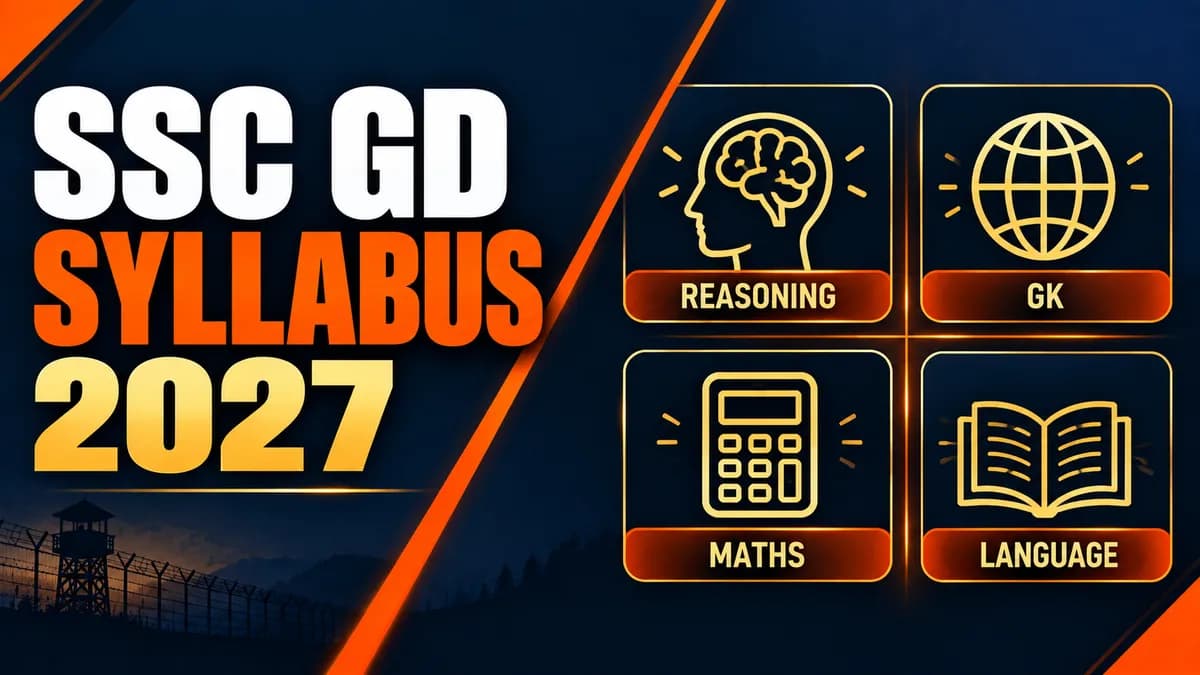
SSC GD Syllabus 2027: Subject-Wise Topics for Reasoning, GK, Maths and English or Hindi
SSC GD Syllabus 2027: Subject-Wise Topics for Reasoning, GK, Maths and English or Hindi
The SSC GD syllabus is built at Class 10 level. That is the good news and the trap at the same time. The questions are simple, so nobody fails because a question was too hard. Candidates fail because 80 simple questions in 60 minutes leaves no room for a slow answer.
Syllabus does not change with the notification either. The four parts, the topic list and the difficulty level have stayed stable across cycles, so you can start today and only adjust the current-affairs window later.
Syllabus structure
All four parts carry equal marks, but they do not carry equal difficulty for the same candidate. A Hindi-medium candidate from a village school usually gains most from Maths and Reasoning and needs a defensive plan for English. Decide your own split after one mock, not before.
Part A: General Intelligence and Reasoning
This is the highest scoring section per minute for most candidates, and it is also the first tie-breaker in the merit list. Twenty questions, largely non-verbal and analytical.
Topics to cover
- Analogies, both word based and figure based
- Similarities and differences
- Spatial visualisation and spatial orientation
- Visual memory and discrimination
- Observation and relationship concepts
- Arithmetical reasoning and figural classification
- Arithmetic number series and non-verbal series
- Coding and decoding
- Mirror images and water images
- Paper folding and paper cutting
- Embedded figures and figure completion
- Blood relations
- Direction sense and distance
- Ranking and order arrangement
- Venn diagrams and syllogism basics
- Odd one out and classification
- Counting figures such as triangles and squares
- Dice and cube problems
How to attack it
Mirror image, water image, paper folding and counting figures are pure practice topics. Nobody reasons them out fresh in the exam, they recognise the pattern from having seen fifty similar ones. Keep a notebook where you draw each type once by hand.
Coding and decoding gives you two or three questions almost every cycle. Learn the standard families: letter shifting, positional coding, arithmetic coding on letters.
Blood relations and direction sense take 20 seconds with a diagram and two minutes without one. Always draw.
Part B: General Knowledge and General Awareness
The section candidates most often postpone and most often regret. It is also the second tie-breaker, and it needs no calculation, so the marks per minute are unbeatable if your preparation is done.
Static portion
- Indian history: ancient outline, medieval dynasties, freedom struggle with dates and personalities
- Indian polity: Constitution basics, Fundamental Rights and Duties, Parliament, President, judiciary, important Articles
- Geography: rivers, mountain ranges, national parks and wildlife sanctuaries, soils, crops, minerals, neighbouring countries
- Economy: budget terms, banking basics, RBI functions, important schemes
- General Science: physics, chemistry and biology at Class 10 level, human body, diseases, vitamins, units and measurement
- Culture: dances, festivals, monuments, UNESCO sites in India
- Sports: major tournaments, trophies, recent champions
- Books and authors, awards, important days
- Abbreviations and organisations such as UN, WHO, ISRO, DRDO
Current affairs portion
Work with a six to twelve month window before the exam month. If the CBE lands in January or February 2027, your serious current-affairs coverage should run from roughly March 2026 onward, with heavier revision of the last six months.
Priority areas for a GD paper: government schemes, defence and paramilitary news, appointments, sports results, awards, national and international summits, science and space missions, and anything connected to the Ministry of Home Affairs and the central forces.
The one habit that decides this section
Fifteen minutes a day, every day, with a one-line note for each item. Candidates who try to finish a year of current affairs in the last three weeks always sacrifice Maths revision to do it, and lose more than they gain. Daily quizzes on ExamAtlas are built for exactly this fifteen-minute slot.
Part C: Elementary Mathematics
Class 10 arithmetic, no advanced algebra, no trigonometry beyond basics. The skill being tested is speed with clean numbers.
Topics to cover
- Number systems, LCM and HCF, divisibility rules
- Fractions, decimals and simplification
- Percentage
- Ratio and proportion
- Average
- Simple interest and compound interest
- Profit, loss and discount
- Time and work, pipes and cisterns
- Time, speed and distance, trains and boats
- Mensuration: area and volume of squares, rectangles, triangles, circles, cubes, cylinders, cones and spheres
- Partnership and mixtures
- Simple algebraic identities
- Basic data interpretation from tables and bar graphs
- Number series and simplification chains
What actually saves time
Learn tables up to 20, squares up to 30, cubes up to 15, and the common fraction to percentage conversions. This is not old-fashioned advice, it is the difference between a 40-second solution and a 90-second one.
Percentage, ratio, average, profit and loss and time-speed-distance together supply the largest share of the Maths questions in most cycles. Finish those five before touching mensuration formulas.
Practical rule for the exam hall. If a Maths question is still unsolved after 90 seconds, mark it for review and leave. Two questions attempted well beat one question conquered stubbornly.
Part D: English or Hindi
You choose one at the time of application, and the choice is not a small decision. Pick the language you read fastest, not the one you think looks better.
English syllabus
- Reading comprehension, usually one short passage
- Fill in the blanks
- Error spotting and sentence correction
- Spelling correction
- Synonyms and antonyms
- One word substitution
- Idioms and phrases
- Active and passive voice
- Direct and indirect speech
- Sentence rearrangement and para jumbles
- Common grammar: articles, prepositions, subject-verb agreement, tenses
Hindi syllabus
- संधि और संधि विच्छेद
- समास
- उपसर्ग और प्रत्यय
- पर्यायवाची और विलोम शब्द
- मुहावरे और लोकोक्तियाँ
- अनेक शब्दों के लिए एक शब्द
- वाक्य शुद्धिकरण और वर्तनी
- कारक, लिंग, वचन, काल
- रस, छंद और अलंकार का परिचय
- गद्यांश पर आधारित प्रश्न
Honest comparison
Hindi grammar questions are more rule based, which means they reward memorised lists. English questions lean on vocabulary and usage, which takes longer to build but is more forgiving on a bad day. If your school medium was Hindi, take Hindi and finish the grammar lists properly. Switching to English two months before the exam helps nobody.
Indicative topic weight from past GD papers
SSC does not publish a topic-wise break-up, so treat this as a pattern observed across recent GD, CHSL and MTS papers rather than an official split. It is still useful for deciding what to finish first.
The practical takeaway. Six Maths topics and six Reasoning topics cover most of those 40 questions. Finish those twelve before you open a mensuration formula list.
Formulas and rules worth memorising cold
- Percentage to fraction conversions from 6.25% up to 50%
- Profit and loss with successive discounts, and the single equivalent discount shortcut
- SI and CI difference for 2 years, which is P times r squared over 100 squared
- Average of first n natural numbers, and the effect of adding or removing one value
- Time and work in terms of one day's work, plus the efficiency ratio method
- Relative speed for same direction and opposite direction, and train-crossing lengths
- Areas and volumes of cube, cuboid, cylinder, cone and sphere
- Divisibility rules for 3, 4, 6, 8, 9 and 11
- Ratio distribution when a total is split in a given ratio
- Simple algebraic identities, especially a squared minus b squared and (a plus b) whole squared
Write these on one sheet and keep it where you drink your morning tea. Ten minutes a day on that sheet gives a better return than a new chapter.
Section-wise mistakes that cost marks quietly
Reasoning. Doing figure questions in the head instead of drawing. Rotating a mirror image mentally is how candidates lose four marks in a section that should give 34 out of 40.
General Awareness. Reading current affairs without writing anything. Recognition feels like knowledge until the options are similar.
Maths. Completing a long calculation and then marking the wrong option because the answer needed a percentage, not a value. Read the last line of the question again before clicking.
Language. Skipping the comprehension passage on principle. In a GD paper the passage is short and the questions are usually direct, so you are handing over easy marks.
One more general one. Many candidates revise only what they like revising. If your mock report shows 48% accuracy in time and work across three papers, that is where the next week goes, not into another round of coding-decoding you already score 90% in.
What is not in the syllabus
No essay, no interview, no typing test, no descriptive paper. SSC GD is a single objective paper followed by physical and medical stages. Anyone selling you an SSC GD essay course is selling you nothing.
Also worth saying clearly: no website or Telegram channel has the actual exam questions before the exam. Reproducing live exam questions is illegal under the Public Examinations Act 2024, and channels that claim to have them are running a scam on aspirants.
A 90-day syllabus plan
Run physical training through all 90 days, not after them. Candidates who separate CBE study from running preparation are the ones who clear the paper and then lose at the ground. The reason that matters: in the 2025 cycle, 3,94,121 candidates reached PET/PST and only 95,575 came out of it. The plan for running both tracks together is in SSC GD Preparation Strategy.
Books and sources that are enough
- NCERT Class 6 to 10 Science and Social Science for the static GK base
- One arithmetic book of your choice, worked cover to cover rather than three books half done
- One reasoning practice book with figure-based chapters
- A daily current-affairs source with a monthly compilation
- Previous year papers of SSC GD, CHSL and MTS for question style
Five sources, finished. That beats fifteen sources, sampled.
Where mock tests fit
The syllabus tells you what to study. Mocks tell you what is wrong with how you are studying. An accuracy of 80% in untimed practice and 55% in a timed mock is not a knowledge problem, it is a pacing problem, and only a timed paper reveals it.
ExamAtlas has free SSC GD mock tests for 2027-28 on the exact 80-question pattern with negative marking, and the analytics show topic-wise accuracy so you can tell whether percentage or time-speed-distance is quietly costing you eight marks.
For the marking scheme and stage-wise process read SSC GD Exam Pattern, and keep the SSC GD complete guide as your reference hub.
FAQs
What is the syllabus level of SSC GD?
Class 10 or Matriculation level across all four parts, with no advanced mathematics.
Is the SSC GD syllabus the same every year?
The structure and topics have stayed stable across cycles. Only the current-affairs window shifts with the exam date, and the notification confirms the final syllabus.
Should I choose English or Hindi in Part D?
Choose the language you read fastest and can revise properly. Hindi grammar rewards memorised rules, English rewards vocabulary built over months.
How many current-affairs questions come in SSC GD?
SSC does not publish a break-up within the 20 General Awareness questions, but a mix of static GK and recent current affairs is standard, so cover both.
Is there any maths beyond Class 10 level?
No. The Maths part stays at elementary arithmetic and basic mensuration, and the challenge is speed rather than depth.
Which section should I prepare first?
Start with Maths and Reasoning because they need daily practice, and run General Awareness as a fifteen-minute daily habit alongside.
Are previous year papers useful for SSC GD?
Yes, for question style and topic weight. Solve past papers of SSC GD, CHSL and MTS, but never trust channels claiming to sell live exam questions.
How long is enough to prepare for SSC GD?
A focused 90 days works for a candidate with a decent Class 10 base, provided running practice starts on day one instead of after the CBE.