
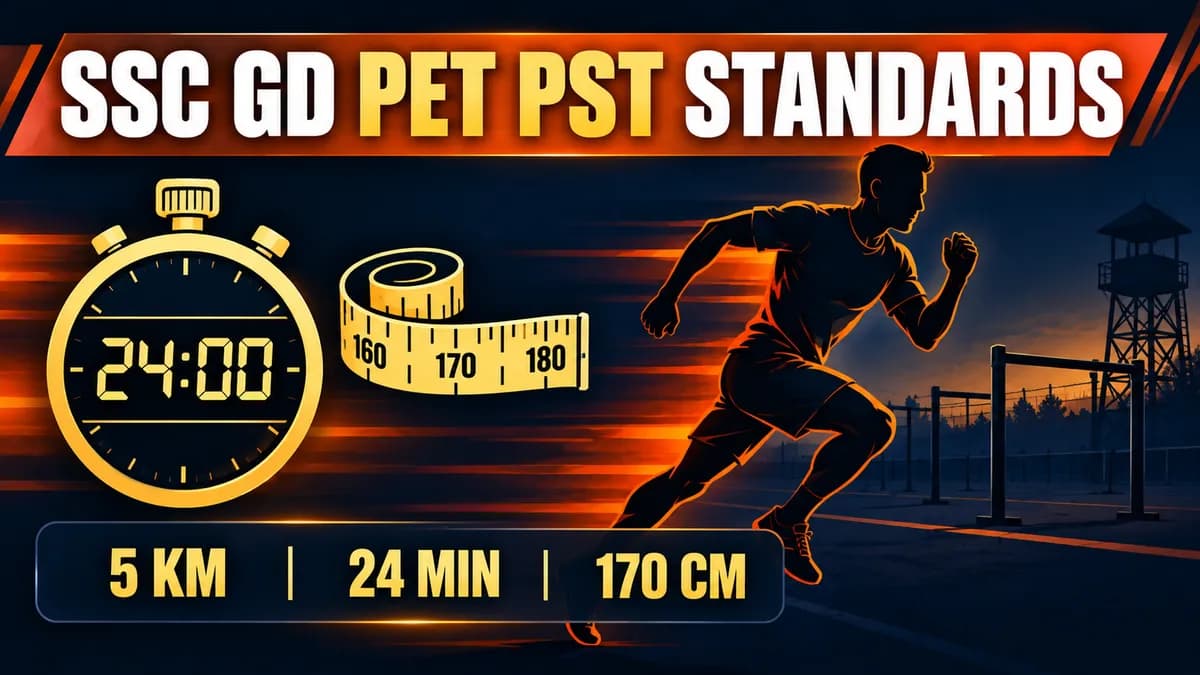
SSC GD Physical Test 2027: PET Race, PST Height and Chest, and the New BMI Rule
SSC GD Physical Test 2027: PET Race, PST Height and Chest, and the New BMI Rule
Here is the number that should decide how you plan your year. In the SSC GD 2025 cycle, 3,94,121 candidates were shortlisted for PET and PST. Only 95,575 came out of that stage. Nearly three out of four went home from the ground, not from the exam hall.
Candidates prepare for the written paper for eight months and for the run in the last three weeks. Then they are surprised. This page has the official standards, the change that most websites still have not updated, and a running plan you can start today.
Who conducts PET and PST
Not SSC. The CAPFs do, under a nodal force, which was CRPF in the 2025 cycle. The SSC notification states that conduct of PET/PST and DME/RME is the sole responsibility of the CAPFs, and that the Commission will not entertain any representation, appeal, RTI application or CPGRAMS complaint against the decision of those boards.
So your queries on the ground go to the CAPF board on the spot. An email to SSC three weeks later achieves nothing.
PET: the race
Ex-servicemen are exempt from PET but must appear for PST measurements.
PET is qualifying. You either finish inside the time or you do not, and the timing adds nothing to your merit. Merit comes only from normalised CBE marks, as explained in SSC GD Exam Pattern.
Do the arithmetic on that male standard. 5 km in 24 minutes means 4 minutes 48 seconds per kilometre, held for five kilometres, usually on an uneven ground, often in the heat, after a night of travel and waiting. A candidate who can run 5 km in 26 minutes on a good day at home is not safe. Train for 22 minutes so that 24 is comfortable.
PST: height
These are the standards from the official notification. Relaxed categories are specified, so check which row applies to you before you assume you are short.
The relaxation is claimed with a certificate, not by saying it at the measurement table. A candidate from a hill area without the district certificate is measured at the general standard.
PST: chest
Chest is measured for male candidates only. Female candidates do not undergo chest measurement.
Two things candidates get wrong here.
First, the expansion matters as much as the base measurement. A candidate at 84 cm unexpanded who can only expand 3 cm fails, while a candidate at 80 cm who expands to 85 cm passes. Expansion comes from chest and breathing work, not from mass.
Second, the tape is placed at nipple level and the reading is taken twice. Trying to hold a permanent fake inhale does not survive two readings.
The weight rule has changed: read this carefully
This is the update most sites still have not corrected, and it matters to thousands of candidates.
The old practice was simple and harsh: weight had to be proportionate to height and age, and the PST board could reject you on it. The SSC 2026 notification still carries that old wording at Para 12.5.3.
Then MHA issued Office Memorandum No. 45020/03/2025-PP/28 dated 09.03.2026, amending Para 2(d) of the Uniform Guidelines for recruitment medical examination in CAPFs and Assam Rifles. SSC published a corrigendum on 29 April 2026 to implement it.
What changed, in plain terms:
- The PST board no longer rejects a candidate on the basis of weight.
- Weight is now measured and recorded by the Medical Officer during the medical examination.
- Assessment is by BMI, with the normal range 18 to 25.
- BMI below 18 is treated as underweight and above 25 as overweight, and either can lead to rejection at the medical stage.
- The formula used is weight in kilograms divided by height in metres squared.
So the honest version is not "weight no longer matters". The honest version is that the weight check has moved from the measurement ground to the medical room, and the yardstick is now BMI.
Work out your own BMI today. A candidate of 170 cm needs to sit roughly between 52 and 72 kg to stay inside 18 to 25. If you are outside that band, you have months to fix it, and fixing it slowly is the only sensible way. Crash dieting before a medical usually produces a weak run and a failed race instead.
What PST does not decide
PST gives you no marks. Neither does PET. Both are qualifying, and merit is prepared from normalised CBE marks plus NCC bonus where applicable. A candidate with 170.5 cm height and 148 marks ranks above a candidate with 180 cm and 130 marks, every time.
A 12-week running plan you can start without a coach
This plan assumes you can currently run 2 km without stopping. If you cannot, spend two weeks on brisk walking and jogging intervals before starting week 1.
Practical notes from candidates who cleared comfortably:
- Run on ground or mud tracks, not only on roads. PET grounds are uneven.
- Train in the same clothes and shoes you will wear on the day, and break the shoes in early.
- Do one run a week at the time of day your PET is likely to be scheduled, usually early morning.
- Practise the 1.6 km distance separately if you are a female candidate. Sprint-endurance pacing for 8 minutes 30 seconds is a different skill from slow distance running.
- Add chest expansion work if you are close to the chest standard: deep breathing sets, dips, and overhead stretches daily.
- Do not skip sleep to study. A tired body fails a race it was otherwise ready for.
On the day of PET and PST
- Carry the admit card and all original documents the call letter lists
- Reach the venue the previous evening if it is far, since the process starts very early
- Eat light, at least two hours before the run
- Warm up properly, because most cramps happen in candidates who sat in a queue for three hours and then sprinted from a cold start
- Do not argue with the measuring tape, ask for the re-reading procedure at the board itself
One more thing. The medical stage follows soon after, and RME consent has to be given within 24 hours if you are declared unfit. Know those rules before you travel, they are in SSC GD Medical Standards.
Plan the paper and the ground together
The mistake is not laziness, it is sequencing. Candidates decide to clear the CBE first and then train. The CBE result in the 2025 cycle came on 17 June and PET/PST started on 20 August. Two months is not enough to build a 24-minute 5 km from nothing.
Run in the morning, study in the day, and keep checking your written preparation with timed papers. ExamAtlas has free SSC GD mock tests for 2027-28 on the exact 80-question pattern, so the written track keeps moving while your legs do the rest.
Eligibility conditions are in SSC GD Eligibility, the four-stage flow in SSC GD Exam Pattern, and the overall map in the SSC GD complete guide.
FAQs
What is the PET standard for SSC GD male candidates?
5 km in 24 minutes, with a separate standard of 800 metres in 5 minutes for candidates of the Ladakh region.
What is the PET standard for female candidates?
1.6 km in 8 minutes 30 seconds, and 1.6 km in 7 minutes for candidates of the Ladakh region.
What is the minimum height for SSC GD?
170 cm for male and 157 cm for female candidates in the general standard, with relaxation for ST candidates, specified hill categories, North-East states and GTA.
Is chest measured for female candidates?
No. Chest measurement applies only to male candidates, who need 80 cm unexpanded in the general standard with a minimum 5 cm expansion.
Can I be rejected in PST because of my weight?
No. After the corrigendum dated 29 April 2026, the PST board does not reject on weight. Weight is recorded at the medical examination and assessed through BMI, with 18 to 25 as the normal range.
Do PET and PST marks count in the final merit?
No. Both are qualifying stages, and merit is prepared from normalised CBE marks plus NCC bonus where applicable.
Are ex-servicemen exempt from the physical test?
They are exempt from PET but still appear for PST measurements.
How many candidates fail PET and PST in SSC GD?
In the 2025 cycle, 3,94,121 candidates were shortlisted for PET and PST and 95,575 moved forward, so roughly three out of four did not clear the stage.