
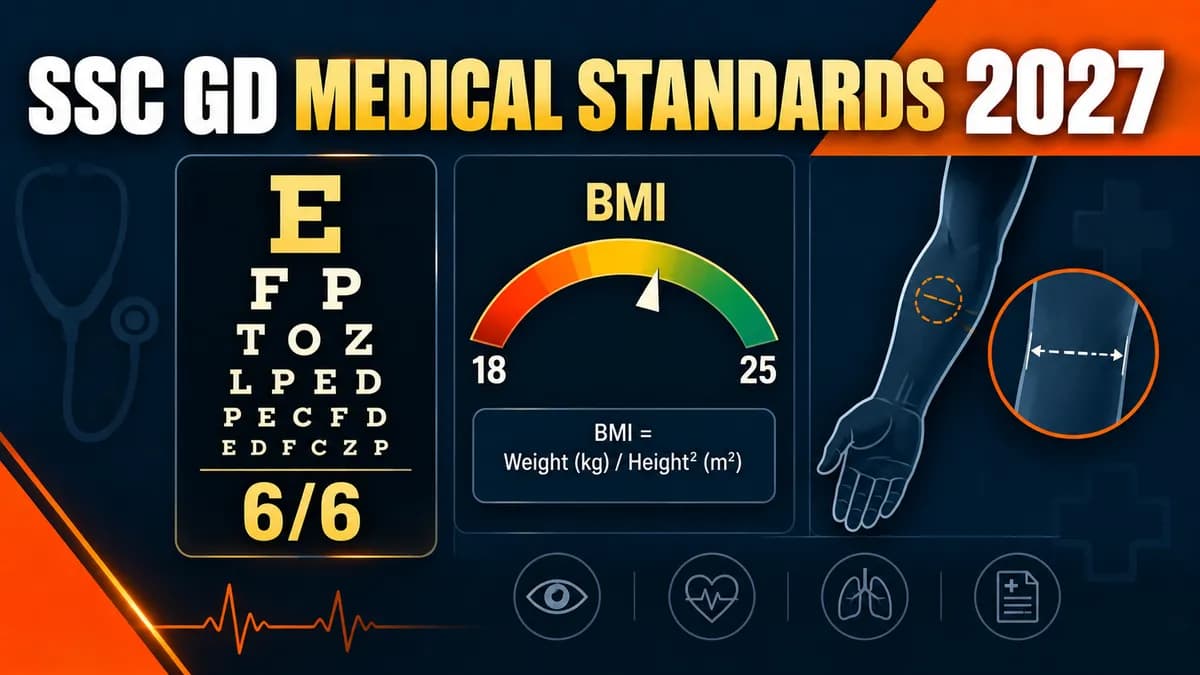
SSC GD Medical Standards 2027: Vision, BMI, Tattoo Rules, DME and RME
SSC GD Medical Standards 2027: Vision, BMI, Tattoo Rules, DME and RME
A candidate who clears the CBE and runs 5 km in 23 minutes can still lose the job over a tattoo on the wrong forearm or an inter-malleolar gap of 6 cm. Medical rejection is the cruellest stage of SSC GD, because it arrives after everything else has gone right.
The standards are not secret. They sit in the MHA Uniform Guidelines for recruitment medical examination in CAPFs and Assam Rifles, issued vide UO No. A.VI-1/2014-Rectt.(SSB) dated 20.05.2015, amended for Review Medical Examination in 2021 and amended again for weight in 2026. The SSC notification refers to these guidelines directly. This page puts the parts that decide rejections in one place.
Who conducts the medical examination
The CAPFs, through medical boards constituted by them, under a nodal force. SSC states in the notification that conduct of DME and RME is the sole responsibility of the CAPFs and that the Commission will not entertain any representation, appeal, RTI application or CPGRAMS complaint against a medical board decision.
Vision standards for Constable and GD posts
The visual standards come from MHA policy F.No. I-45024/1/2008-Pers.II dated 18.05.2012, framed after the Delhi High Court directed a review. For Other Ranks, which includes Constable (GD), the table reads as follows.
Two details that most pages skip.
The guidelines treat the right eye as the better eye for a right-handed candidate, and the left for a left-handed candidate. And the colour vision requirement is CP-III, not perfect colour vision, so a mild colour defect is not automatically a rejection while complete colour blindness is.
Eye surgery is examined rather than assumed. The RME guidelines list investigations to rule out LASIK, LASEK, PRK, glaucoma, squint and pterygium surgery, including slit lamp examination, corneal topography and tonometry as applicable.
The weight rule: from PST to BMI
This is the biggest change in years.
MHA Office Memorandum No. 45020/03/2025-PP/28 dated 09.03.2026 amended Para 2(d) of the Uniform Guidelines, and SSC issued a corrigendum on 29 April 2026 to implement it. The effect:
- The PST board no longer rejects a candidate on weight
- The Medical Officer records weight during the medical examination
- Assessment is by BMI, with the normal range 18 to 25
- BMI below 18 is underweight, above 25 is overweight, and either can lead to rejection
- The formula is weight in kilograms divided by height in metres squared
The older guidelines carried height and age wise average weight charts, with a line saying that in doubtful cases of overweight the assessment is to be made on the basis of BMI. The 2026 amendment makes BMI the standard rather than the exception.
Tattoo policy, exactly as the guidelines write it
Tattoos are judged on three counts.
So a name on the left inner forearm, small, usually passes. The same tattoo on the right forearm is the classic rejection, because the right arm is the saluting arm for most candidates. This has been litigated repeatedly, including CRPF cases in the Delhi High Court, and the Rajasthan High Court held in Union of India vs Sanyogita (16 May 2024) that a scar left by tattoo removal is not by itself a ground for disqualification.
Practical advice. If you have a tattoo on the right forearm and you are serious about the central forces, consult a doctor now about removal and keep the documentation, because the process takes months and the medical is unforgiving about timing.
Deformities that cause rejection
The guidelines are specific, and the numbers matter.
- Knock knee. The inter-malleolar distance is measured with a 5 cm wooden block. A reading of more than 5 cm is a cause of rejection. For female candidates the maximum permissible inter-malleolar distance is 8 cm.
- Flat foot (pes planus). Disqualifying.
- Clubfoot or high-arched foot (pes cavus). Disqualifying when it prevents proper wearing of combat footwear or impairs walking, marching, running or jumping.
- Varicose veins. Disqualifying. The guidelines use the WHO definition and classify varicose veins as dilated, palpable subcutaneous veins usually more than 4 mm in diameter. Varicose ulcer is also listed.
- Knee ligament problems. Uncorrected anterior or posterior cruciate ligament injury, evidence of surgical correction of knee ligaments, and medial or lateral collateral ligament injury are disqualifying.
- Squint, bow leg, cubitus valgus and varus deformities, mal-developed or absent toes, bony deformities, sinuses and muscle wasting are all on the examination list.
- Infected ingrown toenails. Disqualifying.
- Gynaecomastia. An ultrasound is done to establish whether the swelling is fatty tissue or breast tissue. Candidates with breast tissue are rejected.
Knock knee deserves a note. Many candidates have a gap of 3 to 5 cm and do not know it. Stand with your inner ankles touching and ask someone to look at your knees. If they overlap, get it checked by an orthopaedic doctor early, because mild cases respond to physiotherapy over months.
Post-operative waiting periods
If you have had surgery, the guidelines prescribe a wait before fitness can be certified.
Plan any elective procedure around the recruitment calendar rather than the other way round.
DME and RME: the difference, and the 24-hour rule
DME is the Detailed Medical Examination. RME is the Review Medical Examination for a candidate declared unfit in DME. The rules were revised by MHA vide F.No. E.32012/ADG(Med)/DME and RME/DA-1/2020 dated 2021, to cut delays, and they are strict about time.
- Every candidate declared unfit in DME is allowed RME, provided written consent is given on the prescribed form, Annexure A-1
- The consent must be submitted within 24 hours after the candidate is informed of the unfitness
- RME is conducted in continuation of DME, preferably on the next day
- The Medical Officer who conducted the DME cannot be part of the RME Board for the same candidate
- The Review Medical Board examines the candidate specifically for the defect for which he or she was declared unfit
- No fee is mentioned in the guidelines for RME
That 24-hour window is why so many candidates lose their appeal. They travel home after being declared unfit, plan to write a letter, and the door has already closed. If you are declared unfit, sign the consent form there.
The clause every rejected candidate should know
The RME guidelines require the board to back a rejection with evidence, not just an opinion. Investigations are prescribed by defect type:
- Knock knee, bow leg, cubitus valgus and varus deformities: X-ray plate with findings attached
- Varicose veins and vascular malformations: Colour Doppler
- Any type of deafness: audiometry
- Dental points less than 14: OPG
- Suspected coronary artery disease: TMT
- Cardiac cases such as valvular defects: ECG and echocardiogram
- Hypertension or tachycardia: the candidate is admitted so the board can see whether the rise is transient or due to organic disease
- Suspected diabetes: GTT and glycosylated haemoglobin
And the guidelines say it plainly: rejection merely on clinical findings is to be avoided. A decision on rejection must be supported by valid clinical findings and corroboratory investigation reports, with specialist opinion where needed.
Knowing that one line changes how a candidate stands at the board. You can ask, politely and on the spot, for the investigation the guidelines prescribe for your defect.
Before you reach the medical stage
Get a basic check done in the year before the exam: vision test, colour vision test, BMI, and an orthopaedic look at knees and feet. Most medical rejections in SSC GD are for conditions the candidate did not know about, not for conditions that appeared suddenly.
Physical standards and the running plan are in SSC GD Physical Test PET PST, and force-wise duty profiles in SSC GD Posts and Forces. Keep the SSC GD complete guide for the full picture.
FAQs
What is the vision requirement for SSC GD?
Distant vision 6/6 in the better eye and 6/9 in the worse eye, without any correction, with near vision N6 and N9 and colour perception CP-III by Ishihara.
Can a candidate with spectacles join SSC GD?
The standard for Other Ranks does not permit visual correction of any kind, including glasses, so the required acuity has to be met unaided.
Is colour blindness a rejection in SSC GD?
The requirement is CP-III by Ishihara, so a mild defect within that standard is acceptable while full colour blindness is not.
What is the tattoo rule for SSC GD?
Religious symbols or a name are permitted on the inner aspect of the left forearm or the dorsum of the hands, and the tattoo must be less than one-fourth of that body part. The right forearm is the saluting arm and a tattoo there leads to rejection.
What is the BMI requirement now?
The normal range is 18 to 25 after the amendment dated 09.03.2026 and the SSC corrigendum dated 29 April 2026. Weight is no longer a PST rejection ground.
How much knock knee gap is allowed?
An inter-malleolar distance of more than 5 cm is a cause of rejection for male candidates, and the maximum permissible distance for female candidates is 8 cm.
How many days do I get to apply for RME?
Not days. The signed consent for RME must be submitted within 24 hours of being informed of unfitness in DME, and RME is held in continuation of DME, usually the next day.
Is there a fee for Review Medical Examination?
The MHA guidelines do not mention any fee for RME. Follow the instructions printed on your DME call letter.