
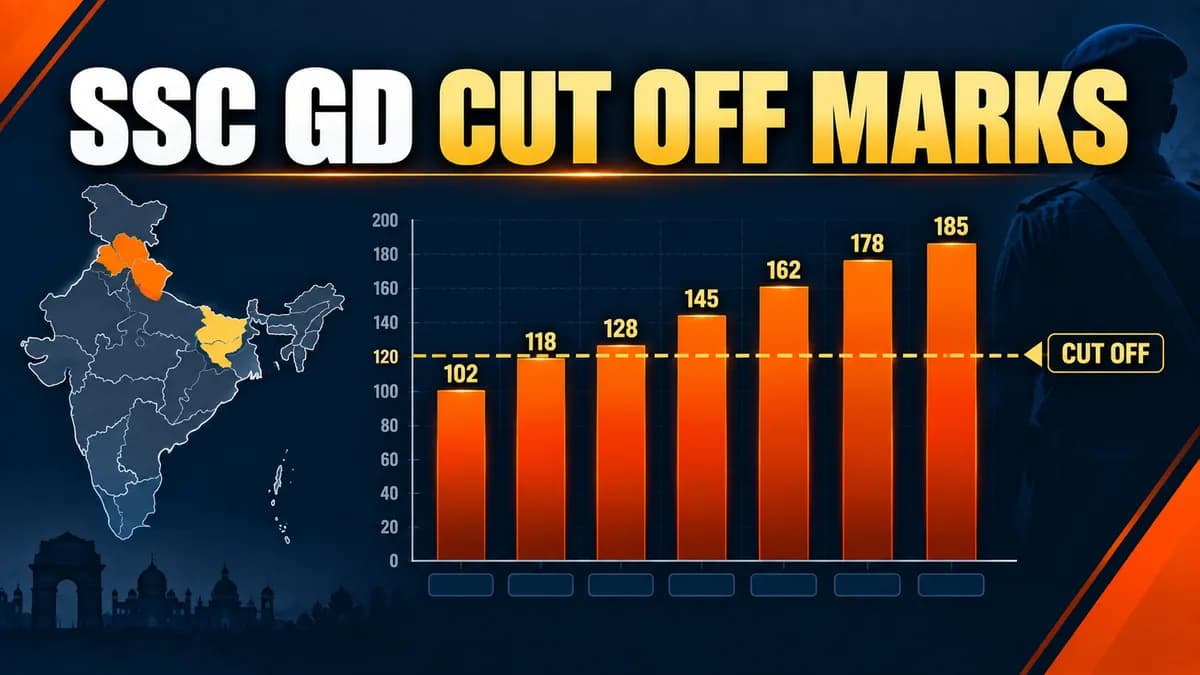
SSC GD Cut Off: Previous Year Category-Wise, State-Wise and Force-Wise Marks
SSC GD Cut Off: Previous Year Category-Wise, State-Wise and Force-Wise Marks
Two candidates write the same paper on the same day. One scores 130 normalised marks and misses selection in Rajasthan. The other scores 80 and gets selected in Kerala. Nothing is broken. That is how SSC GD cut-offs work, because vacancies are distributed state-wise and merit is drawn inside each pool.
Everything on this page comes from the official SSC final result of the Constable (GD) Examination 2025, notice No. HQ-C-3007/5/2025-C-3 dated 15 January 2026. No estimated figures are mixed into the tables.
How the cut-off is built
- Merit runs on normalised marks, not raw marks, using the formula published by SSC through notice No. 1-1/2018-P&P-I dated 07-02-2019
- NCC bonus marks are added on top of the normalised score before merit is drawn
- Cut-offs are published to five decimal places
- Separate cut-offs exist for each state, force, area type and category, and separately for male and female candidates
- Area types are General area, Border area, and Naxal or militancy affected area
PET, PST and the medical stage do not add marks. The mechanics are in SSC GD Normalisation and SSC GD Exam Pattern.
The 2025 cycle funnel
Category-wise cut-off range, general area, 2025
These ranges cover all states and forces in the official result, so use the median as a realistic marker and the maximum as the tough-state marker.
Notice something counter-intuitive. The OBC median sits above the UR median. That happens because reserved seats in some states are fewer than the number of strong candidates competing for them, while UR pools in low-competition states close at much lower marks.
State-wise UR cut-off, male, general area, 2025
This is the table that changes how a candidate plans. Same paper, same category, wildly different marks.
A UR male candidate from Rajasthan needed almost double the marks of a UR male candidate from Kerala. This is the single most useful number for a Bihar or Jharkhand aspirant to internalise: your target is not 100, it is closer to 135 and above.
Female cut-off in the big states, UR, general area, 2025
Female vacancies are a small slice of the total, 4,932 of 50,047 recommended in 2025, which keeps female cut-offs high in states with many applicants.
Force-wise cut-off range, 2025
Force profiles and how allocation works are in SSC GD Posts and Forces.
Border area and Naxal affected area cut-offs
The state pool is not one pool. Within a state, vacancies are further reserved for candidates of border districts and of Naxal or militancy affected districts, and the final result publishes separate cut-offs for General area, Border area and Naxal or militancy affected area.
The 2025 result explains the order of consideration. Candidates of Naxal or militancy affected areas are first considered against the vacancies of those areas and then against General area vacancies. Candidates of border areas are first considered against border area vacancies and then General area. A candidate belonging to both is considered first against Naxal or militancy affected area, then border area, then General area.
What this means in practice. If your district qualifies, the district certificate is worth real marks, because the area pool is smaller and usually closes lower than the General area pool of the same state. A Jharkhand or Chhattisgarh candidate who does not attach the certificate is competing in the hardest pool available to them by choice.
Reading a cut-off row correctly
A row in the official annexure looks like this: state, force, area, category, vacancy, filled, cut-off marks, Part A marks, Part B marks, date of birth. That last set exists because of the tie-break order.
Two things to note when you read the annexures yourself.
- A row with vacancy but no cut-off means no candidate was selected against it. In the 2025 result many ESM rows are like this.
- Filled numbers below vacancy numbers are common, and the result notes candidates selected at UR standard separately, which is why the UR row often reads "includes EWS and OBC candidates provisionally qualified at UR standard".
How many selected against how many vacancies
Look at the EWS row. In both male and female lists, the shortfall is the largest there. Seats went unfilled while candidates who could have taken them were competing elsewhere, which usually points to certificate problems rather than a shortage of capable candidates.
Why the ESM cut-off looks so low
In the same 2025 result, the SSF male ESM cut-off was 104.50641 against 150.75218 for UR in the same force. ESM pools are small and separate, and the drop is real. If you are an eligible ex-serviceman, file the claim properly with the discharge documents, because the difference is over 45 marks.
What the 2026 cycle is likely to show
The 2026 cycle had 25,487 vacancies against 53,690 in 2025, which is less than half. Fewer seats with a similar candidate volume usually pushes cut-offs up, and the CBE result for that cycle had not been declared when this page was written.
So treat any 2026 or 2027 figure you see as an expectation, not data. Expected cut-offs are opinions, and even careful ones move by eight to ten marks once the real result lands. This page will carry the official figures for 2026 once SSC publishes them.
Setting your own target
A workable method, using the 2025 table above.
- Find your state's range for your category and gender.
- Take the upper end, not the median, because your preferred force may be the crowded one.
- Add 8 to 10 marks as buffer, since the 2026 vacancy drop suggests upward pressure.
- Convert that into attempts. At 2 marks per question with 0.25 negative, a target of 140 needs roughly 72 to 75 correct answers with tight accuracy.
For a UR male candidate from Bihar, that means aiming at 145 and above rather than feeling safe at 130. Uncomfortable, but a candidate who plans for the real number does not lose a year finding it out.
Tie-breaks decide the last seats
When scores tie including NCC bonus, the order is marks in Part A, then Part B, then date of birth with the older candidate higher, then alphabetical order of names. Since Part A is Reasoning and Part B is General Awareness, those two sections quietly carry more weight than their 40 marks each.
Where to go next
The verified compilation lives on the ExamAtlas SSC GD cut-off page. To turn a target into a score, use the free SSC GD mock tests for 2027-28, which run on the exact 80-question pattern with negative marking and report topic-wise accuracy. The study plan is in SSC GD Preparation Strategy, and the full guide in SSC GD complete guide.
FAQs
What was the SSC GD cut-off in the last declared result?
In the Constable (GD) 2025 final result dated 15 January 2026, general-area UR male cut-offs ranged from about 48 to 152.04 depending on state and force, with a median near 102.
Why is the cut-off different for each state?
Vacancies are allotted state-wise and UT-wise, with further reservation for border districts and Naxal or militancy affected districts, so merit is drawn separately inside each pool.
Is the SSC GD cut-off based on raw marks?
No. It is based on normalised marks, plus NCC bonus where applicable, and it is published to five decimal places.
What is the expected SSC GD cut-off for 2027?
SSC has not declared anything for 2027, and the 2027 notification is still awaited. Any expected figure is an estimate, and the 2026 vacancy drop suggests upward pressure.
Which state had the highest cut-off in 2025?
Among the larger states, Rajasthan, Haryana, Madhya Pradesh and Uttar Pradesh sat at the top for general-area UR male candidates, all above 132 at the upper end.
Do PET and PST marks affect the cut-off?
No. Both stages are qualifying, and the cut-off is prepared from CBE normalised marks alone.
How much does the NCC certificate help?
NCC bonus marks are added to the normalised score before merit is drawn, so in an exam decided at five decimal places the bonus can change a selection.
Is the female cut-off lower than the male cut-off?
Not automatically. Female vacancies are far fewer, so in states with heavy competition the female cut-off can sit close to or above the male figure for the same category.