
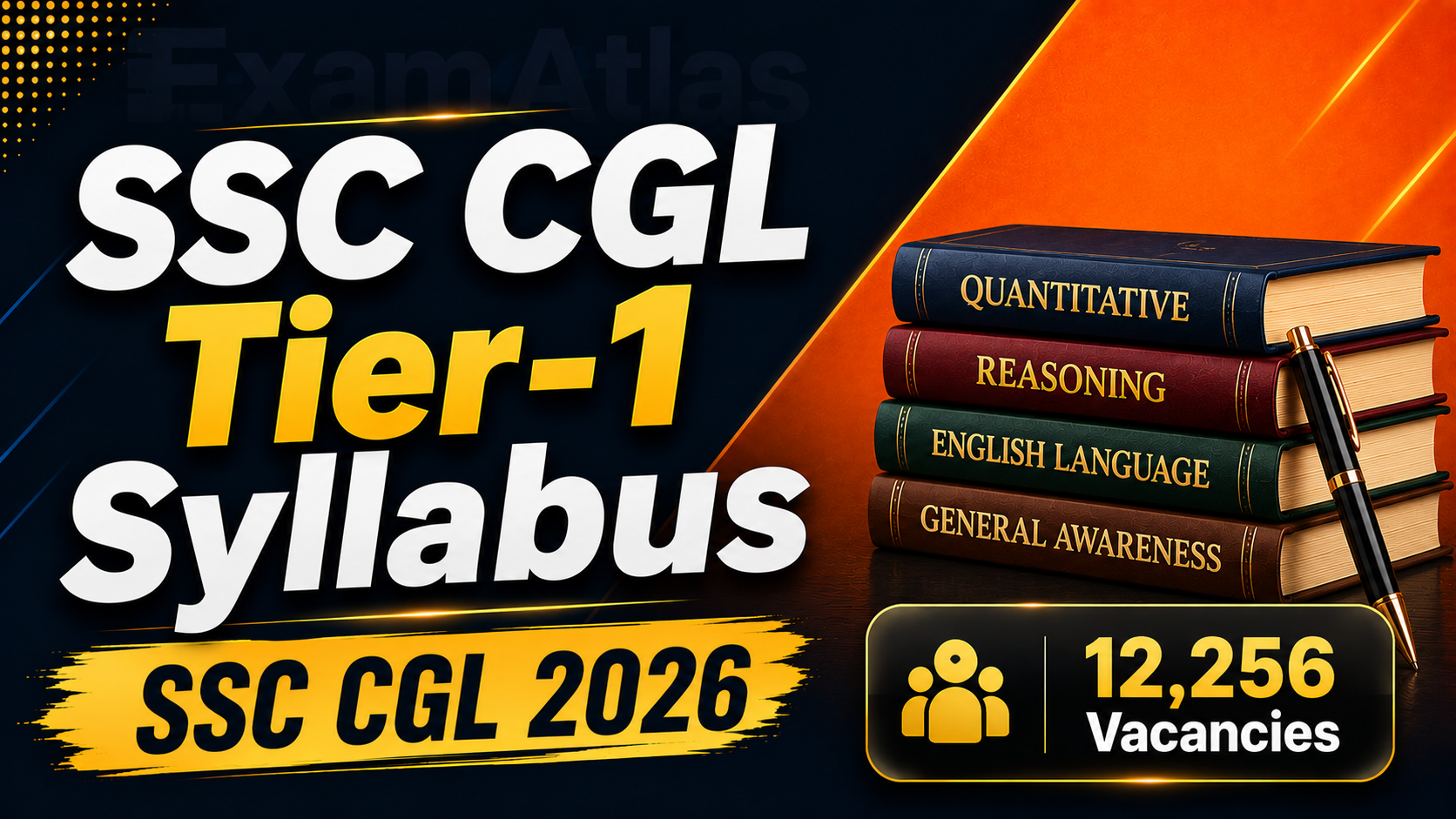
SSC CGL Tier 1 Syllabus 2026: Section-Wise Topics, New Pattern and the 15-Minute Timer
SSC CGL Tier 1 Syllabus 2026: Section-Wise Topics, New Pattern and the 15-Minute Timer
SSC CGL 2026 has 12,256 tentative vacancies for Group B and Group C posts, and the Tier 1 exam window falls in August–September 2026. The notification came out on 21 May 2026, applications closed on 22 June, and now lakhs of aspirants are staring at the same question: what exactly do I need to cover for Tier 1?
This post lays out the complete Tier 1 syllabus section by section, the 2026 exam pattern with its 15-minute sectional timer, and what that timer does to your attempt strategy. One request before we start: for exam dates and the final vacancy figure, verify from the official notification PDF on ssc.gov.in, because SSC revises these numbers mid-cycle more often than people expect.
SSC CGL 2026 Overview
SSC CGL Tier 1 Exam Pattern 2026
Tier 1 has four sections, 25 questions each, 2 marks per question. Total 100 questions, 200 marks, in 60 minutes. Wrong answers cost you 0.50 marks each.
The big point: the 60 minutes are not one open pool anymore. Each section is locked to its own 15-minute timer. You cannot finish Reasoning in 10 minutes and carry the spare 5 into Quant. When a section's clock ends, that section closes. Candidates eligible for a scribe get 20 minutes per section (80 minutes total).
Also remember how Tier 1 counts: it works as a screening stage. Clear the cut-off and you move to Tier 2, where the final merit is actually decided. So your Tier 1 goal is a safe, comfortable score above the expected cut-off, not a record attempt with reckless guessing that bleeds negative marks.
SSC CGL Tier 1 Syllabus: Section-Wise Topic List
1. General Intelligence and Reasoning
Reasoning in CGL Tier 1 is speed-friendly if your basics are set. The verbal part dominates, with a small non-verbal block.
- Analogy: semantic, symbolic, number and figural analogy
- Classification (odd one out): words, numbers, figures
- Series: number series, alphabet series, figural series
- Coding-Decoding: letter shifting, substitution, conditional coding
- Blood Relations and coded relations
- Direction and Distance
- Order and Ranking, word arrangement in dictionary order
- Syllogism and statement-conclusion
- Venn Diagrams
- Matrix, Word Formation and jumbled letters
- Mathematical Operations and BODMAS-based interchange questions
- Non-verbal: mirror image, water image, paper folding and cutting, embedded figures, figure completion, counting figures, dice and cubes
Most papers keep 20+ of the 25 questions from the verbal list. Non-verbal usually contributes 4–6 questions and they are gift marks if you have practised paper folding and mirror images even for two days.
2. General Awareness
This is the section that decides who finishes Tier 1 relaxed, because GA takes no calculation time. A prepared aspirant clears 25 questions in 8–9 minutes here; an unprepared one burns the full 15 and still guesses.
- Current Affairs: last 10–12 months: schemes, appointments, sports, awards, summits, defence exercises, reports and indices
- History: ancient, medieval, modern; freedom struggle carries visible weight
- Geography: Indian and world: rivers, mountains, national parks, crops, climate
- Polity: Constitution, articles, amendments, parliament, judiciary, panchayati raj
- Economy: budget basics, RBI and monetary policy, banking terms, five-year-plan legacy topics, economic survey highlights
- General Science: physics, chemistry, biology at NCERT Class 6–10 level; science makes up a big chunk of static GA
- Static GK: books and authors, important days, first-in-India, art and culture, dance forms
- Computer basics: hardware, software, internet terms (a few questions in recent cycles)
My honest take: GA is the highest-ROI section of Tier 1. Fifty marks with zero solving time, and it is also the section where a daily 20-minute current-affairs habit beats any last-month PDF cramming. ExamAtlas runs a free daily current-affairs quiz that is built exam-wise, so SSC-relevant items get tagged for you.
3. Quantitative Aptitude
Quant in 15 minutes is the real pressure test of the new pattern. The syllabus splits into arithmetic and advanced maths.
- Arithmetic: number system, LCM-HCF, simplification, percentage, ratio and proportion, averages, simple and compound interest, profit and loss, discount, mixture and alligation, time and work, pipes and cisterns, time-speed-distance, boats and streams, partnership
- Advanced Maths: algebra (identities, polynomials), geometry (triangles, circles, chords, tangents), coordinate geometry basics, mensuration (2D and 3D), trigonometry (identities, heights and distances)
- Data Interpretation: bar graph, pie chart, table-based sets
Recent CGL papers keep a rough balance: around 12–14 arithmetic questions, 8–10 advanced maths, and one DI set of 3–4 questions. Treat that split as trend analysis, not a promise, because SSC never publishes chapter-wise weightage.
4. English Comprehension
English in Tier 1 is vocabulary-and-grammar heavy, with light reading.
- Vocabulary: synonyms, antonyms, one-word substitution, idioms and phrases, spelling correction
- Grammar: error spotting, sentence improvement, fill in the blanks, active-passive voice, direct-indirect narration
- Reading: one short comprehension passage or cloze test
- Para jumbles: sentence rearrangement
For Hindi-medium aspirants this section decides the cut-off battle. The fix is unglamorous: previous-year vocabulary lists, because SSC repeats idioms and one-word substitutions across cycles with a frequency that still surprises people.
What the 15-Minute Sectional Timer Changes
Under the old single 60-minute clock, toppers front-loaded GA and English in 15–18 minutes combined and gave Quant 25+ minutes. That route is gone.
- No time borrowing. A weak section can no longer be subsidised by a strong one. Your Quant has to survive on its own 15 minutes.
- Sectional speed practice is now compulsory. Practise 25-question blocks against a 15-minute timer, section by section, not just full mocks.
- Skipping logic changes. Inside a section, a question eating 90+ seconds must be dropped fast, because unused seconds die with the section.
- Negative marking discipline matters more. With 0.50 per wrong answer and no chance to revisit a closed section, blind end-of-exam guessing sprees are costlier.
Build your mock habit around this. ExamAtlas mock tests run with sectional timing and the AI analytics show your per-topic accuracy and time-per-question, which is exactly the data you need to decide what to skip on exam day.
Important Dates for SSC CGL 2026
How to Use This Syllabus in the Last Stretch
With the Tier 1 window already running into September, a fresh cover-everything plan is unrealistic. Sequence matters now.
- Finish arithmetic revision before advanced maths; arithmetic gives more questions per hour of prep.
- Give GA a fixed daily slot: half static revision, half current affairs of the last year.
- Do one sectional test daily in your weakest section, plus one full mock on alternate days.
- Maintain an error notebook. In the last two weeks, revise only errors and formulas, not fresh chapters.
This assumes your basics exist. If you are starting from zero in advanced maths today, my honest advice is to master triangles, circles and trigonometry identities only, and let the rest go; partial mastery of high-frequency chapters beats shallow coverage of everything.
If you are also weighing other exams this season, the selection maths differs a lot across them; see our comparison of IBPS Clerk vs SBI Clerk 2026 and the RRB NTPC CBT-1 syllabus and weightage breakdown before splitting your prep time.
FAQs on SSC CGL Tier 1 Syllabus 2026
Q1. Is there sectional timing in SSC CGL Tier 1 2026?
Yes. Each of the four sections gets a separate 15-minute timer within the 60-minute exam. You cannot move leftover time from one section to another, and a closed section cannot be reopened.
Q2. Is there negative marking in Tier 1?
Yes, 0.50 marks are deducted for every wrong answer in Tier 1. With 2 marks per question, four wrong answers wipe out one correct one, so guess only when you can eliminate two options.
Q3. Do Tier 1 marks count in the final merit list?
Tier 1 works as a screening stage in the current CGL scheme; the final merit is prepared from Tier 2 performance. You need to clear the Tier 1 cut-off comfortably, not top it. Confirm the marking scheme details in the official notification PDF.
Q4. How many vacancies are there in SSC CGL 2026?
The advertised figure is 12,256 tentative vacancies across Group B and Group C posts. SSC updates vacancy counts during the cycle, so treat the final number on ssc.gov.in as authoritative.
Q5. Is the Tier 1 syllabus the same for all posts?
Yes. Every CGL applicant writes the same Tier 1 paper regardless of the post preference. Post-specific papers (like Statistics or the computer proficiency test) come only at the Tier 2 stage.
Q6. Which section should I attempt first?
You do not choose; the sections come in a fixed sequence with their own timers. What you control is strategy inside each 15-minute block: attempt sure questions first, mark and drop anything crossing 90 seconds, and use spare seconds for review within that same section.
Final Word
The CGL Tier 1 syllabus has stayed stable for years; what changed is the clock. In 2026 the exam rewards aspirants who have rehearsed each section as a separate 15-minute sprint. Keep the topic list above as your checklist, verify every date and figure against the official PDF on ssc.gov.in, and let your mock analytics, not your mood, decide which chapters get your remaining days.