
CTET September 2026: Exam on 6 September, Admit Card Status, Pattern and a 15-Day Plan
CTET September 2026: Exam on 6 September, Admit Card Status, Pattern and a 15-Day Plan
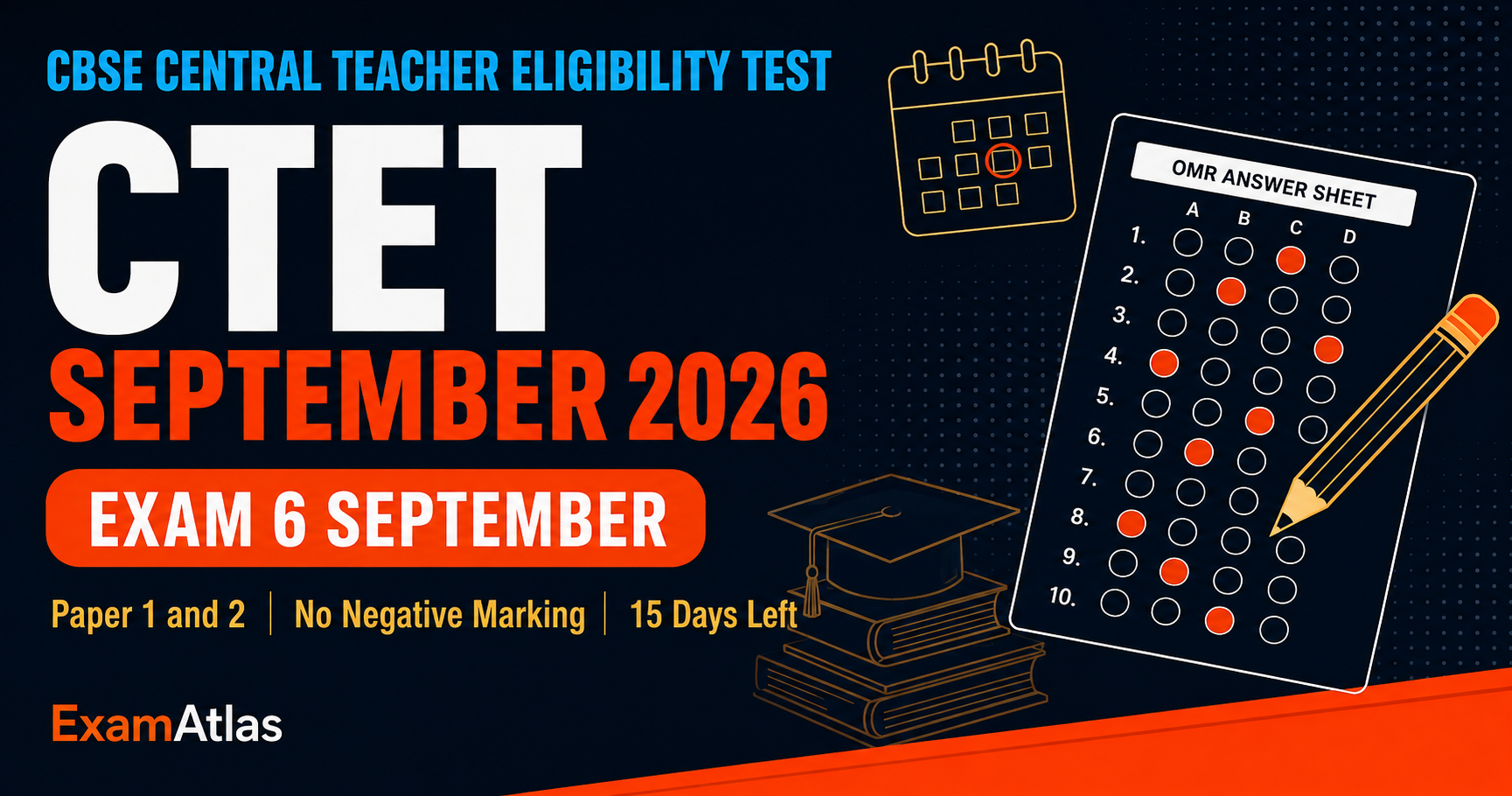
The Central Teacher Eligibility Test for the September 2026 session is 15 days away. CBSE will hold it on Sunday, 6 September 2026 in offline OMR mode, with Paper 1 in the morning and Paper 2 in the afternoon. The reserve exam date on record is 5 September 2026.
Two things matter right now. First, the live status: as of today the city intimation slip has not been released, and CBSE has not announced a date for either the city slip or the admit card. Second, the fifteen days you have left, which is enough to change your result if you spend them on the right sections. This guide covers the confirmed pattern, the qualifying bar, a realistic day-by-day plan, and one connection to Bihar's teacher recruitment that most CTET candidates are missing.
CTET September 2026 at a glance
Live status: city slip and admit card
The two documents are not the same thing and candidates keep confusing them. The city intimation slip tells you only which city you have been allotted, so you can plan travel and book a stay while it is still affordable. The admit card comes later and carries the exact centre address, reporting time and exam-day instructions. Both are downloaded from ctet.nic.in with your application number and password.
Because CBSE has not announced a release date, treat any specific date you see circulating as a guess. Based on how recent cycles have run, the city slip usually appears first and the admit card follows within a few days of the exam. Check the official site directly rather than relying on a screenshot.
Exam day timings
Each paper runs for two and a half hours. If you have applied for both papers, you sit the morning and the afternoon session on the same day, which is a long day and needs planning for food, water and rest between shifts. Your own reporting time will be printed on the admit card and is well before the start time.
Paper 1 pattern: Classes 1 to 5
Paper 2 pattern: Classes 6 to 8
In Paper 2 you choose one subject block worth 60 marks: Mathematics and Science if you intend to teach those, or Social Studies if that is your stream. That single block carries 40% of the paper, which is why it deserves the largest share of whatever study time you have left.
No negative marking changes your entire strategy
CTET carries no penalty for a wrong answer. Read that again, because it flips the approach most aspirants carry over from SSC, banking or railway exams.
With no negative marking, leaving a question blank is a wasted opportunity and nothing more. There is no such thing as a safe skip here. Your target should be to mark all 150 questions, and the practical implication for exam day is time management rather than caution: keep a strict eye on the clock so that you never reach the end with unmarked bubbles. A useful habit is to leave the last five minutes purely for filling in anything you left, using elimination where you can and a considered choice where you cannot.
Qualifying marks and what the certificate gives you
The same bar applies to Paper 1 and Paper 2. Clearing it earns you the CTET certificate, which now carries lifetime validity and is issued through DigiLocker, so you never have to sit the exam again once you qualify. The certificate makes you eligible for teaching posts in Kendriya Vidyalayas, Navodaya Vidyalayas, central government schools, and it is accepted by several state and private school recruitments as well.
Note what the certificate does not do: it does not give you a job by itself. It makes you eligible to apply for teacher recruitment, which is a separate exam in every state.
Your 15-day plan
Fifteen days is not enough to learn a subject from scratch, and it is more than enough to convert a borderline score into a comfortable pass. The plan below assumes you have covered the syllabus once and need to consolidate.
Two rules make this plan work. Put pedagogy first, because Child Development and Pedagogy is 30 marks on its own and pedagogy questions also sit inside the Maths, EVS, Science and Social Studies sections, which means the same study pays twice. And take your mocks in the actual time slot of your paper, morning for Paper 1 and afternoon for Paper 2, so your concentration peaks at the right hour.
Do not neglect the languages. Candidates routinely lose the exam on Language II because they assume it is easy and never revise the grammar and pedagogy of language teaching, which is where the marks actually sit.
The CTET and BPSC TRE 4.0 connection most candidates miss
If you are sitting CTET this September and you have any interest in Bihar teacher recruitment, this section is for you.
BPSC TRE 4.0, advertised for 32,388 posts, requires CTET or BTET Paper 1 for Classes 1 to 5 posts and CTET or BTET Paper 2 for Classes 6 to 8. In other words, the certificate you are chasing on 6 September is exactly the qualification that opens the primary and middle-school half of the biggest teacher recruitment Bihar has run. The TRE 4.0 application window runs from 1 to 30 September 2026.
Now the honest part about timing. The CTET exam is on 6 September and the TRE 4.0 form closes on 30 September, so a fresh CTET result is unlikely to be in your hands during that window. The TRE advertisement does carry a provision allowing candidates appearing in Bihar STET 2026 to apply on condition they clear it before the TRE Preliminary exam, but that clause was written for STET specifically. Whether the same treatment extends to CTET September candidates is something you must verify from the official advertisement on bpsc.bihar.gov.in before you rely on it. If you already hold a CTET or BTET certificate from an earlier cycle, you are covered and can apply in September without any doubt.
For the recruitment side of the picture, our guide to the TRE 4.0 notification, vacancy and eligibility sets out the full requirement, and the Bihar STET 2026 guide covers the secondary-level route for Classes 9 to 12.
Exam-day checklist
A soft copy of the admit card on your phone is not accepted. If you spot an error in your name, photograph or signature on the admit card, contact the CBSE CTET unit immediately with your application number rather than waiting until exam day. Since this is an OMR exam, carry a spare pen and fill the bubbles cleanly, because a half-filled bubble is a lost mark that no amount of preparation can recover.
Frequently asked questions
When is the CTET September 2026 exam?
6 September 2026, a Sunday, in offline OMR mode. Paper 1 runs from 9:30 AM to 12:00 noon and Paper 2 from 2:30 PM to 5:00 PM. The reserve date on record is 5 September 2026.
Has the CTET September 2026 admit card been released?
Not yet. Neither the city intimation slip nor the admit card has been released, and CBSE has not announced a date for either. Both will be available at ctet.nic.in using your application number and password.
Is there negative marking in CTET?
No. There is no penalty for a wrong answer, so you should attempt all 150 questions rather than leaving any blank.
What are the CTET qualifying marks?
90 out of 150, which is 60%, for General candidates, and 82 out of 150, which is 55%, for SC, ST, OBC and PwD candidates. The same bar applies to both papers.
How long is the CTET certificate valid?
For life. Once you qualify you never need to sit the exam again, and the certificate is issued through DigiLocker.
Can I use CTET September 2026 for BPSC TRE 4.0?
TRE 4.0 requires CTET or BTET for Classes 1 to 8 posts, and its application window is 1 to 30 September 2026. A fresh CTET result is unlikely within that window, so verify the exact provision from the official BPSC advertisement. An existing CTET certificate from an earlier cycle works without any question.
Final word
CTET rewards a specific kind of candidate: not the one who knows the most, but the one who has drilled pedagogy properly, respects the language sections, and attempts every single question because there is no penalty for trying. Those three habits are worth more in the next fifteen days than any new book you could start now.
Keep checking ctet.nic.in for the city slip and admit card rather than waiting for a forward, take your mocks at the real hour of your paper, and remember that the certificate you earn on 6 September stays with you for life. Verify every date and detail from the official CBSE information bulletin before you act on it.