
BPSC TRE 4.0 vs TRE 3.0: What Actually Changed (And Why It Matters for You)
BPSC TRE 4.0 vs TRE 3.0: What Actually Changed (And Why It Matters for You)
TRE 3.0 is remembered less for who got selected and more for the chaos around it. The exam held on 15 March 2024 was scrapped within five days after Bihar's Economic Offences Unit (EOU) confirmed a paper leak, and the re-exam finally ran from 19 to 22 July 2024. That one episode changed how BPSC runs teacher recruitment.
TRE 4.0 arrives in a different Bihar. The exam window is set for 22 to 27 September 2026 as per the BPSC calendar, the vacancy count is smaller, and the rules around who gets priority have shifted. Whether you missed the TRE 3.0 cut-off or are starting fresh, the changes below decide your strategy.
TRE 4.0 vs TRE 3.0 at a glance
The TRE story so far (1.0 to 4.0)
Bihar handed teacher recruitment to BPSC in 2023 to clear a long-standing vacancy backlog in government schools. TRE 1.0 and 2.0 filled large numbers quickly and gave thousands of D.El.Ed and B.Ed holders their first government posting.
TRE 3.0 was meant to keep that pace. The March 2024 leak forced a reset instead. TRE 4.0 is the first cycle written under Bihar's new domicile policy and the 2024 anti-cheating law, so it is not just "the next phase". It is a different exam in some important ways.
The biggest change is the domicile rule
For TRE 1.0 through 3.0, a graduate from Uttar Pradesh, Jharkhand or anywhere in India could sit the Bihar teacher exam and compete on equal footing. From TRE 4.0, the Bihar government's domicile policy changes that math.
- Bihar domicile candidates: eligible for the reserved quota (reported at around 85% of seats) along with all category reservation benefits.
- Non-domicile candidates: can still apply, but compete only for the unreserved open seats with no category reservation.
In plain terms, if you are a Bihar resident, your competition pool just shrank. If you are from outside Bihar, the door is open but narrower.
This is the change most aspirants underestimate. A Bihar-domicile EBC candidate who fought all-India competition in TRE 3.0 sits in a materially stronger position in 4.0. The exact percentages and wording will be confirmed in the official notification, so treat the figures as indicative for now.
Fewer vacancies, sharper competition
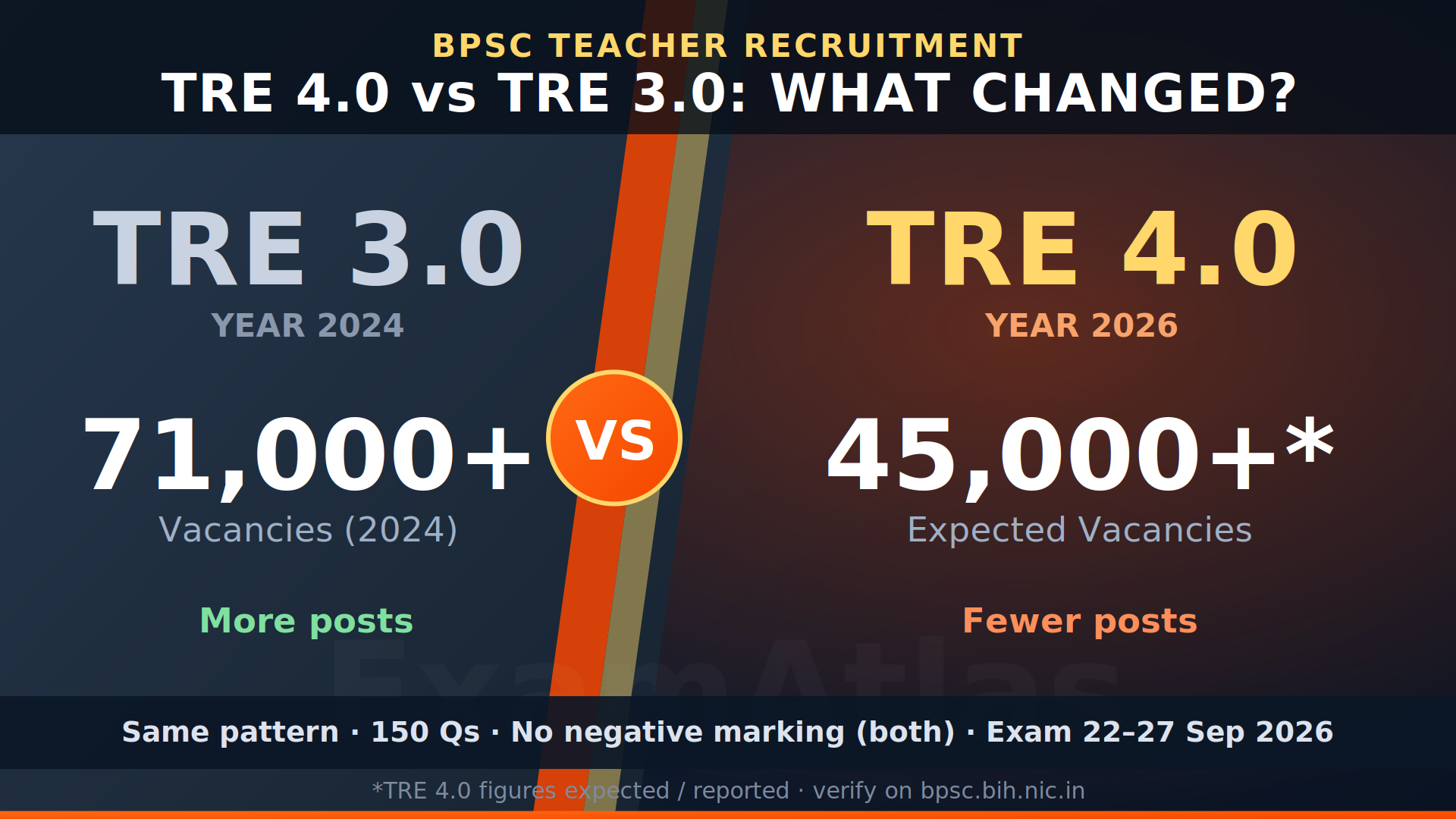
TRE 3.0 advertised 87,774 posts in its February 2024 notification (later revised slightly). TRE 4.0 is tracking near 46,882, which is roughly half. The figure is still unconfirmed, but the direction is clear: fewer seats this cycle.
Fewer vacancies with a similar applicant base usually pushes cut-offs up, especially for general-category seats and high-demand subjects like Mathematics, Science and Social Science at the Classes 9-10 and 11-12 levels.
Do not read the smaller number as bad news if you have actually prepared. A tighter merit list rewards depth and accuracy over lucky guesses.
A cap on attempts (new in 4.0)
TRE 3.0 set no public limit on how many times you could appear. TRE 4.0 is reported to cap attempts at three. If that holds, the casual "appear every cycle and see what happens" approach is over, and serious preparation matters from attempt one.
This is an aggregator-reported detail, so confirm it in the official notification before you plan around it.
Why exam security got tighter
The TRE 3.0 leak was not a rumour. The EOU detained candidates on exam day, traced a solver gang that accessed the paper before bar-coding, and BPSC cancelled the test. Since then, the Public Examinations (Prevention of Unfair Means) Act, 2024 has come into force, raising penalties for leaks and impersonation.
For TRE 4.0, expect stricter centre protocols, Aadhaar authentication, and live photo capture during the form stage. Keep your documents in order and reach the centre well before reporting time.
Eligibility: mostly familiar, two things to watch
The qualification ladder is broadly the same as TRE 3.0. By level:
- Primary (Classes 1-5): D.El.Ed plus CTET or BTET Paper 1.
- Middle (Classes 6-8): Graduation with B.Ed or D.El.Ed plus TET Paper 2.
- Secondary (Classes 9-10): Graduation with B.Ed plus Bihar STET Paper 1.
- Senior Secondary (Classes 11-12): Post-graduation with B.Ed plus Bihar STET Paper 2.
Two things change the game in 4.0. First, the STET requirement weighs more as you move to higher classes. Second, the domicile certificate is now central to claiming reservation, not just an optional document. Keep both ready before the form opens.
Exam pattern: what to expect
BPSC has not signalled a major pattern overhaul, so the TRE 3.0 structure is the safe assumption until the notification says otherwise.
This split applies to Middle, Secondary and Senior Secondary posts. The Primary (Classes 1-5) paper is structured differently, with Language plus a larger General Studies section and no separate subject paper, so check your level before timing your prep.
One objective paper, around 2.5 hours, and based on past cycles there is no negative marking. The final marks split and the negative-marking rule will be confirmed in the official notification.
What this means for your prep
Three practical takeaways:
- If you are Bihar domicile, the odds improved. Use that, but expect cut-offs to climb with fewer seats.
- If you are from outside Bihar, decide early whether the open-quota seats are worth your time against your home-state recruitment.
- Lock in your TET or STET certificate and domicile paperwork now, not in the last week of the form window.
The honest line: TRE 4.0 rewards candidates who treat it as one well-prepared shot, not a routine form-fill every cycle.
Who gains the most, and who should rethink
Not every aspirant is affected the same way. Here is the blunt read:
- Bihar-domicile freshers with TET or STET already done: best positioned in years. Reservation plus a smaller domicile pool works in your favour.
- TRE 3.0 cut-off missers from Bihar: the re-shaped competition helps, but only if you fix the weak section that cost you last time, usually Pedagogy or the language part.
- Out-of-state aspirants: reconsider honestly. The open quota is thin and carries no category reservation, so weigh it against your home-state teacher recruitment.
- Anyone eyeing Classes 9-12 without STET: the vacancy at that level means little until your STET certificate is in hand. Clear that gate first.
One more point worth saying plainly: TRE cut-offs are never a single number. They move by subject and category, so a 95 that clears General Science may not clear General Social Science in the same cycle. Plan around your specific slot, not a vague "safe score".
Practice the way the exam actually tests you
Reading the syllabus is not the same as scoring under a clock. ExamAtlas has free TRE-specific mock tests with AI analytics that show your topic-wise accuracy, so you can see whether your Social Science or Child Development score is genuinely exam-ready. Keep the daily quiz running to hold pedagogy and current affairs warm between study blocks.
FAQs
Is TRE 4.0 harder than TRE 3.0?
Not necessarily harder on paper difficulty. The pattern is expected to stay similar. But fewer seats and likely higher cut-offs make selection more competitive, so the bar to clear is effectively higher.
Do I need a Bihar domicile for TRE 4.0?
To claim the Bihar reservation quota, yes. Non-domicile candidates can still apply but compete in the open category only, without category reservation. Confirm the exact rule in the official notification.
How many vacancies are in TRE 4.0?
Reported near 46,882, smaller than TRE 3.0's roughly 87,774. The official figure will be confirmed when the detailed notification is released.
When is the TRE 4.0 exam?
The BPSC calendar lists 22 to 27 September 2026. Confirm the final dates on the official website, bpsc.bih.nic.in.
Is CTET or STET mandatory?
Yes, depending on the level. CTET or BTET applies to primary and middle posts, while Bihar STET applies to secondary and senior secondary posts.
Is there an attempt limit in TRE 4.0?
A cap of three attempts has been reported, which was not specified in TRE 3.0. Verify this in the official notification before planning around it.
The bottom line
TRE 3.0 taught Bihar's teaching aspirants a hard lesson about exam integrity. TRE 4.0 answers it with tighter security, fewer seats, and a domicile policy that finally rewards local candidates. The smartest move right now is not to wait for the detailed notification to begin. Fix your documents, pick your post level honestly, and start full-length practice. When the official PDF drops, you only adjust the details, because the groundwork is already done.
Treat the unconfirmed figures here (vacancy, attempt cap, reservation share) as indicative, and verify them on bpsc.bih.nic.in once the detailed TRE 4.0 notification is out.