
BPSC TRE 4.0 Syllabus 2026: Part-wise Topics, Subject List and Section Rules
BPSC TRE 4.0 Syllabus 2026: Part-wise Topics and Subject Options for All Four Levels
The syllabus in Advt 15/2026 sits under clause 4(i) and is shorter than most aspirants expect. What makes it tricky is not length, it is the standard: content is tied to SCERT and NCERT, but the difficulty is pitched at the minimum qualification prescribed for the post. So a Class 11-12 Chemistry paper is NCERT-based in content and post-graduate in level.
Below is the full topic list for each part, the subject options you can choose from at each level, and the Social Science section rule that catches people every cycle.
Part-I: Language, 30 questions
Part-I tests working knowledge of English plus one language from Hindi, Urdu or Bangla. Minimum 30% is compulsory in this part. These marks are qualifying only and never enter the merit list.
One selection rule to remember: once you choose a language subject, the same choice is valid for every level you apply for. You cannot mix and match across levels.
Part-II: General Studies, level by level
Two differences are worth circling. Class 1-5 has two extra areas that the other levels do not: Mental Ability Test and Social Science, plus Environment attached to Geography. And the General Studies paper is tied to SCERT specifically.
For Class 9-10 the source is the secondary school curriculum, and for Class 11-12 it is the higher secondary curriculum. Same topic names, different depth.
Part-III: Subject options, 80 questions
Class 1-5 has no Part-III. For the other three levels you pick exactly one subject, and you can only pick the subject in which you have passed TET.
Class 6-8 subject options
Class 9-10 subject options
Fifteen choices here, and this list also applies to the Special School Teacher posts for Class 9-10: Hindi, Urdu, Sanskrit, English, Science, Mathematics, Physical Education, Music, Social Science, Bangla, Fine Arts, Dance, Maithili, Arabic and Persian.
Class 11-12 subject options
The widest list of all, with thirty choices: Hindi, English, Sanskrit, Urdu, Mathematics, Physics, Chemistry, Botany, Zoology, History, Political Science, Geography, Economics, Sociology, Psychology, Home Science, Music, Philosophy, Computer Science, Business Studies, Entrepreneurship, Accountancy, Bangla, Bhojpuri, Magahi, Maithili, Pali, Prakrit, Arabic and Persian.
A note on some of these. Under departmental letter no. 905 dated 15.08.2026, vacancies for Bangla, Fine Arts, Dance, Maithili, Special School Teacher, Arabic and Persian at Class 9-10, and Bangla, Bhojpuri, Magahi, Maithili, Pali, Prakrit, Arabic and Persian at Class 11-12, will be notified after the supplementary requisition is received through the General Administration Department. The subject exists in the syllabus, the vacancy number is awaited.
Your subject choice is locked to your TET subject
The advertisement is blunt about this. A candidate may select only that one subject in which the TET was passed. Cleared TET in two subjects? You still choose one, by your own preference, and that choice goes into the single application you submit.
For Commerce at Class 11-12 there is a finer rule. A TET-qualified Commerce candidate may apply in any one of Entrepreneurship, Accountancy or Business Study. But a candidate who passed TET specifically in one of those three can apply only in that same subject.
The Social Science section rule
This applies to both Class 6-8 and Class 9-10 Social Science papers, and it decides what you actually study.
- If you choose History in Section-I, you must choose one of Geography, Economics or Political Science in Section-II.
- If you choose Geography in Section-I, you must choose one of Economics or Political Science in Section-II.
So a Social Science candidate is never preparing one subject. You are preparing a pair, and the pair is constrained by what you picked first. Decide the pair before you start making notes, not after.
Syllabus standard: the line people misread
The advertisement says the syllabus of all subject papers will be related to SCERT/NCERT, but the level will be in light of the minimum qualification prescribed for the candidate.
Put concretely: the minimum qualification for a Class 11-12 post is post-graduation in the specified subject plus B.Ed. So NCERT Class 11 and 12 textbooks give you the content map, and your post-graduate understanding gives you the depth at which questions will be framed. Reading only NCERT and stopping there is the most common preparation mistake at the higher secondary level.
For Class 9-10, the minimum qualification is graduation in the specified subject plus B.Ed, so the same logic applies one step down. For Class 1-5, the minimum qualification is Senior Secondary plus a training diploma, which is why the General Studies block there stays at school level but covers more areas.
How the 150 marks map to your study plan
Read that as a time allocation. If you are at Class 6-8 or above, your subject deserves roughly two-thirds of your study hours, General Studies about a third, and language just enough revision to clear 9 out of 30 comfortably. The subject paper is also the first tie-breaker if two candidates finish on the same total.
What to study from where
- General Studies: Bihar SCERT textbooks first, then NCERT for the same chapters. The advertisement ties this paper to SCERT.
- Indian National Movement: a recurring area at every level, and one where Bihar-linked events show up often in state recruitment papers.
- Elementary Mathematics and Mental Ability: only Class 1-5 has Mental Ability as a named area, but elementary maths appears at all four levels.
- Subject paper: NCERT of the relevant classes for the content map, your graduation or post-graduation notes for depth.
One honest caveat about the syllabus text itself. It lists topic headings, not chapter-level detail. Anyone selling you a "100% official detailed syllabus PDF" with sub-topics under each heading has expanded it themselves. Use such lists as a study aid, not as the source of truth.
Remember the marking while you plan revision
Every wrong answer costs 1/3 mark, and so does a question left blank without darkening option E. That changes what "covering the syllabus" means. A topic you half-know is now a liability, because half-knowledge produces confident wrong answers.
It also changes what a "safe" score looks like. The minimum qualifying marks are 40% for General, 36.5% for BC, 34% for EBC and 32% for SC, ST, women and persons with disability, and several websites still print 36.5% against EBC by mistake.
Better to finish 80 percent of the syllabus at a level where you can tell a right option from a close one, than to skim 100 percent and guess across the paper. The full marking rules are in our TRE 4.0 exam pattern guide.
FAQs
What is the syllabus for BPSC TRE 4.0?
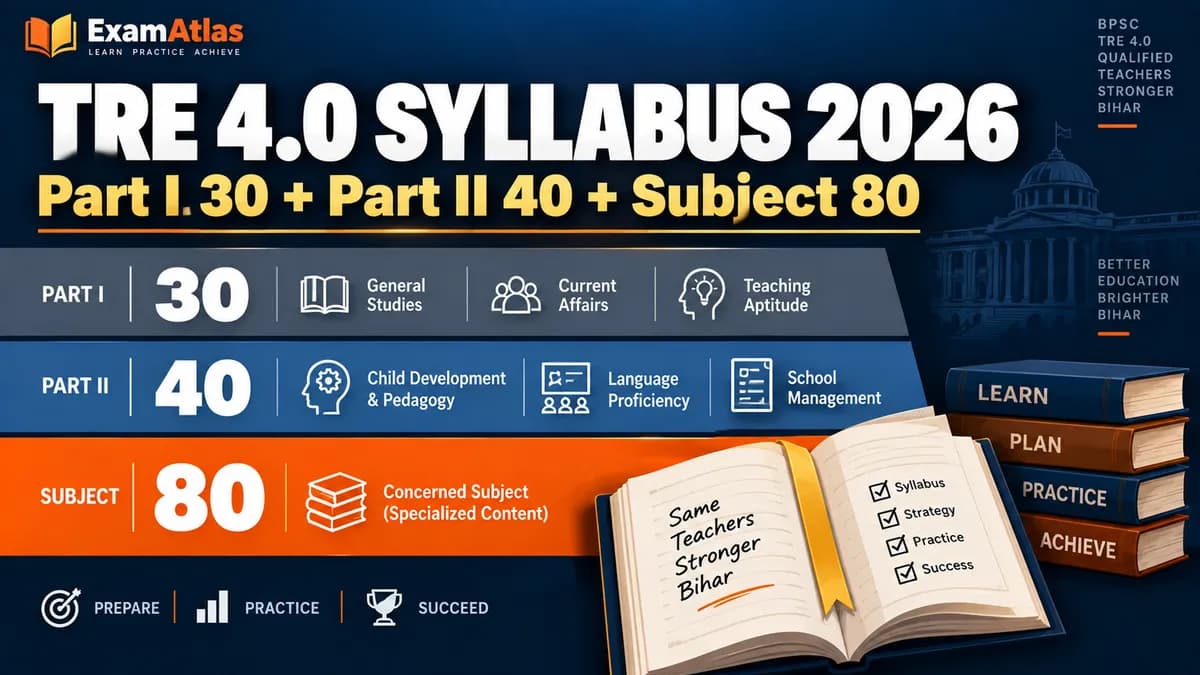
Part-I is language, 30 questions. Part-II is General Studies, 120 questions for Class 1-5 and 40 for the other levels. Part-III is your chosen subject, 80 questions, for Class 6-8, 9-10 and 11-12. All subject papers relate to SCERT and NCERT.
Is the TRE 4.0 syllabus NCERT based?
Yes in content, but the level is set by the minimum qualification prescribed for the post. The General Studies paper is specifically tied to SCERT.
How many subjects can I choose in Part-III?
Exactly one, and it must be the subject in which you passed TET. Even if you have cleared TET in more than one subject, you select only one.
What is the Social Science section rule?
If you pick History in Section-I you must pick Geography, Economics or Political Science in Section-II. If you pick Geography in Section-I you must pick Economics or Political Science in Section-II. It applies to both Class 6-8 and Class 9-10.
Does the Class 1-5 paper have a subject section?
No. Class 1-5 has 30 language questions and 120 General Studies questions. Merit is calculated from the General Studies part alone.
Which subjects have no vacancy number yet?
Bangla, Fine Arts, Dance, Maithili, Special School Teacher, Arabic and Persian at Class 9-10, and Bangla, Bhojpuri, Magahi, Maithili, Pali, Prakrit, Arabic and Persian at Class 11-12. Their vacancies come through a supplementary requisition.
Start with the part that carries the most marks
Take your subject syllabus, split it into the chapters you can already answer confidently and the ones you cannot, and count the marks each group historically carries in school board and state teacher papers. Most candidates discover that four or five chapters carry a third of the subject paper.
Build your first month around those, keep General Studies as daily short sessions rather than weekend blocks, and treat language as a fortnightly check. A week-by-week plan built on this split is in our TRE 4.0 preparation strategy blog, and the full picture of vacancies and dates sits in the main TRE 4.0 guide.