
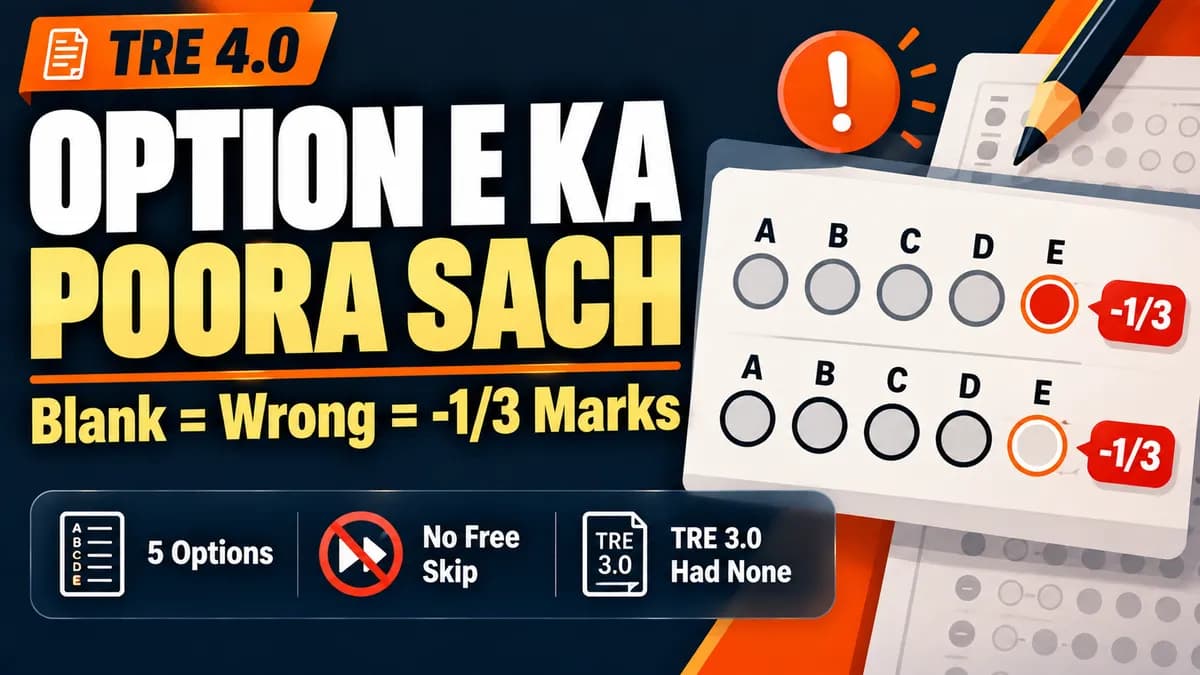
BPSC TRE 4.0 Option E and 1/3 Negative Marking: The Full Rule
BPSC TRE 4.0 Option E and 1/3 Negative Marking: The Full Rule Explained
Advt 15/2026 introduced two things TRE 3.0 never had: a fifth option E on every question, and a 1/3 mark deduction that applies to wrong answers and unanswered questions alike.
Most aspirants have read the first part and missed the second. The result will be thousands of candidates walking out of the hall thinking they attempted 110 questions safely, while the answer sheet records 150 scored questions and 40 deductions.
This page sets out exactly what the notification says, what each choice costs, and how to behave in the exam hall.
What the notification actually says
- Every question carries five options: A, B, C, D and E.
- The correct answer lies in A, B, C or D. Option E is never the correct answer.
- If you do not want to answer a question, filling Option E is mandatory.
- If none of the five is marked, the question is treated as unanswered and 1/3 mark is deducted for it too.
- 1/3 mark is deducted for every wrong answer.
- Only one option may be marked per question.
What each choice costs you
Read the third and fourth rows together. Marking E and leaving the question blank cost you the same thing. Option E is a record-keeping instruction, not a shield.
This is the single biggest change from TRE 3.0, where a skipped question cost nothing at all.
The arithmetic, in marks you can feel
Take a 150-question paper and three candidates who each know 90 questions cold.
These are illustrative figures, not a promise. But the shape of the result is fixed by the rule itself: Candidate A, the cautious one, finishes last. Leaving 60 questions untouched costs 20 marks and earns nothing back.
That is the reversal aspirants need to absorb. In an exam where blanks are free, caution pays. In this exam, caution is the most expensive strategy on the sheet.
When is a guess worth taking?
Work it out on one question.
Because a blank is never free, even the break-even case is better attempted than skipped. The practical rule for the hall is simple: mark something on every question, and spend your thinking time on eliminating options rather than deciding whether to attempt.
Our honest caveat: this holds at the level of the whole paper, across 150 questions where averages work. On any single question a guess is still a guess.
Then why does Option E exist at all?
The notification makes E mandatory when you choose not to answer. It exists so that a deliberate non-attempt is recorded on the sheet rather than being left ambiguous, which matters for evaluation and for any later dispute about a blank response.
Understand it as a declaration, not a safe harbour. The penalty is identical either way, so from a scoring point of view E gives you nothing that a blank does not, while non-compliance with a mandatory instruction is a risk you do not need to take.
How this changes your OMR habits
- Do not leave rows empty as you go. The old habit of circling doubtful questions and returning at the end is fine, but every row must carry a mark before you hand the sheet in.
- Keep the last ten minutes for filling. Not for solving. Reserve time to mark every remaining row rather than solving two more questions and leaving twenty blank.
- Never double-mark. Only one option per question is permitted, so a half-erased change can cost you the mark you had.
- Practise elimination as a timed skill. Ruling out one option in fifteen seconds is worth more in this paper than solving one extra question fully.
Where the deduction hits each level
The 1/3 rule applies to all 150 questions, but the damage lands differently depending on which paper you sit.
Part-I deserves its own warning. It is qualifying at 30% and its marks do not add to merit, but the deduction still applies inside it. Leaving ten language questions blank pulls you more than three marks down on a paper where you only need nine out of thirty.
At Class 1-5 the exposure is largest in raw terms. With 120 merit-bearing questions in one part, a candidate who leaves 30 of them untouched has already given away 10 marks before a single wrong answer is counted.
What it means for your preparation
A topic you know at 50% used to be worth a cheerful guess. Today it breaks even at best, so depth on fewer chapters beats thin coverage of everything, especially in Part-III where 80 of the 150 questions sit at Class 6-8, 9-10 and 11-12.
Score every mock with the deduction applied. A practice paper marked at plus-one-only inflates your number and trains the wrong instinct. After each paper, count three things separately: sure attempts that were right, guesses that were right, and rows left empty. The second number is your elimination skill, and below 40% it needs work before you attempt more papers.
ExamAtlas has free TRE 4.0 mocks on the five-option pattern with AI analytics that separate sure attempts from guesses and show topic-wise accuracy. The full paper structure is in our exam pattern guide, and the phase-wise plan in our preparation strategy page.
The qualifying marks you are protecting
EBC is 34% in this advertisement, not 36.5%, whatever several websites still print. Against a bar of 51 marks, the 13 to 20 marks that careless skipping costs is not a rounding error. It is the difference between qualifying and not.
The Commission also retains discretion over the qualifying standard under Rule 7(v) of the Bihar Rajya Vidyalaya Adhyapak Niyamavali 2023.
What several websites are getting wrong
- Pages claiming no negative marking. Some still carry the TRE 3.0 position. Advt 15/2026 applies 1/3 negative marking.
- Pages claiming 1/3 negative in prelims and mains. There is no prelims and no mains. One written objective exam decides selection.
- Pages describing E as a safe skip. Marking E carries the same 1/3 deduction as a wrong answer.
Frequently asked questions
What is Option E in BPSC TRE 4.0?
Option E is the fifth option on every question. It records that you do not want to answer that question, and the notification makes filling it mandatory in that case. The correct answer is always in A, B, C or D.
Does marking Option E save me from negative marking?
No. Marking E carries the same 1/3 deduction as a wrong answer, and as leaving the question blank.
What happens if I leave a question completely blank?
It is treated as unanswered and 1/3 mark is deducted for it, exactly as if you had marked E.
Should I attempt all 150 questions?
Since a blank costs the same as a wrong answer, an informed attempt is almost always better. Attempt every question, and use your time to eliminate options rather than to decide whether to attempt.
Was there negative marking in TRE 3.0?
No. TRE 3.0 had no negative marking, which is why old practice habits will quietly cost marks in TRE 4.0.
Can I mark more than one option?
No. Only one answer per question is permitted.
One line to write on your first mock
Before your next practice paper, write this at the top of the sheet: a blank costs the same as a wrong answer. Then attempt accordingly and score with the deduction applied.
Candidates who internalise this in October will be ten to twenty marks ahead of equally prepared candidates who discover it in the hall. The rest of the rule set is in our Advt 15/2026 breakdown.