
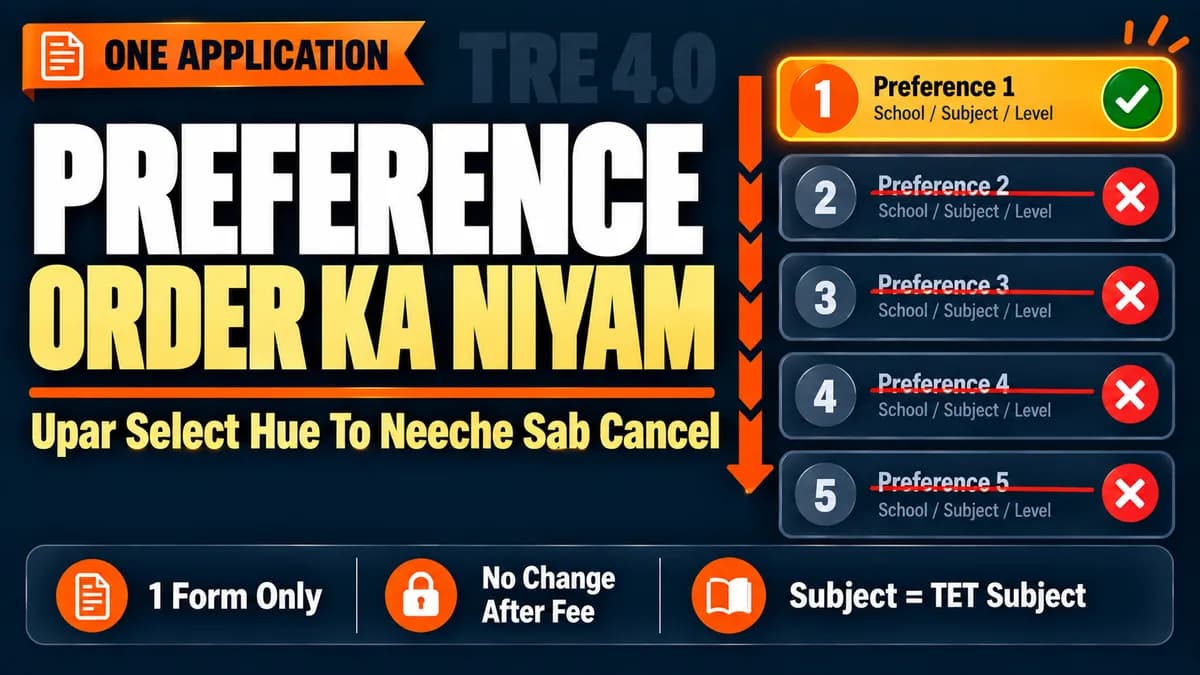
BPSC TRE 4.0 Preference Order: The Stepwise Rule Explained
BPSC TRE 4.0 Preference Order: The Stepwise Rule That Cancels Your Other Options
If you are eligible at more than one level, Advt 15/2026 asks you to set a preference order inside your single online application. That order is not a wish list. It works in steps, and once a higher preference selects you, every lower option is cancelled automatically.
Candidates who fill this casually lose the post they actually wanted. There is no appeal, because the advertisement requires you to declare in the form that you have no objection to this.
The rule in six lines
- Candidates eligible for more than one level choose the priority order while filling the online application.
- Only one application is to be submitted, and every preference goes inside it.
- If you are found eligible at a higher preference, the result is published for that post.
- Your candidature for every other option then becomes automatically invalid.
- If you fill no preference at all, the result is published for the higher level only, and the lower post lapses.
- You must declare in the form that you have no objection to this arrangement.
How it plays out, using the advertisement's own example
The notification itself gives an illustration with five preferences.
If this candidate succeeds at Class 11-12 in either the unreserved or their reserved category, nothing below is considered at all. Not preference 2, not preference 3, not the rest.
If they do not succeed at Class 11-12, the Commission looks at preference 2, then 3, then 4, then 5, in that order.
Why this catches people out
The trap is putting the easier level first. A candidate who thinks "Class 1-5 is the safest, let me keep it at number one" will be selected there and will never be considered for Class 11-12, even if their marks would have been comfortably enough.
Remember what sits at each level. Class 11-12 carries 16,101 of the 32,388 posts and a starting pay of Rs 32,000. Class 1-5 carries 3,847 posts at Rs 25,000. Putting the smaller, lower-paying level first is a decision most candidates would not make deliberately, but plenty will make it by accident.
Our position on this is plain: place the level you actually want at number one, not the one you think is easier to clear. The stepwise rule already protects you at the lower levels if the first one does not work out.
The subject rule that sits alongside it
Preference order decides the level. A separate rule decides the subject, and it is just as final.
You can select only the subject in which you passed TET or STET. Cleared two subjects? You still pick one, by your own choice. And once the fee is paid against a chosen post and subject, nothing can be added or removed unless you cancel the payment and repeat the whole process, with no refund.
So the order of operations matters: decide the level order, decide the subject, then pay. Our apply online guide covers the form steps around this.
A checklist for setting your order
That last row is the one nobody thinks about. If you would not actually join at Class 9-10, leaving it off your preference list is a legitimate choice. Filling every box is not compulsory.
Three sample orders for common profiles
These are illustrations, not advice for your case. Your certificates decide what can go on the list at all.
The third row shows a real judgement call. Special School Teacher posts at Class 9-10 are among the subjects whose requisition has not yet come through the General Administration Department, under departmental letter 905 dated 15.08.2026. Placing an option with no published vacancy first is a gamble; placing it second costs nothing.
After the merit list, what still moves
Your preference decides which post your result is published against. Several things happen after that, and they are worth knowing before you set the order.
The Commission prepares a provisional merit list and sends it to the Education Department, which verifies the eligibility claims made in the form. The merit list can be revised after that check. District allotment then happens at the Department's end, not the Commission's.
Guest teachers should note one more thing here. The weightage of 5 marks per year of service, capped at 25 marks and subject to the outcome of LPA 593/2024, is added only after the minimum qualifying marks are crossed. It lifts your rank at whichever preference you are being considered for, it does not move you between preferences.
What the preference order does not decide
- Your district. The Commission conducts the exam and publishes the result, but district allotment is done by the Education Department.
- Your qualifying marks. The same category thresholds apply: 40% General, 36.5% BC, 34% EBC, 32% for SC, ST, women and PwBD.
- Your merit score. That comes from Part-II and Part-III, with Part-I qualifying at 30% and not counted in merit.
Since the exam is one written objective paper with five options and 1/3 deducted for wrong and unanswered questions alike, your score at every preference comes from the same sheet. Preference order allocates the result, it does not improve it.
One more thing the form locks
Preference order is not the only irreversible entry on that page. Six fields in the One Time Registration have no correction provision at any later stage: name, father's name, mother's name, gender, Aadhaar number and date of birth. Only one OTR is permitted, and a duplicate registration can get the application rejected.
Reservation works the same way. The benefit is given only on a claim made inside the online form, backed by a certificate from the competent authority, and it cannot be added afterwards. Married women need caste, residence and creamy-layer-free certificates issued in the father's name and father's permanent address, not the husband's.
Frequently asked questions
Can I submit separate applications for different levels?
No. Only one online application is to be submitted, with every preference set inside it.
What happens if I qualify at more than one preference?
The result is published for the higher preference, and your candidature for every lower option becomes automatically invalid.
What if I do not fill any preference?
The result is published for the higher post only, and candidature for the lower post lapses automatically.
Can I change my preference order later?
No. Once you have applied against the advertisement, no entry in it can be changed. Before payment the profile can still be reopened so entries are corrected.
Can I choose two subjects across two levels?
No. You may select only the subject in which you passed TET or STET, and only one even if you cleared several.
Does BPSC decide which district I am posted in?
No. District allotment is done by the Education Department, not the Commission.
Fill this before you open the form
Write your preference order on paper first, with the post count and pay against each line, and check it against your certificates. Ten minutes on paper is cheaper than a lifetime at a level you did not want.
Then confirm the vacancy in your own category, because a level with a large total can still be thin for you. The full subject-wise split is in our Advt 15/2026 breakdown.