
Which Level to Choose in BPSC TRE 4.0? Class 1-5 to 11-12 Compared
Which Level Should You Apply For in BPSC TRE 4.0? Class 1-5, 6-8, 9-10 or 11-12
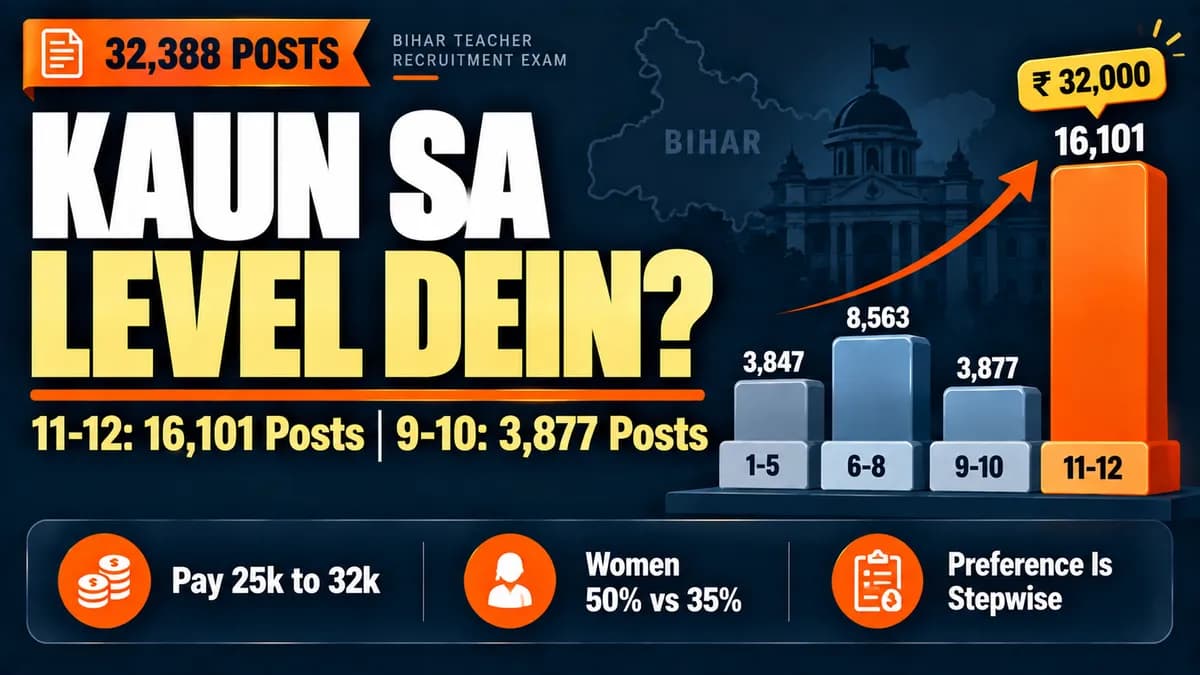
BPSC TRE 4.0 has 32,388 posts spread very unevenly across four levels. Class 11-12 alone holds 16,101 of them, while Class 9-10 has just 3,877. The pay ranges from Rs 25,000 to Rs 32,000, and the women's quota changes from 50% to 35% halfway up.
If your certificates open more than one door, this is the decision that shapes everything else, including the preference order you can never change after paying the fee.
The four levels side by side
Two things jump out. Class 11-12 pays the most and carries the most posts, which is unusual. And Class 9-10 is the hardest level in the recruitment: fewer posts than Class 6-8, a smaller women's quota, and a heavier qualification.
The paper is different at Class 1-5
At Class 1-5 there is no subject paper at all, and General Studies carries 120 of the 150 questions. It also tests two areas the other levels do not: a Mental Ability Test and Social Science, on top of Elementary Mathematics, General Awareness, General Science, Indian National Movement, and Geography and Environment.
So a candidate whose strength is their post-graduate subject gains nothing at Class 1-5. A candidate strong in general aptitude and school-level general knowledge may find it the easier paper.
What each level demands of your degree
SC, ST, EBC, BC and PwBD candidates get a 5% relaxation in the prescribed minimum marks for academic and training qualifications at every level.
Age is a quieter filter than people expect
Minimum age is counted on 01.08.2026 and maximum age on 01.08.2024, and the minimum differs by level: 18 years for Class 1-5 and 6-8, 21 years for Class 9-10 and 11-12.
PwBD candidates get 10 years of relaxation, ex-servicemen get 3 years plus service rendered, and teachers under Panchayati Raj institutions and urban local bodies have the upper limit relaxed. Regular Bihar government servants get 5 years across a maximum of five attempts counted from 12.12.2022.
None of this changes level by level. It is the same ceiling whichever preference you set, which is why age rarely decides the level, only whether you can apply at all.
Four honest trade-offs
Class 11-12 against Class 9-10
If both are open to you, Class 11-12 is usually the stronger choice. It has 16,101 posts against 3,877, pays Rs 32,000 against Rs 31,000, and the women's quota is the same 35% at both. The only reason to prefer Class 9-10 is a subject where your own category count is better there, or a subject that exists at 9-10 and not at 11-12.
Class 6-8 against Class 1-5
Class 6-8 has 8,563 posts against 3,847, pays Rs 28,000 against Rs 25,000, and both carry the 50% women's quota. The catch is the paper: Class 6-8 needs 80 questions of subject command, while Class 1-5 needs breadth across seven general areas.
Class 6-8 against Class 11-12
This is the genuinely hard one. Class 11-12 has almost twice the posts and better pay, but the women's quota drops from 50% to 35%, and the subject is tested at post-graduate standard. For a woman candidate eligible at both, the quota difference is real: 2,569 quota posts at Class 6-8 against 2,571 at Class 11-12, despite the latter having far more posts overall.
A subject post against Special School Teacher at Class 9-10
Special School Teacher vacancies are among those still awaiting a supplementary requisition under departmental letter 905 dated 15.08.2026. Until that number is published, a subject post at the same level is the option with a known vacancy.
How this feeds your preference order
You submit one application with a priority order inside it, and the rule is stepwise. Qualify at a higher preference and every lower option is cancelled automatically. Fill no preference and the result is published for the higher level only.
The mistake to avoid is putting the easier level first because it feels safer. A candidate who places Class 1-5 at number one and is selected there will never be considered for Class 11-12, however good their marks were.
Put the level you actually want at number one. The stepwise rule already catches you at the lower levels if the first one does not work out. Our exam pattern guide has the full paper structure behind each level.
A decision sequence that works
- List the levels your TET or STET actually opens. CTET or BTET Paper-I for Class 1-5, Paper-II for Class 6-8, STET Paper-I for Class 9-10, STET Paper-II for Class 11-12.
- Strike out any level where your degree does not match the subject group or post-graduate list.
- For each surviving level, note the post count in your own category and subject, not the level total.
- Add the women's quota figure if it applies to you, remembering it is 50% at the two junior levels and 35% at the two senior ones.
- Ask which paper you would score higher in, given that 80 of 150 questions come from your subject at three levels and none at Class 1-5.
- Order them by what you want, not by what looks easier, and leave off any level you would not actually join.
That last point is legitimate. Filling every preference box is not compulsory, and a level you would decline is better left off the list than placed at the bottom of it.
What does not change with the level
Whichever level you choose, the paper is 150 questions and 150 marks in 2 hours 30 minutes, with five options per question and 1/3 deducted for a wrong answer, for marking Option E and for leaving a question blank. TRE 3.0 had no negative marking, so this applies equally at all four levels.
The qualifying bar is also the same: 40% for General, 36.5% for BC, 34% for EBC and 32% for SC, ST, women and PwBD candidates. Several websites still print BC and EBC at the same figure, which is wrong for this cycle.
And the 40% domicile share applies across the whole recruitment, not level by level: 40% of total vacancies go to candidates who passed matriculation or intermediate from an institution in Bihar.
Frequently asked questions
Which level has the most vacancies in BPSC TRE 4.0?
Class 11-12 with 16,101 posts, which is roughly half the recruitment. Class 6-8 follows with 8,563.
Can I apply for more than one level?
Yes, in one single application by setting a preference order. If you qualify at a higher preference, your candidature for the lower options is cancelled automatically.
Which level pays the most?
Class 11-12, at Rs 32,000 starting pay, plus allowances fixed by the State Government.
Is the women's quota the same at every level?
No. It is 50% at Class 1-5 and Class 6-8, and 35% at Class 9-10 and Class 11-12, for women who are permanent residents of Bihar.
Is Class 1-5 an easier paper?
It has no subject paper, so General Studies carries 120 of the 150 questions and also includes a Mental Ability Test and Social Science. Whether that is easier depends on your own strengths.
Can I change my level after paying the fee?
No. Once payment is made against a chosen post, nothing can be added or removed without cancelling the payment and repeating the process, and cancelled payments are not refunded.
Decide before the portal decides for you
Write the four levels on paper, strike out the ones your certificates close, and put your own category count next to each of the rest. The level with the most posts in your category, at a paper you can score in, is your first preference.
Then check the subject tables before the fee, because a level is only as good as your row inside it. The full split is in our Advt 15/2026 breakdown, and the qualification clauses in our eligibility page.