
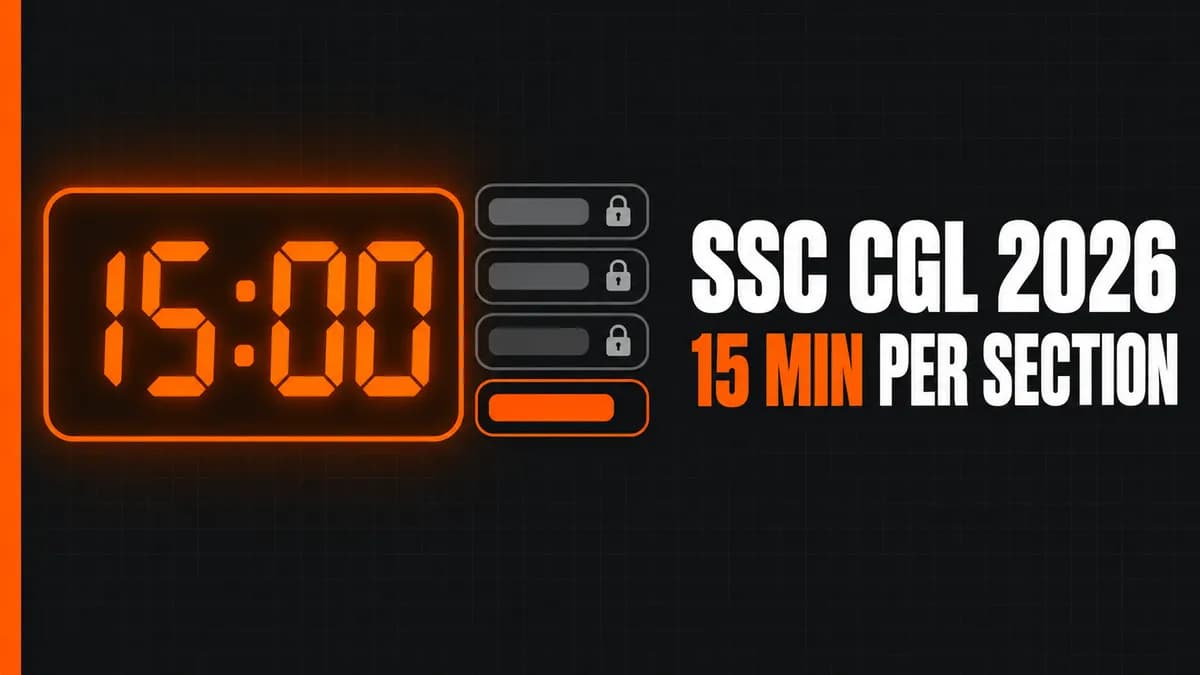
SSC CGL 2026 New Changes: Sectional Timing, a Reopened Window and a 30 September Exam Start
SSC CGL 2026 New Changes: Sectional Timing, a Reopened Window and a 30 September Exam Start
Status on 13 September 2026: the application process is closed, the final last date having been 25 June 2026 after SSC reopened the window. Tier 1 runs as a Computer Based Examination from 30 September to 30 October 2026, and the Admit Card has not been released yet.
Every SSC CGL cycle carries small edits. This one does not. The 2026 cycle changed the single thing that decides how you sit in the chair for 60 minutes, and if you prepared through 2024 and 2025 on the old format, a fair chunk of your exam-hall technique is now dead weight. Below is what changed, what it costs you, and what stayed exactly as it was.
Everything that changed in SSC CGL 2026, in one table
Start here. If a line in this table surprises you, read the section under it before you do anything else.
Sectional timing is the change that actually matters
Tier 1 still has 100 questions, 200 marks and 60 minutes. Nothing about that line changed. What changed is that the 60 minutes is no longer yours to spend.
Each of the four sections now carries its own 15-minute timer. General Intelligence and Reasoning gets 15. General Awareness gets 15. Quantitative Aptitude gets 15. English Comprehension gets 15. Four times fifteen is sixty, so the total is unchanged, but the paper is now four small exams stitched together rather than one long one.
Negative marking in Tier 1 stays at 0.50 per wrong answer, and Tier 1 stays qualifying only, so these marks do not enter the final merit. The full section-by-section breakdown, along with the topic list sitting behind each section, is on our SSC CGL exam pattern page.
How the 15-minute lock behaves in the exam hall
The mechanics are simple and unforgiving. When a section's 15 minutes run out, that section closes on its own. You do not click anything. The screen moves you to the next section and the previous one is gone.
Two consequences follow from that single rule.
- You cannot carry unused time. Finish Reasoning in 11 minutes and the remaining 4 minutes vanish. They do not get added to Quant.
- You cannot return to a question you marked for review once the section has closed. Marked-for-review still works, but only inside the same 15 minutes.
The 15-minute figure is reported widely by prep portals and is being treated as settled by most coaching centres. Before your exam date, open the Scheme of Examination annexure on ssc.gov.in once and confirm it yourself. That takes two minutes and removes any doubt. Candidates using a scribe get compensatory time as per SSC rules, and the exact allowance is stated in the official rules rather than here.
Tier 2 gets sectional timing too, but the minutes are not out
SSC has introduced sectional timing in Tier 2 as well. That part is clear. What is not clear is how many minutes each section of Tier 2 Paper 1 receives, because SSC has not published per-section minutes for Tier 2. Any site printing an exact Tier 2 sectional figure today is guessing.
Treat the Tier 2 numbers as pending and check the official notice when Tier 2 is formally scheduled. Tier 2 itself remains tentatively in December 2026 from the notification, with no separate SSC notice issued so far. The paper structure has not changed: Paper 1 for everyone across Session I and Session II, Paper 2 for JSO, Paper 3 for AAO. Negative marking stays at 1 mark in Paper 1 Section I and Section II, and 0.50 in the Computer Knowledge module. Since final merit is decided entirely by Tier 2, this is the stage worth protecting, and our SSC CGL Tier 2 guide covers the module-wise structure.
What breaks for a candidate trained on the old format
This is the part nobody says loudly enough. Three exam-hall habits that were considered good practice until last year now actively cost marks.
Banking time from Reasoning to spend on Quant is over. The standard plan was to clear Reasoning in 10 to 12 minutes, clear GA in 5 to 7, and push the saved 8 or 9 minutes into Quant, where the marks were slowest to earn. That transfer is no longer possible. Quant now gets 15 minutes and only 15 minutes, which for 25 questions works out to roughly 36 seconds each. If your Quant plan assumed a 22-minute block, rebuild it.
Leaving GA for last is over. Plenty of toppers used to open with GA precisely because it is fast, or leave it to the end and clear 25 questions in four minutes flat while the clock bled out. Neither option exists now. GA arrives when the paper decides, it gets its own 15 minutes, and those minutes cannot be shortened or shifted. The odd side effect is that GA has become more generous, not less. Fifteen minutes for 25 factual questions is comfortable, so the section that used to be a speed round now has slack in it. Use that slack on the two or three GA questions you would normally skip.
Coming back to a marked question is over. A common habit was to park four or five hard Quant questions, finish English, then return with a clear head. Once Quant closes, those parked questions are scored as unattempted. Your marking strategy has to shrink to within-section only.
The honest summary: sectional timing punishes the candidate whose speed is uneven across subjects and rewards the one who is merely adequate in all four. If Quant is your weak section and you were covering for it with borrowed minutes, that cover is gone. Sectional mocks are the only way to feel this properly, and the Tier 1 test series is worth running under a real 15-minute lock rather than a self-paced timer. Rebuild your attempt plan on what those scores show, not on what worked last year.
The application window reopened, and that moved the eligibility date
The notification came on 21 May 2026 and applications opened the same day. The original last date was 22 June 2026 at 23:00 hrs. SSC then reopened the window from 23 June 2026 to 25 June 2026 at 23:00 hrs, which made 25 June the final closing date.
The reopening carried a consequence bigger than an extra weekend of form-filling. SSC stated that the part of the Notice of Examination treating the closing date as the crucial date for ascertaining eligibility now reads as the new closing date, 25 June 2026. So age, qualification and every other eligibility condition are now judged as on 25 June 2026, not 22 June.
For most candidates the shift of three days changes nothing. For a final-year student whose result landed in that gap, or for someone sitting right at the upper edge of an age band, it changes everything. Final-year students could apply provisionally, with the qualification required to be complete by that cut-off date.
The correction window charged Rs 200 the first time and Rs 500 the second. Application fee was Rs 100 for UR and OBC, with female, SC, ST and PwD candidates exempt. Full stage-wise detail, including the eligibility conditions attached to each post, sits on the SSC CGL notification page.
The exam window landed later than the early estimate
For months the circulating estimate was August to September 2026. That estimate was never an SSC date. On 12 September 2026 SSC released the Tier 1 schedule notice and fixed the window at 30 September to 30 October 2026, spread across multiple days as a Computer Based Examination.
If you are reading an older page that still says August to September, that page is wrong and has not been updated since the notice. The same applies to any page saying the Tier 1 date has not been announced.
What SSC has not released yet is the date-wise, shift-wise and candidate-wise schedule, so nobody knows their own exam date yet. The city intimation slip is expected around 22 September 2026 and the Admit Card around 27 September 2026, or region-wise about 2 to 4 days before each candidate's date. Both of those are expectations based on how SSC usually works, not announced dates. Shift timings are not in the official notice either. Aggregators list four shifts based on previous years, and that is worth knowing but not worth planning around. Track releases on the SSC CGL admit card page.
One thing the month-long window guarantees: normalisation applies. With many days and multiple shifts, SSC normalises scores across shifts, which is why published cut offs carry five decimal places instead of round numbers. The list-wise cut offs from 2023, 2024 and 2025 are on our SSC CGL Tier 1 cut off tool, and they tell you far more about the real line than any applicant ratio does.
12,256 posts against more than 28.5 lakh applicants
The tentative vacancy for this cycle is 12,256 across roughly 40 Group B and Group C posts. It has not been revised and no corrigendum has been issued. Against that, 28,52,665 candidates applied, which is more than 28.5 lakh.
That works out to roughly 233 applicants per post before a single question is answered. The number sounds brutal and is worth reading honestly: a large share of those 28.5 lakh forms belong to candidates who will not sit the exam, and of those who do, a large share have not finished the syllabus once. The real competition is smaller than the headline. It is still the hardest graduate-level recruitment in the country by volume.
Vacancy being tentative also matters. SSC routinely revises the figure upward after indents come in from departments, so 12,256 is a floor for planning, not a ceiling. Plan against the previous years' cut offs rather than against the applicant ratio, because the ratio tells you almost nothing about the marks you actually need.
Pay levels: AAO at Level-8, ASO at Level-7
Pay did not change this cycle, but the way it is reported on many sites did not improve either, so this is worth stating plainly. SSC CGL posts run from Pay Level-4 (Rs 25,500 to 81,100) up to Pay Level-8.
Assistant Accounts Officer sits at Pay Level-8 with grade pay 4800, the highest entry in the CGL basket. Assistant Section Officer in CSS sits at Pay Level-7 with grade pay 4600, not Level-8. Several widely-read sites print ASO as Level-8, and if you picked your post preference on that basis you were comparing the wrong numbers. Post-wise detail is on the SSC CGL salary page.
What did not change
Quite a lot, actually, and knowing this saves you from rewriting a study plan that is still fine.
- Tier 1 is still 100 questions, 200 marks, 60 minutes total, and still qualifying only.
- Negative marking is unchanged at 0.50 in Tier 1.
- The syllabus is unchanged. No topic was added or dropped.
- Qualifying marks stay at 30% for UR, 25% for OBC and EWS, and 20% for every other category. Qualifying marks are not the cut off, and any page that presents them as one is misleading you.
- Base eligibility is a Bachelor's degree, with JSO, Statistical Investigator Grade-II and AAO carrying their own extra conditions.
- Final merit is still decided by Tier 2 alone.
Post-wise age bands and the physical standards for CBI, NIA and Narcotics posts are in the official notification PDF annexure. Do not trust a blog table for either, including ours, because SSC has not put those figures into a form we can verify here.
What to do with the next two weeks
Your exam could fall on 30 September or on 30 October, and until the date-wise schedule appears you have to prepare as though it is the earlier one. That means the revision phase starts now, not after the Admit Card.
The one change worth acting on immediately is the section lock. Take your next three full mocks with a hard 15-minute cap per section, enforced by a phone timer if your platform does not do it. The first attempt will feel bad. That is the point: better to discover your Quant overflow on a Sunday in Boring Road than on a Tuesday morning in the exam centre. ExamAtlas keeps the SSC CGL hub updated as each notice drops, including the shift-wise schedule when SSC releases it.
FAQs
Is sectional timing confirmed for SSC CGL 2026 Tier 1?
Yes, Tier 1 has sectional timing this cycle, with each of the four sections carrying its own 15-minute timer for a 60-minute total. The 15-minute split is reported consistently across prep portals, and you should confirm it in the Scheme of Examination annexure on ssc.gov.in before your exam date.
Can I use leftover time from one section in another?
No. Unused minutes from a section are lost when that section's timer ends. If you finish General Awareness in 9 minutes, the other 6 minutes do not move to Quantitative Aptitude. This is the single biggest break from the older format, where all 60 minutes were yours to distribute.
How many minutes does each Tier 2 section get?
SSC has introduced sectional timing in Tier 2, but has not published the per-section minutes. Check the official notice on ssc.gov.in when Tier 2 is formally scheduled. Treat any specific Tier 2 sectional figure you see elsewhere today as unverified.
When is SSC CGL 2026 Tier 1 being held?
From 30 September to 30 October 2026, as a Computer Based Examination across multiple days. SSC released this schedule notice on 12 September 2026. The earlier August to September estimate was never an official date and is now outdated.
Is the SSC CGL 2026 application still open?
No. Applications closed on 25 June 2026 after SSC reopened the window from 23 to 25 June. Fee payment closed on 26 June and the correction window ran from 1 to 3 July 2026. There is no fresh window for this cycle.
Why does the eligibility crucial date matter more this year?
Because it moved. SSC stated that the crucial date for ascertaining eligibility now follows the new closing date of 25 June 2026 rather than the original 22 June. Age and qualification are judged as on that date, which matters for final-year students and for anyone at the upper boundary of an age band.