
SSC CGL Normalisation 2026: Why Your Result Never Matches the Answer Key
SSC CGL Normalisation 2026: Why Your Result Never Matches the Answer Key
Where the cycle stands on 13 September 2026: the SSC CGL 2026 application window is closed, with 25 June 2026 as the final last date after the reopened window, and Tier 1 runs as a Computer Based Examination from 30 September to 30 October 2026. The Admit Card is still awaited.
Read those exam dates again, because the whole subject of this page sits inside them. Tier 1 is not one exam on one morning. It is spread across 31 days, in multiple shifts per day, for more than 28.5 lakh registered candidates chasing 12,256 tentative vacancies. Nobody sits the same question paper as the person beside them, let alone the person who writes on 30 October.
So how does SSC compare a candidate who got an easier Quant set on 2 October with one who got a brutal set on 21 October? It normalises. That process is the reason your result will almost certainly show a number you have never seen on any answer key calculator.
What normalisation actually is, in plain terms
Normalisation is a statistical correction. SSC takes the raw marks a candidate scored in one particular shift, looks at how that shift performed as a whole, and converts the raw marks into a common scale so that scores from every shift sit on the same yardstick.
The logic is simple even if the mathematics is not. If one shift's paper was harder, the whole shift scores lower. That is a property of the paper, not of the candidates. Punishing a candidate for the accident of which slot they were allotted would be unfair, and SSC has no way to hand every candidate an identical paper across a month-long window.
So the raw mark is treated as evidence, not as the verdict. The normalised score is the verdict. Every shortlist, every merit position and every published cut off in SSC CGL Tier 1 is expressed in normalised marks.
One honest boundary before we go further. SSC publishes the exact normalisation formula in a separate notice on ssc.gov.in, and this page does not state that formula or the date of that notice, because neither is verified here. If you want the algebra, read the formula notice on the official site. What follows is what the output of that formula looks like in practice, and there is plenty of hard evidence for that.
The five decimal places are the proof
Here is the single most useful thing to notice about SSC cut offs, and most candidates scroll straight past it.
Tier 1 has 100 questions of 2 marks each, 200 marks total, with a penalty of 0.50 for every wrong answer. Work through the arithmetic and you will see that a raw score can only ever land on a multiple of 0.5. You can score 136, or 135.5, or 136.5. You cannot score 136.40215.
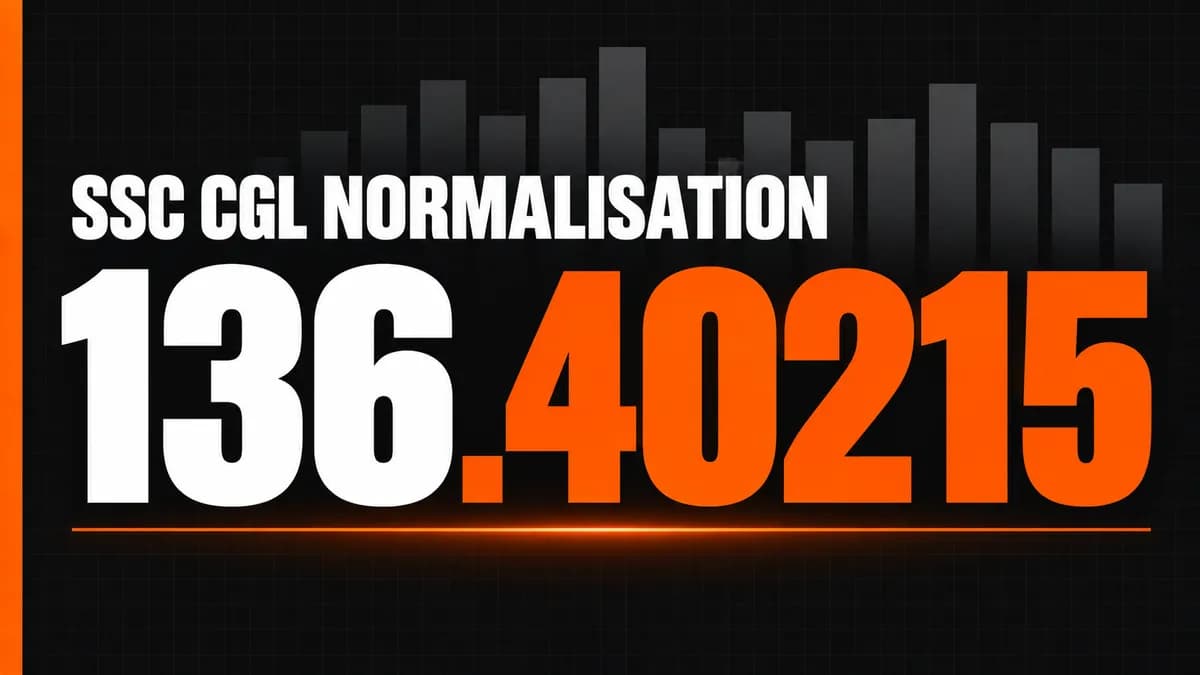
And yet 136.40215 is exactly the 2025 Tier 1 UR cut off for the all-other-posts list. A raw score can never produce that figure. Only a normalised score can. Those five decimal places are not decoration, and they are not SSC being fussy. They are the fingerprint of the conversion.
Any page that quotes you an SSC CGL Tier 1 cut off as a clean round number has either rounded it off or copied it wrong. The real numbers look like the table further down.
Raw score versus normalised score
These two numbers get mixed up constantly in coaching WhatsApp groups every December. They are not the same thing and they are not produced at the same stage.
Notice the fourth row. Raw marks are perfectly real, they are just not a shared currency. Two candidates with an identical raw 140 from different shifts can finish with different normalised scores, and one may be in while the other is out.
Why your answer key total never matches your result
The sequence every year goes like this. SSC releases the tentative Answer Key with your response sheet. You sit with a calculator, count your correct and wrong attempts, apply the 0.50 penalty, and arrive at, say, 142. You screenshot it. You tell your family. Then the result PDF arrives and shows something like 138.67412, and you assume a mistake has been made.
No mistake. The 142 was your raw score and it was probably correct. The 138.67412 is that same performance re-expressed on the common scale, and the difference between the two numbers is what SSC calculated your shift's relative difficulty to be. If your shift was on the easier side, the normalised number drops below the raw. If your paper was a beast, the normalised number can land above your raw score.
This is also why the gap is not the same for everyone. Your friend in the same category, same day, different shift may see their raw score barely move while yours shifts by four marks. Different shift, different statistics.
Two practical consequences. First, do not treat your Answer Key calculation as a result. Treat it as a range. Second, if you are within about five marks of last year's cut off on raw marks, you genuinely do not know your position yet, and no aggregator can tell you either. Our verified SSC CGL Tier 1 cut off tool keeps the published normalised figures year by year, which is a better reference point than a screenshot of somebody's calculator.
When normalisation applies, and when it does not
Normalisation is not sprinkled over everything SSC does. It applies to an objective Computer Based Examination conducted in more than one shift, which Tier 1 2026 clearly is, given the 30 September to 30 October spread.
What it does not touch matters just as much.
- It does not change the qualifying marks. Those are a fixed percentage threshold: 30% for UR, 25% for OBC and EWS, 20% for every other category. A percentage of the paper total is a rule, not a statistic, and it does not move shift to shift.
- It does not turn a wrong answer into a right one. Normalisation adjusts the scale, not your accuracy. A shift-wide correction cannot rescue 30 careless mistakes.
- It does not apply where there is only one shift. If a paper is held in a single sitting for everyone, everyone already has the same paper.
- It has nothing to do with document verification, the Data Entry Speed Test as a qualifying requirement, or post preference allocation.
Keep the qualifying marks and the cut off in separate compartments in your head. Qualifying marks are the floor you must clear to be considered at all. The cut off is the score of the last candidate who actually made the list, and it sits far above that floor. Plenty of blogs print one under a heading meant for the other.
Three merit lists means three normalised cut offs
Here is where most candidates get misinformed. There is no single "SSC CGL Tier 1 cut off". SSC publishes three separate lists, each with its own normalised cut off and its own qualified count.
List-3 is the one that applies to the overwhelming majority of candidates, and it is the number people mean when they say "the Tier 1 cut off". Yet a striking number of websites print the JSO figure of 153.46 as the general cut off, which will scare a perfectly safe candidate into thinking they failed.
Note also that the JSO and SI Gr-II lists are drawn from a much smaller eligible pool, since JSO needs 12th with Maths at 60% or graduation with Statistics, and Statistical Investigator Gr-II needs Statistics in every year or semester of graduation. Smaller pool, higher cut off, separate normalised list.
What normalised cut offs actually look like
This is the List-3 table, all other posts, across three cycles. Read the decimals.
Every cell carries five decimals. Every cell is a normalised figure. The 2025 List-3 qualified count was 1,31,027 in the revised list, against 1,65,240 in 2024, and the revision that year corrected a display error in the cut-off table without changing who qualified.
Look down the UR column and you will see the 2025 number sitting almost 17 marks below 2024. That is not a formula change. Cut offs move with vacancy count, applicant count and how the paper behaved that year, and this is exactly why chasing a target score copied from an older cycle is a poor plan. If you want to understand what feeds those swings, our SSC CGL previous year papers breakdown is more useful than any prediction thread.
A 31-day spread: does a late exam date help you?
This is the question that fills every aspirant group the moment the schedule notice lands, and it deserves a straight answer rather than reassurance.
Yes, a candidate assigned 30 October has roughly a month more preparation time than a candidate assigned 30 September. That is a real difference and normalisation does not fix it, because normalisation compares papers, not preparation. It corrects for the difficulty of the question set you received. It cannot correct for the calendar.
But do not overstate it either. The late candidate carries a month of extra nerves, a month of watching shift reviews from people who have already written, and a paper that SSC may well have pitched differently after seeing early shifts. And if the later shifts do turn out easier overall, normalisation pulls those scores down, which is precisely the correction it exists to make.
The practical reading: treat your date as fixed from the moment the SSC CGL Admit Card gives it to you, and plan backwards from it. The city intimation slip is expected around 22 September 2026 and the Admit Card around 27 September 2026, or two to four days before each candidate's exam date region-wise, though SSC has not given a firm date for either. Until then, prepare as though you are in the first week.
One more thing the 2026 cycle changes. Each of the four Tier 1 sections now has its own 15-minute timer, so 4 x 15 gives you the 60 minutes, and a closed section stays closed with no carry-over of unused time. That reshapes which raw score is even achievable for you, which then feeds into the normalised one. The full structure is laid out in our SSC CGL exam pattern guide, and you should confirm the sectional timing detail in the Scheme of Examination annexure on ssc.gov.in.
What SSC has not told us yet
Being straight about the gaps is more useful than filling them in.
SSC has released the Tier 1 schedule notice but has not yet released the date-wise, shift-wise or candidate-wise schedule. Shift timings are not in the official notice either. The exact normalisation formula sits in its own notice on ssc.gov.in, and you should read it there rather than trust a paraphrase, including this one. Tier 2 remains tentative for December 2026 with no separate notice yet, and while SSC has introduced sectional timing in Tier 2 as well, the exact per-section minutes are not confirmed by any source.
What to actually do with all this
Stop trying to predict your normalised score. You cannot, and neither can anyone selling you a predictor.
Aim instead for a raw score comfortably clear of the band where normalisation decides your fate. If the UR List-3 cut off has ranged from roughly 136 to 153 across the last three cycles, then a raw score parked around 150 puts you out of the zone where a two-mark shift adjustment matters. That is a far calmer place to sit than 138.
Accuracy earns you more than speed here, because the 0.50 penalty eats attempts at both the raw and the normalised stage. Practise in timed shifts so a 15-minute section feels ordinary rather than alarming. A full-length SSC CGL Tier 1 mock test under the new sectional timing tells you more in 60 minutes than a week of topic-wise revision. And since Tier 1 is qualifying only, with the final merit decided at Tier 2, treat Tier 1 as a gate to clear cleanly and keep an eye on the SSC CGL Tier 2 preparation that actually decides your posting.
Everything else on this cycle, from vacancy distribution to post-wise eligibility, sits on our SSC CGL hub page.
FAQs on SSC CGL normalisation
Why is the SSC CGL cut off written with five decimal places?
Because it is a normalised score, not a raw one. Tier 1 raw marks can only land on multiples of 0.5 given the 2-mark questions and the 0.50 penalty, so a figure like 136.40215 can only come out of the normalisation process. The decimals are the clearest evidence that normalisation was applied.
Does normalisation increase or decrease my marks?
Either, depending on how your shift performed overall. If your shift's paper was on the harder side, your normalised score can end up above your raw score. If your shift was easier, it typically comes down. There is no fixed direction and no fixed size of adjustment.
Will normalisation apply to SSC CGL Tier 1 2026?
Tier 1 2026 runs from 30 September to 30 October 2026 in multiple shifts across many days, which is exactly the situation normalisation exists for. Read the formula notice on ssc.gov.in for the official method, since this page does not state the formula.
Why does my answer key calculation not match my result?
Your Answer Key calculation gives you a raw score. Your result shows a normalised score. The two are meant to differ, and the gap reflects your shift's statistics. Nothing has gone wrong with your evaluation.
Is there one Tier 1 cut off for SSC CGL?
No. SSC publishes three lists: List-1 for Junior Statistical Officer, List-2 for Statistical Investigator Grade-II and List-3 for all other posts. Each carries its own normalised cut off. In 2025 the UR figures were 153.46, 152.47 and 136.40215 respectively.
Do candidates with a later exam date get an unfair advantage?
They get more preparation time, and normalisation does not correct for that because it compares papers rather than study weeks. What it does correct is any difficulty gap between the papers themselves, so an easier late shift does not convert into free marks.
Are qualifying marks and the cut off the same thing?
No, and the difference is large. Qualifying marks are a fixed percentage floor, 30% for UR, 25% for OBC and EWS, 20% for other categories. The cut off is the normalised score of the last candidate who made the list, which in 2025 sat at 136.40215 for UR in List-3. Clearing the floor does not mean clearing the cut off.