
RRB NTPC UG Admit Card 2026: City Slip & Exam Date
RRB NTPC UG Admit Card 2026 (June Exam): City Slip, Exam Date & Download Link
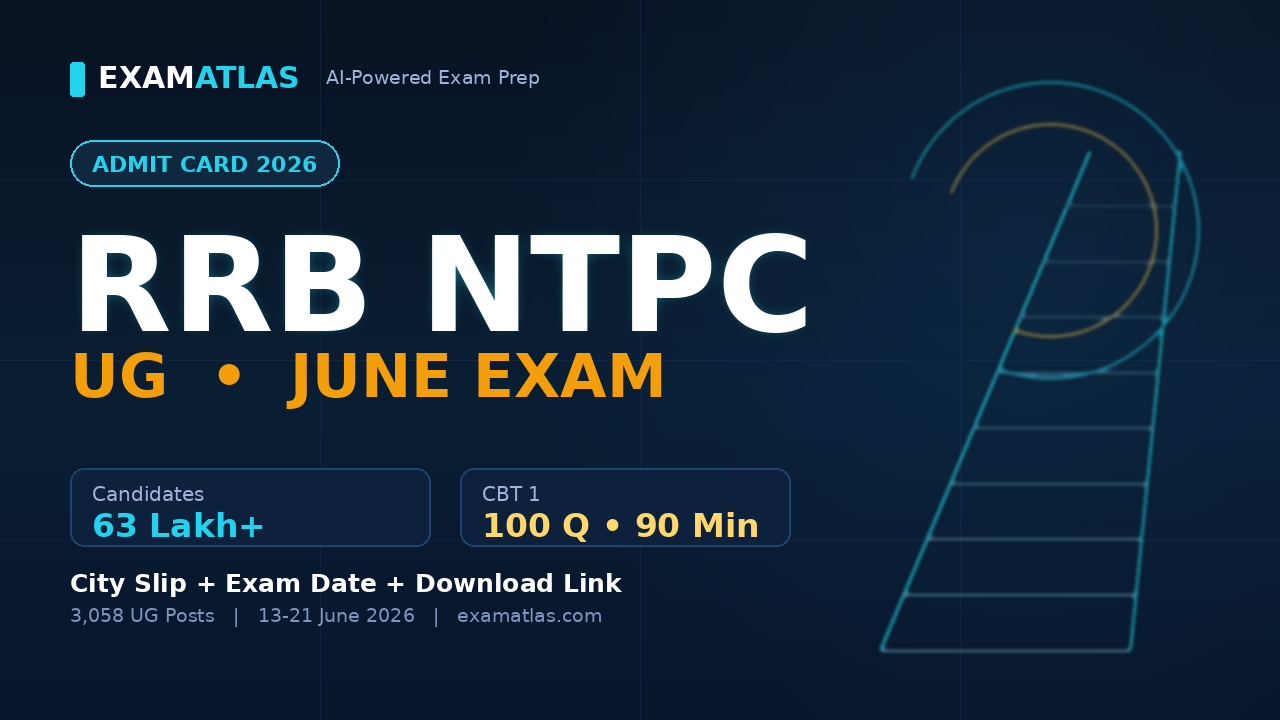
The Railway Recruitment Board has reopened the RRB NTPC UG admit card window for the June 2026 exam phase, and the numbers are staggering: over 63 lakh candidates are appearing for just 3,058 undergraduate-level vacancies under CEN 07/2025. That is roughly 2,000 applicants per seat.
This guide covers everything for the June phase point by point: exam dates, shift timings, how to download your admit card and city slip, exam-day rules, the CBT 1 pattern, expected difficulty based on the May phase, and a tight last-two-week plan.
RRB NTPC UG 2026 Overview
Latest Updates
- The May phase (7, 8, 9 May 2026) of CBT 1 is already over and was rated Easy to Moderate by candidates.
- The June phase runs on 13, 14, 16, 17, 18, 19, 20 and 21 June 2026 across roughly 200 centres.
- Admit cards for the June phase release about 4 days before each candidate's exam date.
- The City Intimation Slip comes out earlier, around 10 days before the exam, so you can plan travel.
- Application was open from 28 October to 4 December 2025. No fresh applications now.
Exam Dates & Shift Timings
How to Download RRB NTPC UG Admit Card 2026
- Go to your regional RRB website or the exam portal at rrb.digialm.com.
- Open the link for RRB NTPC UG (CEN 07/2025) Admit Card.
- Log in with your Registration Number and Date of Birth or password.
- Check your name, roll number, exam date, shift, centre and reporting time carefully.
- Download the e-call letter and take at least two clear printouts.
- If any detail is wrong, contact your RRB immediately, do not wait till exam day.
City Intimation Slip: What It Tells You
- It shows your allotted exam city, exam date and shift, but it is not the admit card.
- Use it to book travel and stay early, since centres can be in another district.
- The full admit card with centre address and reporting time comes 4 days before the exam.
- Do not treat the city slip as entry permission. You still need the printed admit card.
Documents to Carry on Exam Day
- Printed RRB NTPC admit card (e-call letter).
- One original valid photo ID such as Aadhaar, voter ID, PAN, driving licence or passport.
- A recent passport-size photograph, same as uploaded in the form.
- Reach the centre well before the reporting time, as late entry is not allowed.
- Avoid carrying banned items: phones, smartwatches, calculators, books or any electronic device.
RRB NTPC CBT 1 Exam Pattern (UG)
Marking & Key Rules
- Each question carries 1 mark, with 90 minutes for the full paper (120 minutes for PwD).
- 1/3 mark is deducted for every wrong answer. No deduction for unattempted questions.
- CBT 1 is only qualifying and screening in nature.
- The normalised CBT 1 score is used to shortlist around 20 times the vacancies for CBT 2.
- Your final merit depends on CBT 2, not CBT 1, so treat CBT 1 as the gate, not the goal.
Minimum Qualifying Marks
- UR and EWS: 40 percent.
- OBC and SC: 30 percent.
- ST: 25 percent.
- Clearing these is only the first filter. The cut-off for CBT 2 shortlisting is much higher.
Section-Wise Preparation Trends
These are the high-weight areas per the official syllabus and past papers. This is study guidance, not the live paper.
1. General Awareness (40 marks, biggest section)
- Static GK, current affairs of the last six months, Indian Railways facts, basic science, polity and economy basics.
- This is the largest section, so it decides your screening score the most.
- Revise current affairs daily and add a few Railway-specific facts each day.
2. Mathematics (30 marks)
- Number system, percentage, ratio, average, time and work, time-speed-distance, simple and compound interest, mensuration basics.
- Mostly arithmetic, very scoring if your speed is good.
- Drill formulas and shortcut methods till they become reflex.
3. General Intelligence & Reasoning (30 marks)
- Analogy, series, coding-decoding, syllogism, blood relations, direction sense, Venn diagrams, statement-conclusion.
- Predictable and easy to score with daily practice.
- Target near-full accuracy here, since reasoning rarely surprises you.
Expected Difficulty for the June Phase
- The May phase was Easy to Moderate, so expect a similar standard in June.
- General Awareness will likely stay the deciding section between shifts.
- Maths and Reasoning should remain scoring for prepared candidates.
- Do not assume June will be harder. Prepare for the same balanced level and focus on speed.
Normalisation: Why Raw Score Is Not Final
- RRB NTPC runs in many shifts, so RRB normalises marks across sessions.
- If your shift was tougher, normalisation can lift your score slightly.
- If your shift was easier, your score may adjust down a little.
- Stop comparing raw scores with friends in other shifts. The normalised score is what counts.
Selection Process After CBT 1
- CBT 1: qualifying and screening stage, decides who reaches CBT 2.
- CBT 2: the merit-deciding stage, 120 questions for 120 marks.
- Typing Skill Test or CBAT: for specific posts, qualifying in nature.
- Document Verification and Medical: the final gates before appointment.
- The Typing Skill Test needs 30 words per minute in English or 25 in Hindi for typist posts.
Salary & Job Profile (UG Posts)
- UG posts fall mostly under Pay Level 2 and Level 3 of the 7th Pay Commission.
- Basic pay starts around ₹19,900 (Level 2) and ₹21,700 (Level 3).
- In-hand salary lands roughly in the ₹25,000 to ₹35,000 range with allowances.
- Allowances include DA, HRA, transport allowance and railway-specific perks.
- Plus the usual railway benefits: pass facility, medical, pension under NPS and job security.
Last Two-Week Strategy
- Stop new topics. Revise what you already know and fix weak areas.
- Solve at least one full mock daily in the exact 90-minute window.
- Analyse every mock: find the two or three topics quietly losing you marks.
- Lock your section order and time split before exam day, do not decide it live.
- Sleep well the last two nights. A fresh mind beats one extra revision at 2 AM.
Common Mistakes to Avoid
- Treating the city slip as the admit card and reaching unprepared.
- Blind guessing and stacking up 1/3 negative marks.
- Ignoring General Awareness because it feels too broad. It is the biggest section.
- Comparing raw scores across shifts and panicking before normalisation.
- Carrying banned items and risking disqualification at the gate.
Practice & Mock Strategy
Reading about the exam does nothing unless you convert it into timed attempts. Solve previous RRB NTPC CBT 1 papers first, then move to full 90-minute mocks. ExamAtlas has free RRB NTPC-specific mock tests with AI analytics that show your topic-wise accuracy after each attempt, which is exactly how you spot the weak areas before the real exam.
FAQs
When will the RRB NTPC UG admit card 2026 release for the June exam?
The RRB NTPC UG admit card for the June phase releases about 4 days before each candidate's exam date. With exams on 13 to 21 June 2026, admit cards go live from early-to-mid June. The City Intimation Slip comes around 10 days before the exam.
How many questions are in RRB NTPC CBT 1?
RRB NTPC CBT 1 has 100 questions for 100 marks in 90 minutes. The split is General Awareness 40, Mathematics 30, and General Intelligence and Reasoning 30. Each question carries 1 mark, with a 1/3 mark deduction for every wrong answer.
Is RRB NTPC CBT 1 qualifying or scoring?
CBT 1 is only qualifying and screening in nature. The normalised CBT 1 score shortlists candidates for CBT 2, usually around 20 times the vacancies. Your final merit is decided by CBT 2 marks, not CBT 1, so CBT 1 is the gate to the next stage.
What documents do I need for the RRB NTPC exam?
Carry a printed RRB NTPC admit card, one original valid photo ID such as Aadhaar or voter ID, and a recent passport-size photograph. Reach the centre before reporting time and avoid all banned items like phones, smartwatches and calculators.
What is the RRB NTPC UG salary?
UG posts fall mostly under Pay Level 2 and Level 3, with basic pay around ₹19,900 to ₹21,700. The in-hand salary is roughly ₹25,000 to ₹35,000 with allowances like DA, HRA and transport allowance, plus railway perks such as pass facility and medical cover.
How does normalisation work in RRB NTPC?
Because the exam runs in many shifts, RRB normalises raw scores to balance easier and tougher sessions. A tougher shift can see scores adjusted slightly up, an easier one slightly down. The normalised score, not the raw score, is used for shortlisting and merit.
Final Word
With over 63 lakh candidates fighting for 3,058 UG seats, RRB NTPC is one of the most competitive races this year. CBT 1 is only the gate, but missing it on a careless error, a wrong centre, or a banned item at the door ends the journey before it starts.
If your exam is in the June phase, spend these days on timed mocks and General Awareness revision rather than new theory. Try the free RRB NTPC daily quiz on ExamAtlas to keep your current affairs sharp right up to exam day.