
BPSC TRE 4.0 Syllabus 2026: Subject-wise Breakdown, Exam Pattern and PDF
BPSC TRE 4.0 Syllabus 2026: Subject-wise Breakdown, Exam Pattern and PDF
The official TRE 4.0 syllabus drops with the detailed notification, which is still awaited. The good news is that BPSC has kept its teacher syllabus broadly stable across TRE 1.0 to 3.0, so you can start preparing today on the established structure with high confidence.
This guide lays out the section-wise syllabus, the marks split, the best books, and a level-wise plan. Cross-check the final topics against the official syllabus once the notification is out, but the core below rarely changes between phases.
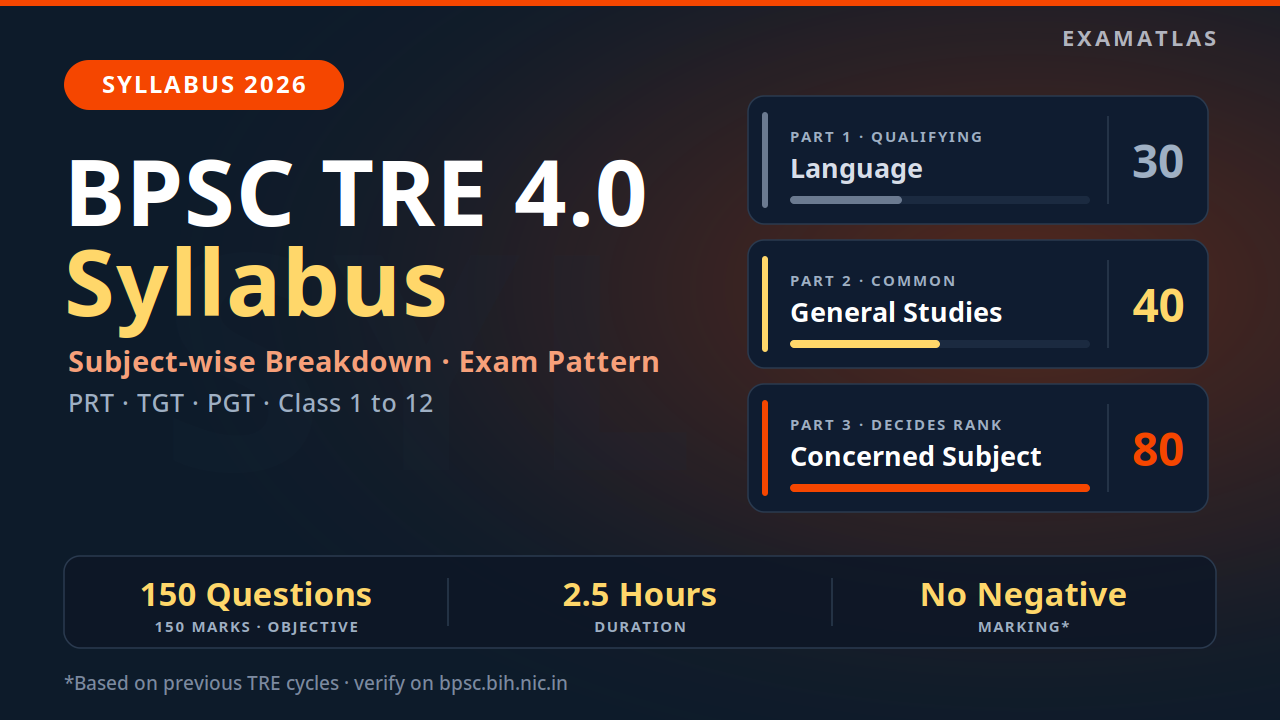
BPSC TRE 4.0 syllabus at a glance
How the syllabus is structured
Every TRE paper, whatever the level, is built on the same three blocks.
- Part I Language (qualifying): English compulsory, plus one regional language from Hindi, Urdu or Bangla.
- Part II General Studies (common to all): the shared knowledge base, identical for every candidate.
- Part III Concerned Subject: your teaching subject, pitched at your post level.
The trick most toppers understand: Language only needs a pass, but General Studies and your Subject decide the merit list. Spend your hours where the marks actually are.
Part I: Language syllabus (qualifying)
The language section checks whether you can teach in the classroom language. English is compulsory for everyone, and you pick one more from Hindi, Urdu or Bangla.
- Reading comprehension from unseen passages.
- Grammar: tense, voice, narration, parts of speech.
- Vocabulary, synonyms and antonyms, sentence correction.
- Basics of language-development pedagogy.
You need roughly 30% to qualify. Do not over-invest here, but do not skip it either, because failing the qualifying part cancels your entire paper.
Part II: General Studies syllabus (the scoring section)
General Studies is common for all posts and stays the same whether you teach Class 5 or Class 12. This is your highest-return section, so treat it as a priority.
For primary-level aspirants (Classes 1-5), General Studies leans more on Child Development and Pedagogy and Environmental Studies, in a pattern close to CTET. Build that base if the primary level is your target.
Part III: Concerned subject (this decides your rank)
This is the section that wins or loses your posting, since subject marks carry the most weight. Depth scales with the level you apply for:
- PRT (1-5): foundational subject knowledge with Child Development and Pedagogy.
- Middle (6-8): subject at upper-primary standard.
- TGT (9-10): subject at Class 9-10 standard.
- PGT (11-12): subject at graduation and post-graduation depth.
A quick example from the Science stream: TGT Science expects Class 9-10 Physics, Chemistry and Biology such as motion, force, atoms, acids and bases, and life processes, while PGT Physics climbs to electrostatics, thermodynamics, optics and modern physics. Study to the standard your post demands, never below it.
Subject-wise focus for TGT and PGT
For Classes 9 to 12, the subject paper is your real battleground. A quick map of what the main subjects demand:
- Mathematics: algebra, trigonometry, geometry and statistics, and for PGT, calculus, matrices and probability.
- Science: motion, force, light, atomic structure and life processes at TGT level, rising to thermodynamics, organic chemistry, genetics and modern physics for PGT.
- Social Science: Indian and world history, Indian and physical geography, Indian polity, and basic economics.
- Languages (Hindi, English, Sanskrit, Urdu): grammar, prose and poetry, literature, and language pedagogy.
Match this to the NCERT and graduation textbooks for your subject. The exam stays close to the prescribed curriculum, so chasing exotic sources only wastes your time.
Primary level (Classes 1-5): how it differs
The primary paper is not a shrunken version of the secondary one. It follows a foundation-teaching design closer to CTET, with five focus areas:
- Language (Hindi, Urdu or Bangla, with English).
- Elementary Mathematics.
- Environmental Studies (EVS).
- Child Development and Pedagogy.
- General Knowledge, including Bihar GK and current affairs.
If you are eyeing the primary level, treat Child Development and Pedagogy as a scoring subject, not an afterthought. It is the section most primary aspirants underrate, and the easiest place to gain a clean ten marks.
Is the TRE 4.0 syllabus changing?
Short answer: no major change is expected. BPSC has run the same three-part structure since TRE 1.0, and the commission has signalled no overhaul for 4.0. Small additions to current affairs and Bihar GK happen every cycle, simply because the news keeps moving.
The one area worth watching is the pedagogy weight at the primary level, which has drifted closer to the CTET model under the newer education framework. If you are a PRT aspirant, keep your Child Development concepts current. Beyond that, prepare confidently on the structure above and adjust only if the official syllabus says otherwise.
Section-wise weightage and marking
This is the standard split for Middle, Secondary and Senior Secondary posts. Some earlier TRE papers used a larger 220-mark structure for TGT and PGT, so confirm your exact split in the official syllabus. There is no negative marking based on past cycles, which means you should attempt every question.
Best books for BPSC TRE 4.0
- General Studies: Lucent's General Knowledge plus NCERT Classes 6 to 10.
- History: Spectrum's Modern India for the freedom struggle.
- Bihar GK and current affairs: a monthly compilation, plus the ExamAtlas daily quiz.
- Child Development and Pedagogy: any updated CTET-focused pedagogy guide.
- Subject: your graduation or post-graduation standard textbooks, revised methodically.
Use a tight set of books. Collecting ten guides and finishing none is the most common preparation mistake aspirants make.
Three syllabus mistakes that cost marks
- Treating Language as a merit section and over-preparing it. It only needs a pass.
- Ignoring Bihar GK and current affairs, which are the easiest General Studies marks on the table.
- Studying the subject above or below your post level instead of exactly to it.
Fix these three and your score climbs without learning a single extra chapter.
How to prepare, section by section
- Clear the Language part early so it stops worrying you, then park it.
- Make General Studies a daily habit: one GS topic plus current affairs every day.
- Give your Subject the largest time block, since it decides your rank.
- Revise NCERT and SCERT for your level first, then move to practice questions.
A rough daily split that works for most aspirants: about half your time on the subject, a third on General Studies and current affairs, and the rest on language upkeep. Shift the balance once your subject feels solid.
Reading the syllabus is not the same as scoring under a clock. ExamAtlas has free TRE-specific mock tests with AI analytics that show your topic-wise accuracy, so you can see exactly which General Studies area or subject chapter is dragging your score. Pair this with the full dates and eligibility in our BPSC TRE 4.0 Notification 2026 guide, and the cycle comparison in BPSC TRE 4.0 vs TRE 3.0.
FAQs
Has the official TRE 4.0 syllabus been released?
Not yet. It comes with the detailed notification. The structure in this guide is based on previous TRE cycles and rarely changes between phases.
How many questions are in the TRE 4.0 exam?
150 objective questions for 150 marks in 2 hours 30 minutes, based on the established pattern. The final split is confirmed in the official syllabus.
Is the language section counted in merit?
No. Language is qualifying, so it only needs a pass. Merit is decided by your General Studies and Concerned Subject marks.
Is there negative marking in TRE 4.0?
Based on past cycles, there is no negative marking, so attempt every question. Confirm the final rule in the official notification.
What matters most for primary teachers?
Child Development and Pedagogy, Environmental Studies and Elementary Mathematics, in a pattern close to CTET.
Which section decides selection?
The Concerned Subject paper carries the most weight and decides your final rank, so it deserves your largest study block.
Final word
The TRE 4.0 syllabus is not a mystery. It has stayed steady across phases, so anyone waiting for the notification to begin is simply losing days. Build General Studies and your subject now, keep the language part on a back burner, and convert your reading into timed practice.
Once the official TRE 4.0 syllabus PDF is released on bpsc.bih.nic.in, cross-check the exact topics and the marks split against this guide.