
BPSC TRE 4.0 40% Domicile Rule: Posts for Bihar-Schooled Candidates
BPSC TRE 4.0 40% Domicile Rule: Posts Reserved for Bihar-Schooled Candidates
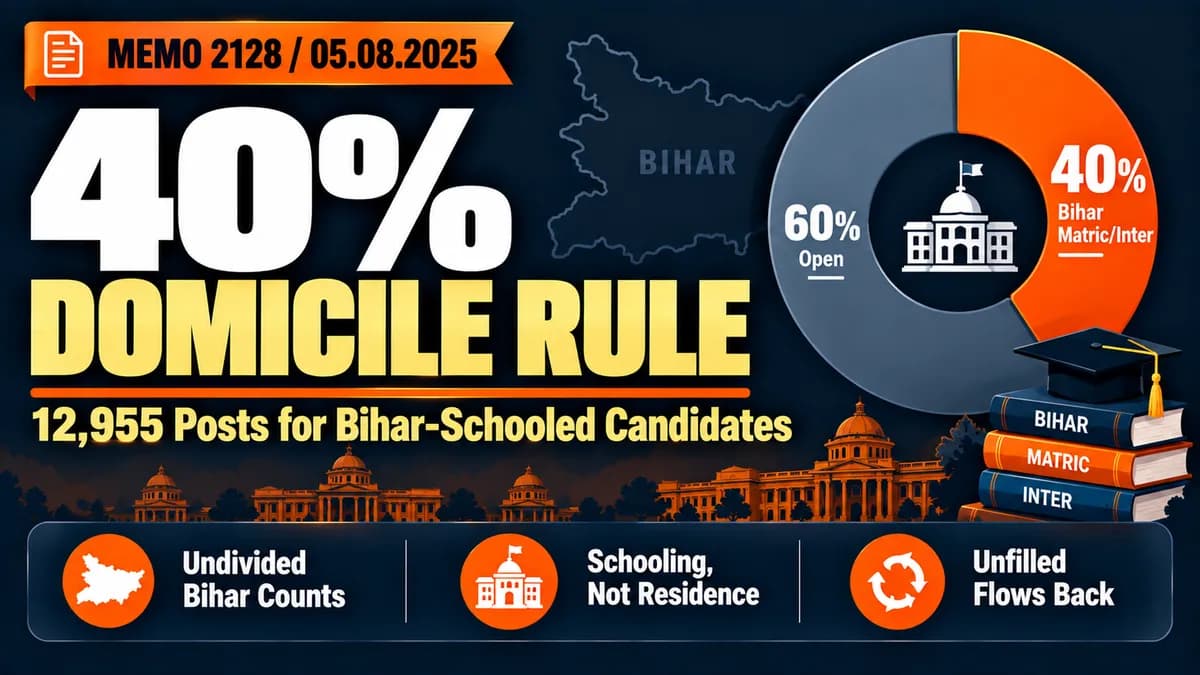
Under Education Department notification memo 2128 dated 05.08.2025, 40% of the total vacancies in BPSC TRE 4.0 will be filled by candidates who passed matriculation or intermediate from an institution located inside Bihar.
On 32,388 posts, that is roughly 12,955 posts tied to where you studied rather than where you were born. It is one of the least discussed rules in this advertisement and one of the most consequential.
What the rule actually says
- 40% of the total vacancies go to candidates who passed matriculation or intermediate from an educational institution situated within Bihar.
- Candidates who passed matriculation or intermediate from undivided Bihar are treated as having passed from Bihar for this purpose.
- If enough eligible candidates are not available against that 40%, the remaining vacancies can be filled from the 60% by eligible candidates of the qualifying categories.
Read the second point carefully. Undivided Bihar includes the territory that became Jharkhand in 2000, so a candidate who passed matriculation from a school in that region before the division is counted as Bihar-passed here.
How the 40% and 60% split works out
These are our arithmetic on the published totals, not figures printed level-wise in the advertisement. The notification states the 40% rule against total vacancies, and the official district-wise, subject-wise and category-wise break-up is published on bpsc.bihar.gov.in.
Domicile and schooling are two different tests
This is where most confusion sits. TRE 4.0 applies two separate conditions that people routinely merge into one.
So a candidate can be a permanent resident of Bihar and still fall outside the 40% share, if she passed matriculation and intermediate from a school in Delhi or Kolkata. And a candidate who studied in Bihar but is not a permanent resident of the state gets the schooling benefit without the reservation benefit.
Our honest reading is that this rule rewards schooling history, not identity, and candidates should check their certificates rather than their assumptions.
Who this helps and who it does not
Candidates in the third row are not shut out. They compete in the remaining 60% share, which is the larger part of the recruitment at roughly 19,433 posts.
Where this rule came from, and why it matters now
Bihar recruitments have carried residence conditions for years, but this one is specific and recent. Memo 2128 dated 05.08.2025 was issued by the Education Department, and Advt 15/2026 carries it into TRE 4.0.
Its practical effect is to protect a share of teaching posts for people who went to school in the state, in a recruitment that is open to candidates from anywhere in the country. Whether you regard that as fair is a policy question this page does not settle. What matters for your application is that the condition is live and is tested on a document you already hold.
It is also worth remembering the counterweight in the same rule: if eligible candidates are not available against the 40%, those posts flow back into the general 60% pool. The share is a floor for Bihar-schooled candidates, not a ceiling for everyone else.
One more residence condition people miss
Reservation is not the only thing tied to permanent residence in this recruitment. The 32% qualifying relaxation for women, the women's horizontal reservation, the 4% PwBD horizontal reservation and the transgender quota are all restricted to permanent residents of Bihar.
Memo 12575 dated 09.07.2025 covers women, memo 8962 dated 21.05.2025 covers benchmark disabled candidates, and letter 10579 dated 15.06.2026 covers transgender candidates listed at entry 47 of the state backward classes list. Freedom fighter kin need the prescribed certificate signed by the District Magistrate of their home district, and a successor identity card is not accepted.
So a candidate's file can end up carrying three different geographies: where they studied, where they permanently reside, and where they currently live and work. Only the first two decide anything here.
What out-of-state candidates should know
Three rules apply to candidates from outside Bihar, and they compound.
- Reservation goes only to permanent residents of Bihar. An out-of-state candidate applies in the unreserved category regardless of category at home.
- All male and female candidates from outside Bihar are assessed at the General category CTET mark of 60%, not the relaxed 55% or 50%.
- EWS cannot be claimed by out-of-state candidates under notification 2622 dated 26.02.2019 and letter 12123 dated 23.06.2023.
Add the 40% schooling rule on top and the field narrows further. That is the honest position, and it is better known before you pay the fee than after, since a cancelled payment is never refunded.
The certificates that prove each claim
The schooling condition is proved by your matriculation and intermediate certificates, which you would be submitting anyway. The matriculation certificate also serves as the proof of date of birth for this recruitment.
Residence-based claims need separate documents, issued by the circle officer or the competent authority.
- SC and ST candidates: caste certificate plus permanent residence certificate.
- BC and EBC candidates: a creamy-layer-free certificate from the revenue or circle officer of their permanent residence area.
- EWS candidates: income and asset certificate in Prapatra-I, valid for one year from issue.
- Married women: caste, residence and creamy-layer-free certificates in the father's name and father's permanent address, not the husband's.
- Transgender candidates: domicile certificate plus a transgender certificate from the competent authority.
Every one of these must be issued on or before 26 October 2026, and the claim must be made inside the online form. A benefit not claimed in the form cannot be added later.
What the rule does not change
The 40% share decides which pool your application competes in. It does not touch the paper or the bar.
You still sit one written objective exam of 150 questions and 150 marks in 2 hours 30 minutes, with five options per question and 1/3 deducted for a wrong answer, for marking Option E and for leaving a question blank. You still need 40% to qualify in the General category, 36.5% for BC, 34% for EBC and 32% for SC, ST, women and PwBD candidates.
Note that EBC figure. It is 34% in Advt 15/2026, although several websites still print BC and EBC at the same 36.5%.
Frequently asked questions
What is the 40% rule in BPSC TRE 4.0?
Under notification 2128 dated 05.08.2025, 40% of the total vacancies go to candidates who passed matriculation or intermediate from an institution located in Bihar.
Does passing from undivided Bihar count?
Yes. Candidates who passed matriculation or intermediate from undivided Bihar are treated as having passed from Bihar for this rule.
I am a Bihar resident but studied outside. Can I still apply?
Yes. You compete in the remaining 60% share, and your reservation benefit still applies if you hold a valid certificate as a permanent resident of Bihar.
What happens if the 40% posts are not filled?
The remaining vacancies can be filled from the 60% share by eligible candidates of the qualifying categories.
Do out-of-state candidates get reservation?
No. Reservation goes only to permanent residents of Bihar, and out-of-state candidates are also assessed at the General category CTET mark of 60%.
Which certificate proves the schooling condition?
Your matriculation and intermediate certificates, which are required for verification in any case.
Check this on your marksheet, not from memory
Pull out your matriculation and intermediate certificates and look at the institution and board printed on them. That single line decides which of the two pools you are competing in, and it is not something the form lets you argue later.
Then confirm your category claim and its certificate before paying, because reservation is given only on the claim made inside the form. The full rule set is in our Advt 15/2026 breakdown, and the qualification clauses in our eligibility page.