
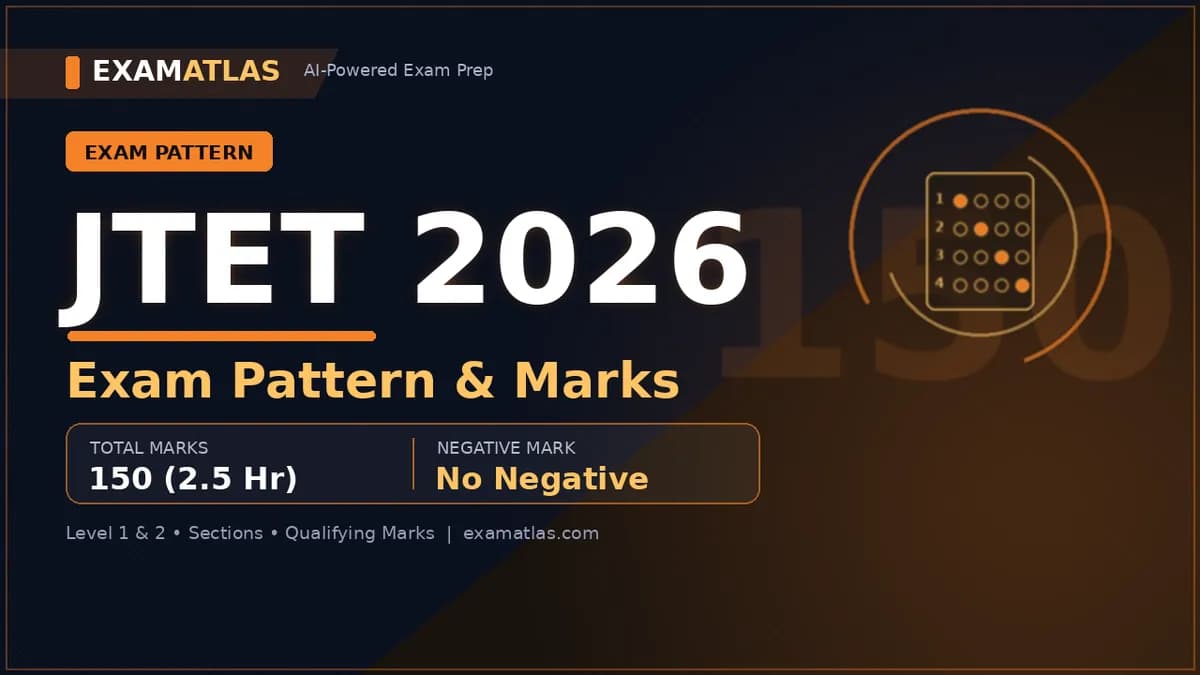
JTET 2026 Exam Pattern: Marks, Sections & Negative Marking
JTET 2026 Exam Pattern: Marks, Sections & Negative Marking Explained
Understanding the JTET 2026 exam pattern is the first real step toward clearing it. The Jharkhand Academic Council (JAC) has kept the structure simple but strict, with one combined paper per level, 150 marks, and a higher passing bar than many other state TET exams.
This guide breaks down the full JTET 2026 pattern, taken straight from the official JAC notification (Advt. 24/2026) and rules, not from secondary sources. We cover the marks split, every section, the duration, the negative marking rule, and the exact qualifying percentages, point by point.
JTET 2026 Pattern at a Glance
The Two Levels of JTET 2026
- Level 1 (Primary): For candidates who want to teach Classes 1 to 5.
- Level 2 (Upper Primary): For candidates who want to teach Classes 6 to 8.
- A candidate can appear for both levels if eligible, by selecting Level 1, Level 2, or both in the form.
- Each level has its own single combined paper, so the two papers are taken separately.
JTET 2026 Level 1 Exam Pattern (Classes 1 to 5)
For Level 1, every section carries equal weight at 30 marks each. There is no single dominant subject, so balanced preparation across all five sections is the smartest approach.
JTET 2026 Level 2 Exam Pattern (Classes 6 to 8)
In Level 2, the fourth block of 60 marks comes from one optional group of your choice:
- Mathematics and Science Teacher: 50 marks of Maths and Science questions plus 10 marks of computer general knowledge.
- Social Studies Teacher: 50 marks of Social Studies questions plus 10 marks of computer general knowledge.
- Language or other teacher: the relevant optional subject, as per the form.
So in Level 2, the first three sections mirror Level 1, but Mathematics and EVS are replaced by a single 60-mark optional group based on the subject you intend to teach.
Negative Marking in JTET 2026
- There is no negative marking in JTET 2026.
- All questions are objective and multiple-choice, answered on an OMR sheet.
- Because nothing is deducted for a wrong answer, you should attempt every single question and never leave a bubble blank.
- Marks are only awarded when the OMR bubble is filled fully in black or blue as per the instructions. A half-filled or unclear bubble will not be evaluated.
JTET 2026 Qualifying Marks
- A General or EWS candidate needs at least 90 marks out of 150 to qualify.
- A BC-1 or BC-2 candidate needs about 83 marks, and an SC, ST, PVGT or Divyang candidate needs about 78 marks.
- SC, ST, PVGT, BC-1, BC-2 and Divyang candidates also get a 5 percent relaxation in the minimum qualifying marks as per their training session rules.
Jharkhand's qualifying bar is higher than the common 60 and 55 percent split seen elsewhere, so do not aim for a bare pass. Target comfortably above the cut-off.
JTET 2026 Difficulty Level
- Level 1 questions follow the state-approved syllabus for Classes 1 to 5, with difficulty at the Secondary or Matric level.
- Level 2 questions follow the Classes 6 to 8 syllabus, with difficulty at the Higher Secondary or +2 level.
- Candidates are expected to know the relevant language and its grammar well enough to express themselves correctly.
- So while the content is school level, the difficulty sits a notch above it, which is why steady revision matters.
Duration, Medium & Special Provisions
- Each level's paper runs for 2 hours 30 minutes.
- Question papers are set in both Hindi and English, and the medium is Hindi or English. Other language subjects appear in the respective language.
- Visually impaired, Cerebral Palsy and both-hand Divyang candidates get 30 minutes of extra time and a Scribe facility.
- There is no re-evaluation or re-checking of the OMR sheet after the result is published.
How to Use the Pattern in Your Preparation
- Make Child Development and Pedagogy your strongest area. It carries 30 marks at both levels and is the most scoring, formula-free section.
- Lock your two languages early. Language I and Language II together carry 60 marks, so choosing comfortable languages is a big advantage.
- For Level 1, do not neglect Maths and EVS. Each is 30 marks, so weakness in one section can pull down your whole score.
- For Level 2, pick your optional group honestly. Choose the group that matches your real subject strength, since it is a full 60 marks.
- Practice full 2 hour 30 minute mocks. With 150 questions, time management and accuracy decide whether you clear the high cut-off.
Mock Test & Practice Strategy
Since JTET has no negative marking, your goal is maximum attempts with maximum accuracy. Practice exactly in the 150-question, 2 hour 30 minute format so the real exam feels familiar. ExamAtlas has free JTET-specific practice sets for both levels in Hindi and English, with AI analytics that show your section-wise accuracy and time per question, which is exactly how you spot weak areas before the real paper.
FAQs
What is the JTET 2026 exam pattern?
Each JTET level has one combined paper of 150 questions for 150 marks, with a duration of 2 hours 30 minutes. The paper is objective and OMR based with no negative marking. Level 1 has five sections of 30 marks each, while Level 2 replaces Maths and EVS with a 60-mark optional group.
Is there negative marking in JTET 2026?
No, there is no negative marking in JTET 2026. Since nothing is deducted for a wrong answer, you should attempt every question. Just make sure each OMR bubble is filled fully in black or blue, as half-filled or unclear bubbles are not evaluated.
How many marks are needed to pass JTET 2026?
You need 60 percent for General and EWS, which is 90 marks out of 150; 55 percent for Backward Class 1 and 2, about 83 marks; and 52 percent for SC, ST, PVGT and Divyang, about 78 marks. These reserved categories also get a 5 percent relaxation as per their rules.
What is the difference between JTET Level 1 and Level 2 pattern?
Both have 150 marks. Level 1 has Child Development, two languages, Mathematics and EVS, each 30 marks. Level 2 keeps Child Development and the two languages, but replaces Maths and EVS with a single 60-mark optional group such as Maths and Science, or Social Studies, based on what you will teach.
What is the duration of the JTET 2026 exam?
The duration is 2 hours 30 minutes for each level. Visually impaired, Cerebral Palsy and both-hand Divyang candidates receive 30 minutes of extra time along with a Scribe facility, as specified in the official notification.
Is JTET 2026 conducted in Hindi or English?
The JTET 2026 question papers are set in both Hindi and English, and the medium of the exam is Hindi or English. Questions for other language subjects appear in the respective language, so you can attempt in the language you are most comfortable with.
Final Word
The JTET 2026 pattern rewards balanced, accurate preparation. With 150 marks, no negative marking, and a high 52 to 60 percent qualifying bar, the candidates who clear it are the ones who attempt every question and stay strong across Child Development, languages, and their core subjects.
Lock your section strategy now, then move to full-pattern practice. Try the free JTET daily quiz on ExamAtlas to keep Child Development and Pedagogy sharp and to track your accuracy right up to exam day.