SSC MTS and Havaldar 2026: Complete Guide to Vacancy, Dates, Pattern and Preparation
SSC MTS and Havaldar 2026: Complete Guide to Vacancy, Dates, Pattern and Preparation
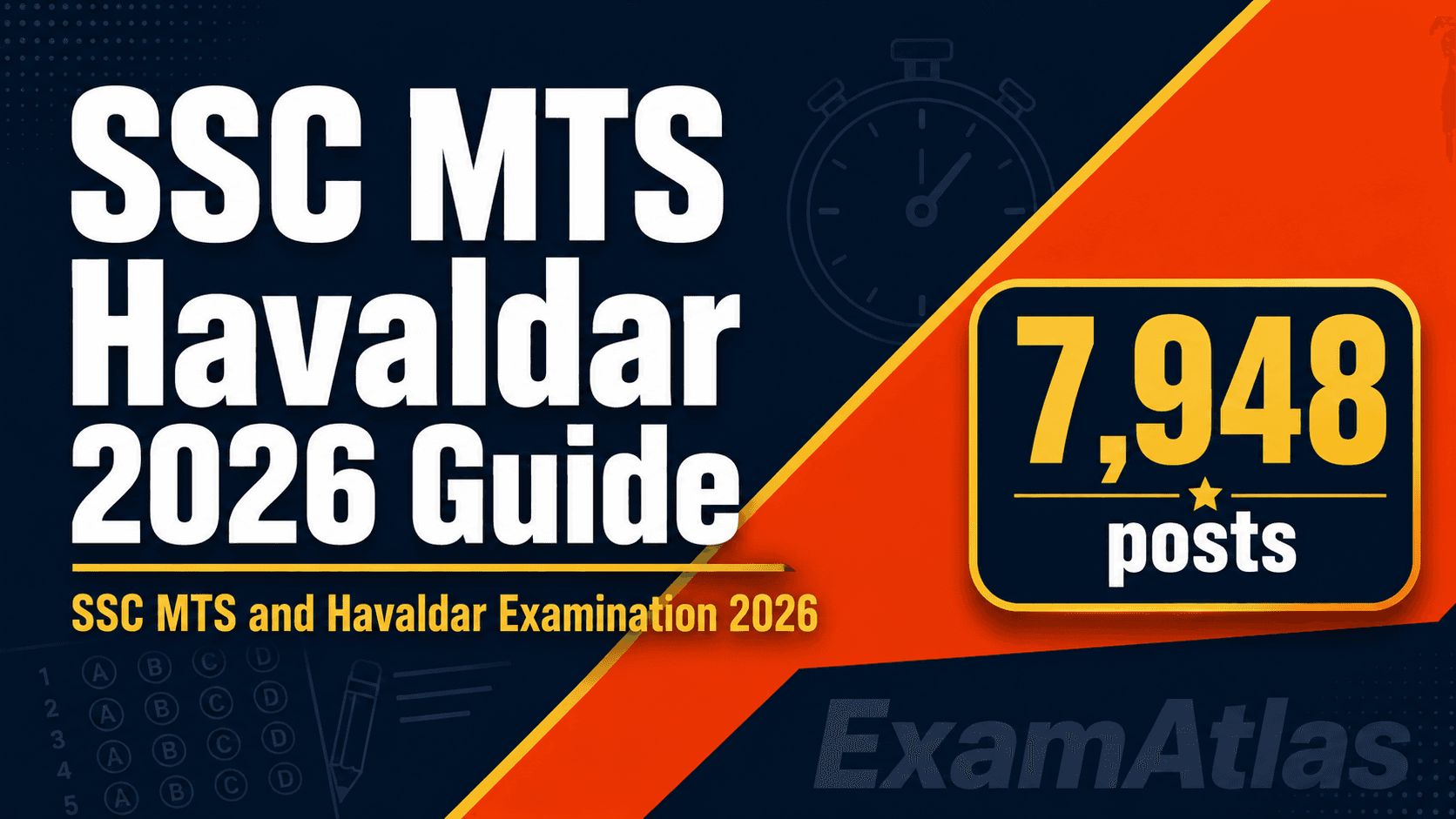
SSC MTS and Havaldar 2026 is the biggest matriculation-level Group-C recruitment the Staff Selection Commission runs. The Commission advertised 7,948 posts in this cycle, split into 6,810 Multi Tasking Staff vacancies and 1,138 Havaldar posts in CBIC and CBN. The application window ran from 30 June 2026 to 31 July 2026, and the computer based exam sits inside a September to November 2026 window. Exact shift dates reach you only through the exam city slip and then the admit card.
This guide gives you what the notification says, section by section, with every figure dated so you can check it against the official PDF on ssc.gov.in yourself. You get the vacancy split, the age bar that differs between MTS and Havaldar, the two-session 270-mark paper, PET and PST standards, and a study plan sized to the weeks you have left. Where a number is still tentative, it is marked as tentative instead of being dressed up as confirmed.
SSC MTS and Havaldar 2026 at a glance
Important dates you should track
SSC publishes three separate things before an exam: the tentative month window, the exam city intimation slip, and the admit card. Most candidates confuse the first with the third and then panic when no admit card appears in September. Keep the table below and check your SSC dashboard weekly rather than daily.
Honest caveat: as on 29 August 2026 the Commission has published a September to November window rather than a fixed date sheet for MTS and Havaldar. Treat any single date circulating on social media as unverified until it appears on ssc.gov.in.
Eligibility: who can apply
Age limit
The age bar is the one place where MTS and Havaldar part ways, and a lot of candidates apply for the wrong post because of it. For MTS the range is 18 to 25 years. For Havaldar in CBIC and CBN the upper limit stretches to 27 years. Age is reckoned as on the cut-off date printed in the notification, not as on the exam day.
- SC and ST: 5 years of relaxation
- OBC (non-creamy layer): 3 years of relaxation
- PwBD (Unreserved): 10 years, with the usual additions for PwBD candidates who are also SC, ST or OBC
- Ex-servicemen: relaxation as per the rules quoted in the notification
Educational qualification
You need to have passed Matriculation or Class 10 from a recognised board. SSC sets no minimum percentage for either post, so a pass certificate is enough. The qualification must be complete by the cut-off date given in the notification; a result awaited candidate is not eligible.
Nationality and physical requirement
The post is open to Indian citizens and to the other categories SSC lists, such as subjects of Nepal and Bhutan, subject to the eligibility certificate rules. Havaldar carries an extra layer: a Physical Efficiency Test and a Physical Standard Test that MTS candidates do not face. If you are borderline on height or chest, apply for MTS rather than gambling on Havaldar.
Application fee
Fee is paid online through BHIM UPI, net banking, or a debit or credit card. SSC does not refund the fee for a withdrawn or rejected application, so a wrong category entry costs you both the money and the seat.
Exam pattern: two sessions, 270 marks
The MTS paper is a single computer based exam split into two sessions that you attempt back to back on the same day. Session I is scoring and forgiving. Session II is where the paper is actually decided, because it is longer, heavier and carries negative marking.
Two consequences follow from that table. In Session I you should attempt every single question, because a blank and a wrong answer cost you the same nothing. In Session II a wild guess is a real loss of 4 marks against a correct answer worth 3, so guess only when you have cut the options down to two.
Both sessions are compulsory. Skipping Session II does not just cost you marks, it can make your candidature invalid. Confirm the exact section-wise split from the notification PDF before your final revision, since SSC has revised MTS marking more than once in recent cycles.
Syllabus break-up section by section
Numerical and Mathematical Ability
This is Class 10 arithmetic with almost no algebra-heavy surprises. Percentage, ratio, average, profit and loss, simple and compound interest, time and work, time speed distance, and basic mensuration cover the bulk of the 20 questions. Number system and simplification questions are usually the fastest marks on the paper.
- Number system, LCM and HCF, simplification, decimals and fractions
- Percentage, ratio and proportion, average, partnership
- Profit and loss, discount, simple and compound interest
- Time and work, pipes and cisterns, time speed and distance
- Mensuration of squares, triangles, circles, cylinders and cubes
- Basic data interpretation from a bar chart or pie chart
Reasoning Ability and Problem Solving
The reasoning section rewards pattern recognition more than heavy logic. Series, analogy, odd one out, coding decoding and non-verbal figure questions repeat with small variations every cycle. Practise these with a stopwatch, because a 20-question section in a 45-minute shared window leaves you under a minute per item once maths is accounted for.
- Number and alphabet series, analogy, classification
- Coding decoding, direction sense, blood relations
- Order and ranking, seating arrangement of the simple linear type
- Mirror and water images, embedded figures, paper folding and cutting
- Venn diagrams, syllogism, matrix based questions
General Awareness
This is the section that separates a 200-plus score from an average one. SSC keeps MTS General Awareness broad and shallow: static history, geography, polity, general science, plus current affairs of roughly the last 8 to 10 months. Reading one daily current affairs digest and revising it weekly beats reading three sources once.
- Indian history: ancient, medieval and the freedom struggle
- Geography: Indian physical features, rivers, soils, world basics
- Polity: Constitution, fundamental rights, Parliament, key articles
- Economy: budget terms, banking basics, government schemes
- General science: everyday physics, chemistry and biology at Class 10 level
- Current affairs: awards, sports, appointments, defence, summits
English Language and Comprehension
Vocabulary and grammar carry this section, not literature. Spotting errors, fill in the blanks, synonyms and antonyms, one word substitution, idioms, and a short reading comprehension passage make up almost the whole paper. A daily habit of 10 new words with usage sentences is worth more than a grammar book you never finish.
- Spot the error, sentence improvement, sentence rearrangement
- Fill in the blanks, cloze test
- Synonyms, antonyms, spelling correction
- One word substitution, idioms and phrases
- Active and passive voice, direct and indirect speech
- Reading comprehension of one short passage
Selection process step by step
- Computer Based Examination with Session I and Session II on the same day
- Normalisation of scores across shifts and release of the CBE result
- For Havaldar only: Physical Efficiency Test and Physical Standard Test
- Document verification and medical examination as applicable
- Final merit and post allocation based on the CBE score and your preferences
Havaldar PET and PST standards
Relaxations apply to specified categories, commonly 5 cm in height for men and 2.5 cm for women, and 2 kg in weight for women, for the groups named in the notification. PET and PST are qualifying in nature and add no marks to your merit. Start the running practice the week you finish the CBE rather than waiting for the result.
How normalisation changes your score
MTS runs across many shifts over several weeks, and no two shifts are equally difficult. SSC therefore converts your raw score into a normalised score using the formula published in its 2018 notice, and the cut-off is applied to the normalised figure. This is why a friend with a higher raw score can rank below you. The mechanics are worked out with examples in our guide to SSC normalisation and how shift-wise scores are adjusted.
What most SSC MTS guides get wrong
The first mistake is copying last cycle's marking scheme. MTS marking has changed across cycles, and articles that still show a uniform negative marking across both sessions send candidates into Session I attempting half the questions out of fear. In the current pattern Session I has no penalty, so leaving a question blank there is a pure loss.
The second is treating the exam city slip as the admit card. They are different documents released at different times, and the city slip carries no roll number for entry. Candidates who print only the city slip get turned away at the centre.
The third is ignoring how the answer options are handled on screen. SSC's option handling and the fix and float behaviour of the interface surprise first-timers who have only practised on printed papers, and we have written about that in detail in our explainer on the SSC sliding mechanism and fix or float options.
The fourth is assuming MTS and Havaldar are the same recruitment with a different label. They differ in age limit, in physical testing and in department. If you are strong in the written exam but weak physically, MTS is the safer preference, and if you want a uniformed CBIC posting, Havaldar is worth the extra preparation. A comparable posting choice problem shows up in SSC CGL, and the logic of ranking preferences is laid out in our breakdown of SSC CGL post preference and salary.
A prep plan that fits the time you actually have
With the exam window opening in September 2026, most candidates have somewhere between 4 and 12 weeks depending on which shift they draw. The plan below assumes 10 weeks and roughly 4 hours a day. Compress it proportionally if your slip lands early.
Weeks 1 to 4: build the base
Split each day into 90 minutes of maths and reasoning, 60 minutes of General Awareness, and 45 minutes of English. Finish one arithmetic chapter every two days and solve 25 questions on it the same evening. Keep a single notebook for formulas and a second one for the current affairs you actually got wrong.
Weeks 5 to 8: shift to timed practice
Take one full-length mock every third day and two sectional tests on the days in between. The target is not a high score yet, it is a stable attempt pattern: roughly 36 of 40 in Session I and 40 of 50 in Session II with accuracy above 85 percent. Spend twice as long analysing a mock as you spent taking it.
Final 3 weeks: revision and shift simulation
Stop learning new topics. Take mocks at the exact time slot printed on your admit card so your body is alert in that window. Revise the formula notebook every alternate day and run one current affairs revision of the last 8 months in the final week. Two days before the exam, do nothing heavier than a light sectional and a full read of your notes.
Practise on a paper that behaves like the real one
A mock is only useful if it reproduces the two-session structure, the asymmetric negative marking and the shift-wise normalisation you will actually face. Our SSC MTS and Havaldar 2026 mock test series is built on that pattern, with sectional analysis after every attempt. If you are still deciding which SSC exam to target this year, the ExamAtlas SSC exam hub tracks notifications, dates and results across every SSC recruitment in one place.
Frequently asked questions
How many vacancies are there in SSC MTS and Havaldar 2026?
The Commission advertised 7,948 posts, made up of 6,810 MTS vacancies and 1,138 Havaldar vacancies in CBIC and CBN. Vacancy numbers are provisional and SSC can revise them before final allocation.
When will the SSC MTS 2026 exam be held?
The computer based exam is scheduled inside a September to November 2026 window as on 29 August 2026. SSC has not released a fixed date sheet yet, and your exact shift will appear on the exam city slip.
Is there negative marking in SSC MTS 2026?
Session I has no negative marking. Session II deducts 1 mark for every wrong answer against 3 marks for a correct one, so attempt Session I fully and guess selectively in Session II.
What is the age limit for MTS and Havaldar?
MTS accepts candidates aged 18 to 25 years and Havaldar accepts 18 to 27 years, both reckoned as on the cut-off date in the notification. Category relaxations of 5 years for SC and ST and 3 years for OBC apply on top.
Do I need a graduation degree for SSC MTS?
No. A Matriculation or Class 10 pass certificate from a recognised board is the only academic requirement, with no minimum percentage.
Is the Havaldar PET counted in the final merit?
No. PET and PST are qualifying tests only. Your final merit rests on the normalised CBE score, so a strong physical performance cannot make up for a weak written score.
What is the salary of an SSC MTS employee?
MTS and Havaldar are Level-1 posts in the 7th CPC pay matrix, with in-hand pay commonly reported in the range of Rs 18,000 to Rs 22,000 a month depending on city classification and allowances. The exact figure varies with your posting.
Should I prepare for SSC GD Constable alongside MTS?
The General Awareness and reasoning overlap is high, so many candidates run both. If a uniformed role suits you, our SSC GD Constable 2026 guide covers the eligibility and physical standards side by side.
Final word
One point that rarely gets said: MTS is the exam where post preference quietly decides your next ten years. Two candidates with the same normalised score can end up in very different departments and cities purely because one filled preferences carelessly. Read the department list before you rank it, and check the posting reality of CBIC Havaldar against a desk MTS role in your home state.
The written paper is not hard. It is short, fast and unforgiving of hesitation, which is why the candidates who clear it are usually the ones who practised the clock rather than the syllabus. Fix your attempt pattern early, keep the formula notebook thin, and verify every date on ssc.gov.in before you act on it.