BPSC TRE 4.0 Strategy 2026: How to Attack the New 150-Question Single Paper
BPSC TRE 4.0 Strategy 2026: How to Attack the New 150-Question Single Paper
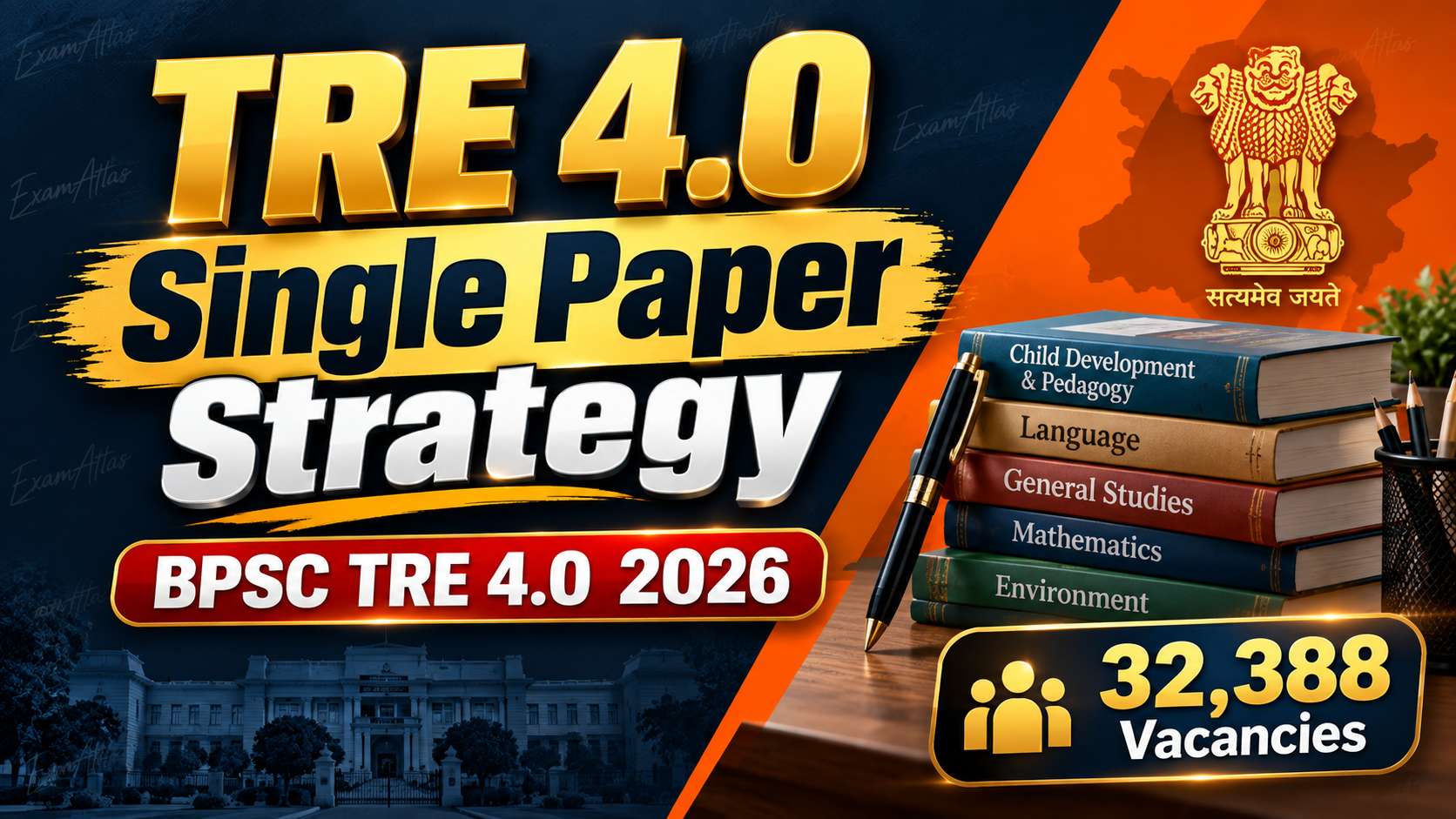
On 27 August 2026 the Bihar government scrapped the TRE 4.0 Prelims. What is left is one paper, 150 questions, 150 minutes, and 32,388 posts riding on it. Most aspirants read that news and panicked about the syllabus they had already covered.
They should not have. Here is the part almost nobody has said out loud: the paper you are going to be ranked on has not changed by a single question. Only the gate standing in front of it disappeared.
What actually changed, in one line
Until 27 August, TRE 4.0 was a two-stage exam. A 150-question General Studies Prelims that was purely qualifying, then a 150-question Mains split as Language 30, General Studies 40, Subject 80. Total questions faced: 300.
Now there is only the second paper. Same 30 plus 40 plus 80. Same 150 marks. The 150-question GS gate is gone, and with it 150 minutes of exam hall time you no longer have to survive.
We covered the announcement itself, with all five sources and the correction to our own earlier pattern blogs, in BPSC TRE 4.0 ab ek hi exam. This article is the other half: what you do about it from tomorrow morning.
The recruitment at a glance
The paper you will be ranked on has not changed at all
Run the comparison honestly and the panic dissolves.
Every hour you spent on your subject paper is intact. Every hour on the Mains GS 40 is intact. The only preparation that lost its purpose is the wide, shallow, 150-question Prelims GS grind, and even that was never a total waste, because the 40 GS questions that survive are drawn from the same pool.
There is a sting in the tail, and it is worth saying plainly. Those old 150 Prelims GS questions added zero to your rank. The 40 that remain are merit marks. A candidate who treated GS as a box to tick can no longer afford that.
Where your marks actually come from: the 120-mark question
Two sources describe Part I Language as qualifying in nature, with a minimum of 30% required. Biharhelp prints it in Hindi as भाषा (अर्हता). PW states candidates must clear a prescribed minimum in the language section.
If that label holds, your merit is fought over 120 marks, not 150. That single change rewrites every weightage table on the internet right now.
Honest flag: BPSC has published nothing on TRE 4.0 since 18 August. The qualifying label comes from two aggregator readings of the notification, not from a Commission circular we could open. Treat 66.67% as the working number and re-check it against the revised Advt 14/2026 the day it drops.
Either way the direction is the same. Under the old 300-question exam your subject paper was 26.67% of everything you sat. It is now at least 53.33%, and probably 66.67% of what decides your rank. That is a doubling at minimum.
Class 1-5 is a different exam wearing the same name
Here the sources split, and the split matters more than any single number in this article.
Two portals (indgovtjobs, freejobalert) apply the 30 plus 40 plus 80 shape to all four levels. Two others (PW, and biharhelp on its 2 September update) give Class 1-5 a completely different paper: Language 30, General Studies 120, no subject section at all.
Two against two. When we wrote the pattern-change piece this morning it was three against one, so the balance moved inside a single day.
For a primary candidate, General Studies would carry exactly 3.0 times the merit weight it carries for anyone else. Our advice has not changed since this morning: prepare for 30 plus 120.
The reason is asymmetric risk, not source-counting. A primary teacher's "concerned subject" is Maths, EVS and language at Class 5 level, which is already sitting inside the General Studies syllabus. Study for 120 GS questions and you are covered if the paper turns out to be 40 plus 80. Study for 40 plus 80 and a 120-question GS paper will bury you.
Language is 30 questions and you need exactly 9
Thirty percent of 30 marks is 9 marks. That is the entire job of Part I.
Nine clean correct answers out of 30 clears it. If you attempt loosely, the 1/3 penalty starts eating: 10 correct with 3 wrong also lands on exactly 9.00, and 12 correct with 9 wrong also lands on 9.00. Notice what that means. Reckless attempting can burn three extra correct answers and leave you in the same place.
Language sits first in the booklet, which is why candidates lose fifteen extra minutes there feeling productive. Reading comprehension, tenses, articles, voice, narration, synonyms, antonyms, one-word substitutions for English, and grammar plus an unseen passage for Hindi, Urdu or Bangla. That is a school-level bar and it deserves school-level effort.
Our opinion, stated flatly: if you are scoring above 15 in language mocks, stop preparing language. Those extra marks buy you nothing on the merit list.
The 40 General Studies questions: what to cut
Forty questions cannot be prepared the way 150 were. The old Prelims GS invited breadth. The new GS block punishes it, because 1/3 negative marking now applies to marks that count.
The syllabus stays as advertised: Elementary Mathematics, Mental Ability, General Awareness, General Science, Indian National Movement, and Geography with Environment. Inside that, the arithmetic block is where a Bihar teaching aspirant reliably converts: percentage, profit and loss, interest, time and work, ratio, averages, speed-time-distance, mensuration and basic geometry are all Class 8 to 10 NCERT material you already teach or are training to teach.
Mental ability is the second bankable block. Series, coding-decoding, blood relations, direction sense, syllogism, seating arrangement. No current affairs risk, no memorisation decay.
What to deprioritise, honestly: sprawling current affairs. In a 40-question paper you might see four or five current affairs items, and chasing a year of monthly magazines to secure four questions is a poor trade against the 80 marks sitting in your subject paper. Read one consolidated Bihar plus national compilation and stop.
The 80 subject questions carry two-thirds of your merit
This is the section that decides whether you get a school. Eighty questions, and BPSC anchors them to the SCERT and NCERT curriculum for the level you applied to, not to a graduation syllabus.
That anchoring is the single most misunderstood thing about TRE. A Class 11-12 Physics candidate is not being tested on B.Sc. Physics. The centre of gravity is NCERT Class 11 and 12, with the difficulty pitched slightly above board level and the pedagogy questions drawn from how that content is taught.
So the reading order that works is boring and effective. NCERT for your level first, cover to cover, then SCERT Bihar for the state-specific framing, then previous TRE 1.0, 2.0 and 3.0 subject papers, then standard reference books only for the topics where your accuracy is still below 70%.
Class 11-12 aspirants have the strongest reason of anyone to sit down today. That level alone holds 16,101 of the 32,388 posts, which is 49.71% of the whole recruitment.
Your 150 minutes, budgeted
One hundred and fifty questions in 150 minutes averages exactly 60 seconds per question. Averages are useless in an exam hall, so here is the split we would actually run.
Read the third column again. The subject block is 53.33% of the questions and takes 75.33% of the clock. That imbalance is deliberate and it is correct, because those 80 questions are worth double the GS block in merit terms.
Practise this split, not the average. A mock where you finish language in 12 minutes is worth more than a mock where you score two marks higher and finish it in 25.
Negative marking: when to guess and when to walk away
With four options and a 1/3 penalty, the expected value of a blind guess is exactly zero.
Twenty two-option guesses across the subject paper are worth about 6.67 marks. TRE cut-offs have been decided by smaller gaps than that. The discipline is not "guess bravely" or "never guess", it is knowing which of the three rows you are standing in before your pencil moves.
The qualifying percentages were written for an exam that no longer exists
One set of numbers is circulating widely: General 40%, BC 36.5%, EBC 34%, and 32% for SC, ST, women and PwBD candidates. Biharhelp is the only portal that prints them, and it prints them under the heading for the Prelims.
The Prelims was scrapped on 27 August. Nobody outside BPSC currently knows whether those bars moved to the single paper, and if they did, whether they apply to 150 marks or to the 120 that count.
The safe rule is to aim past the highest cell in that table. Clear 60 out of 150 and no version of the arithmetic can disqualify you. And remember that qualifying was never the real fight anyway. Past cut-offs, which we broke down in TRE 1.0 to 3.0 cut-off history, have sat far above these floors in the crowded subjects.
Two pages ranking right now say 46,595 posts and an exam on 22 September
This one is a public service. Search for the TRE 4.0 exam date today and two well-ranked pages will tell you the exam runs 22 to 27 September 2026 for 46,595 posts.
46,595 is 43.87% higher than the advertised 32,388. It was a February planning number, published six months before the advertisement existed, and both pages have simply never been revised.
The 22 September exam date fails an even simpler test. The application window is expected to open around 21 September. An exam cannot begin the day after the form opens.
If you have been building a countdown around 22 September, delete it. BPSC has announced no exam date at all.
A 28-day block you can repeat until the date arrives
No exam date means no fixed countdown, so build a block you can run twice if you have to. This assumes your NCERTs for your level are already read once. If they are not, double every subject week below.
The last row is the one people skip and it is the one that pays. A full mock is not a scoring exercise, it is a rehearsal of the clock split. ExamAtlas has a free BPSC TRE 4.0 General Studies mock series with topic-wise accuracy analytics, which is the fastest way to find out whether your 40-question GS block is actually costing you 25 minutes or 40. You can start it at BPSC TRE 4.0 GS Mock Test Series.
One note on that series name. It still carries the word "prelims" because it was built before 27 August. The questions are the same GS pool that feeds the 40 merit questions, so treat it as the GS block of your single paper rather than as a separate stage.
Four mistakes that will cost you a school
- Treating the scrapped Prelims as scrapped preparation. The 40 GS questions come from the same syllabus, and they now carry rank instead of nothing.
- Over-preparing language. You need 9 marks out of 30. Anything past a comfortable 15 in mocks is time stolen from your subject paper.
- Studying your subject at graduation level. BPSC anchors the 80 questions to SCERT and NCERT for the level you applied to. A Class 9-10 Science candidate reading a B.Sc. textbook is preparing for the wrong paper.
- Locking your BPSC profile before your details are correct. Six fields freeze permanently at Profile Lock, and that lock happens before you ever see the TRE 4.0 form. Our OTR correction checklist lists all six.
Where these numbers came from
- From BPSC directly: the notification of Advt 14/2026 dated 18 August 2026 and the 32,388 total. The Commission's board carries no TRE 4.0 notice as of today, and no revised advertisement.
- Cross-verified on two or more independent sources: the 30 plus 40 plus 80 structure for Classes 6-8, 9-10 and 11-12; the 150-mark, 2 hour 30 minute paper; the 1/3 negative marking; the level-wise post split of 3,847, 8,563, 3,877 and 16,101, which sums to 32,388 exactly.
- Split two against two, flagged in-article: the Class 1-5 paper shape.
- Single-source, flagged in-article: the category qualifying percentages of 40, 36.5, 34 and 32 percent, which biharhelp prints under a Prelims heading.
- ExamAtlas arithmetic: every percentage and per-question timing here, including 66.67% and 33.33%, the 3.0 times GS weight for Class 1-5, 24 / 37.5 / 84.75 seconds, all three expected values, 6.67 marks from twenty two-option guesses, and 43.87%.
- Not stated by any source, therefore not printed: the TRE 4.0 exam date, the confirmed application window, the revised advertisement's release date, and any expected cut-off for the single paper.
FAQs
Is the BPSC TRE 4.0 Prelims really cancelled?
The Bihar Chief Minister announced on 27 August 2026 that TRE 4.0 will be held in a single stage. Five independent outlets reported it the same day. BPSC itself has not yet published a revised advertisement, so treat it as a confirmed government decision awaiting a Commission document.
Do my Language marks count towards the merit list?
Two sources describe Part I as qualifying, requiring 30% or 9 marks out of 30. If that holds, merit is decided on the remaining 120 marks. Verify it against the revised Advt 14/2026 before relying on it.
How many questions will Class 1-5 candidates face?
Sources are split two against two between 30 plus 40 plus 80 and Language 30 plus General Studies 120. Prepare for the 120-question General Studies version, because that preparation covers you under either pattern.
What is the TRE 4.0 exam date?
BPSC has not announced one. Pages showing 22 to 27 September 2026 are February 2026 pre-notification schedules that also carry the outdated 46,595 vacancy figure.
Should I guess in TRE 4.0 with 1/3 negative marking?
Only after eliminating at least one option. A blind four-option guess has an expected value of exactly zero. Eliminate two options and the guess is worth a third of a mark, which is always worth taking.
Has my subject preparation been wasted by the pattern change?
No. The 80-question subject section is unchanged, and it has gone from 26.67% of the questions you faced to at least 53.33%, and likely 66.67% of the marks that decide your rank. Your subject work is now worth more, not less.
The one line to take away
Read the change as a weight shift rather than a deletion. Your subject paper just became the exam, your GS block became merit instead of a formality, and your language section became a nine-mark formality instead of a real section.
The revised Advt 14/2026 will settle the Class 1-5 shape, the qualifying bars and the exam date in one go. Until it appears, prepare for the version that survives both patterns and check the level-wise syllabus breakdown against your own level before you plan another week.