IBPS PO Mains Reasoning 2026: 40 Questions, 60 Marks, 45 Minutes
IBPS PO Mains Reasoning 2026: 40 Questions, 60 Marks, 45 Minutes
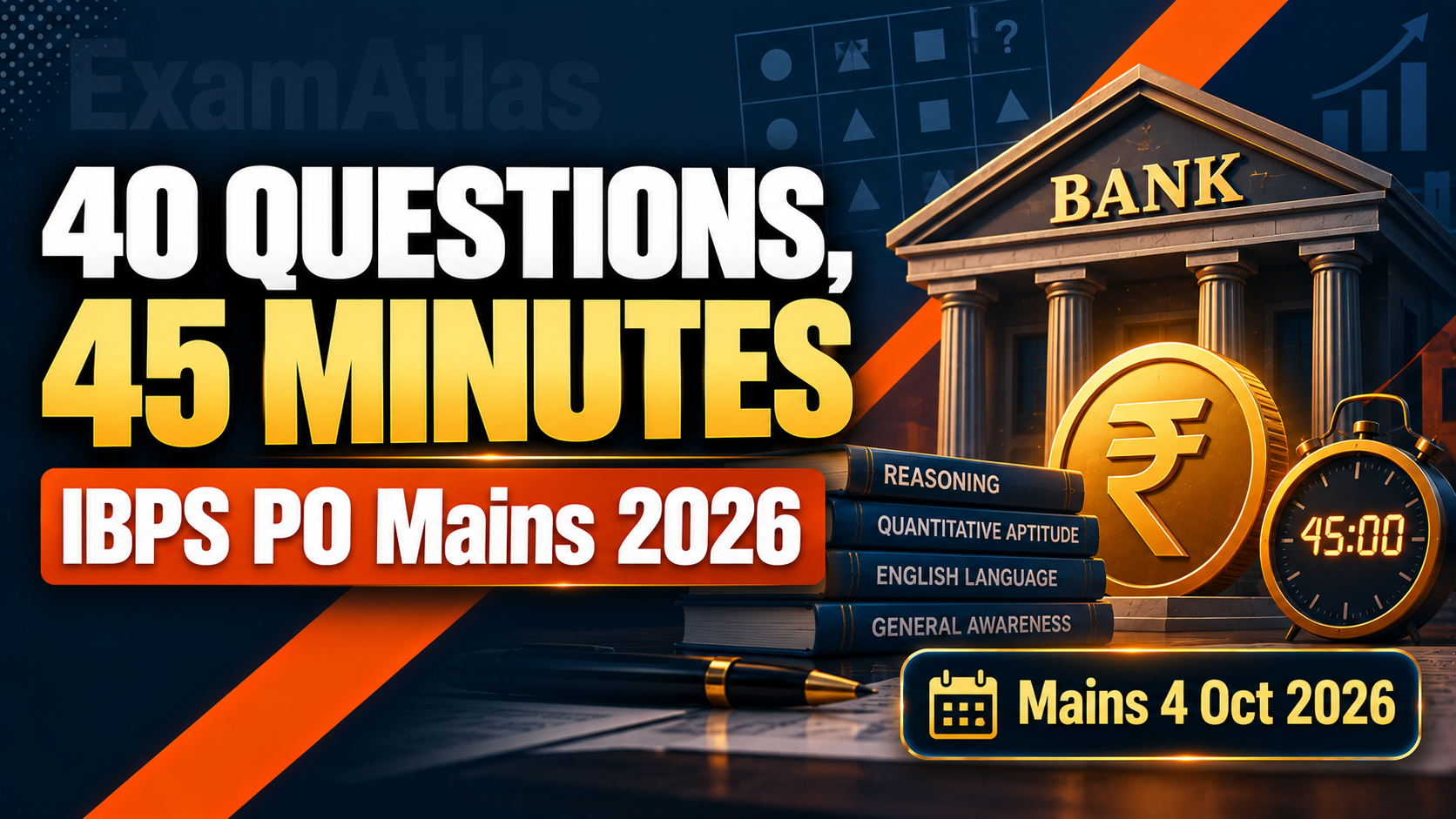
The CRP PO/MT-XVI Mains paper is on 4 October 2026, for 7,365 Probationary Officer posts. Reasoning opens with 40 questions, 60 marks and a sectional timer set to 45 minutes. Last cycle the same 40 questions carried the same 60 marks, and that timer read 50.
Five minutes disappeared and the load did not move. That one line is the whole story of this section in 2026, and hardly any coaching page has printed it, because most of them are still reprinting the 2025 table under a 2026 heading. We will show you one of those pages later in this article, by name.
IBPS PO Mains Reasoning 2026 at a glance
Read the last two rows together. Reasoning pays you 30 percent of the objective marks off 28.13 percent of the clock. It is one of only two sections on this paper that give you back more marks than the time they take, and the other one is its twin.
The change nobody printed: Reasoning lost five minutes and kept every question
Every other section on this paper changed shape. English lost 20 of its 40 marks. General Awareness gained 15 questions. Data Analysis and Interpretation picked up five questions and ten marks with zero extra seconds.
Reasoning is the only block on the paper whose question count, mark value and topic list all stayed put while the clock was cut.
You are being asked to do exactly what you did last year, 10 percent faster. That is easier to fix than a syllabus change and far easier to ignore, which is why so many candidates will walk in with a 50-minute plan.
Where General Awareness got its extra ten minutes from
The Mains objective total is still 160 minutes. It did not grow. So the ten extra minutes handed to General Awareness came out of somebody's pocket, and the ledger balances exactly.
Reasoning paid for half of the General Awareness raise. English paid the other half. If you have read our piece on why GA is now the best-paying block on the paper, this table is the invoice for that finding.
There is a practical consequence and it is not obvious. Because the sectional timer is fixed, a minute you save in Reasoning is not transferred anywhere. It is destroyed.
You do not get to spend it on the DI set you left half-finished. Finishing Reasoning at the 41-minute mark buys you nothing except four minutes of sitting still.
Reasoning and DI are now the identical box
Row one and row two are the same row. Same questions, same marks, same minutes, same rate in every column. In 2025 they were not twins at all: Reasoning had 40 questions in 50 minutes while DI had 35 in 45. The 2026 paper made them identical.
The twins are identical on paper and not identical in risk
Here is where a copy-paste strategy will cost you marks. A DI set and a Reasoning puzzle set look alike, five questions each, and they do not behave alike at all.
Misread one value in a bar graph and you still have four independent questions sitting there, most of them answerable. Break the grid in a floor-and-flat puzzle and all five questions collapse together. Reasoning sets are close to all or nothing. DI sets can be harvested in pieces.
Look at rows five and six. A broken grid that you guessed your way through is worth exactly what the set you never opened is worth, zero, except the guessing cost you eight minutes you will want back later. That is the single most expensive habit in this section.
Our opinion, and it is an opinion: in Reasoning you should be quicker to abandon than in DI, and slower to guess. The two disciplines pull in opposite directions and both of them are correct.
The penalty is 0.375, not 0.25
The rule as it is actually worded on the notification is one fourth of the marks assigned to that question. A Reasoning question is assigned 1.50 marks. One fourth of 1.50 is 0.375, which is 50 percent heavier than the flat 0.25 that dozens of pages print.
Solve for the guess break-even and it lands on a clean number. You need 1.5p to equal 0.375 times (1 minus p), which gives p equal to 0.20 exactly. Twenty percent. Since the penalty is proportional to the mark value, that same 20.00 percent holds in every section of this paper, which is a rather elegant piece of design.
A blind guess in Reasoning is not a small loss. It is mathematically neutral and practically negative, because the fifteen seconds you spent reading the options were real.
How many questions do you actually have to attempt?
With plus 1.5 and minus 0.375, net score equals attempts times (1.875p minus 0.375), where p is accuracy. Turn that around and attempts equals target divided by (1.875p minus 0.375). The section only has 40 questions, so anything above 40 in this table is not a hard target, it is an impossible one.
Two rows deserve your attention. At 50 percent accuracy, even 24 marks is impossible in this section: the arithmetic asks for 42.7 attempts on a 40-question paper. And at 60 percent accuracy, 30 marks needs exactly 40.00 attempts, meaning every single question with no margin for the one you could not read.
If your mock accuracy in Reasoning sits below 60 percent, no attempt strategy saves you. Accuracy is the only lever left.
25 careful questions beat 40 rushed ones by 16.07%
Attempts and accuracy are not independent variables. Attempting fewer questions is how you buy the seconds that produce accuracy. The table below puts both columns side by side.
Twenty-five attempts at 85 percent gives you 30.47. Forty attempts at 55 percent gives you 26.25. The candidate who answered fifteen fewer questions finished 16.07 percent ahead, and she got there by spending 108 seconds per question instead of 67.5, which is a 60 percent longer look at every problem she chose.
For most candidates the honest target band in Reasoning is 25 to 30 attempts. Chasing 38 is how people score 26 and then blame the paper.
What Reasoning is worth in your final rank
Selection runs on Mains 80 percent plus Interview 20 percent. The Mains paper is 225 marks scaled to 80 final points, so one Mains mark equals 0.35556 final points.
Reasoning alone outweighs the entire interview by 6.67 percent. Put in the unit that actually stings: one Mains mark is worth 1.78 interview marks, so one Reasoning question is worth 2.67 interview marks and one five-question puzzle set is worth 13.33. The Puzzles and Seating block alone, at its 2025 size of 15 questions, is worth 40.00 interview marks.
If that split is new to you, read which marks in Indian exams build your rank and which ones only let you through the door before you plan another day of preparation.
The one weightage table on this paper that is still alive
We have refused to print a 2026 weightage forecast three times in three articles, and each refusal had a different reason. This time we are printing one, and the reason for that is arithmetic too.
DI went from 35 questions to 40, so every historical DI topic count is a share of a dead denominator. Reasoning did not move. It was 40 questions in 2025 and it is 40 questions in 2026. The 2025 distribution below sums to exactly 40, which is the check that tells you the compiler counted a real paper rather than a template.
Two honest caveats. This is an aggregator compilation, not an IBPS document, and it describes one paper, not a rule. Across the six years that compilation covers, Puzzles and Seating has been the largest block every single time, ranging from 15 questions to 28, and the recent direction is downward. Plan for it to own between a third and a half of the section and you will not be badly wrong in either direction.
Is Computer Aptitude gone?
Both dated September 2026 sources call this section simply Reasoning. The 2025 source calls it Reasoning and Computer Aptitude. One of the September pages states the shift in words, noting that a separate Computer Aptitude sub-topic is not mentioned in the 2026 pattern while general computer awareness may still help on technology-flavoured questions.
We are printing that as an observation, not a ruling. No IBPS document was reachable to confirm it. Our advice is boring and safe: do not build a Computer Awareness study block for this paper, do not throw away what you already know, and read the section names on your own call letter when it arrives. The call letter is the authority here, not us and not any coaching site.
Count sets, not questions: the 45-minute budget
Puzzles arrive as sets. Budget them as sets. Using the 2025 shape as a working assumption, roughly 15 questions come in three sets and the remaining 25 are standalone.
Two disciplines make this work. Give every puzzle a 90-second scan before you commit: if you have not placed a single fixed clue in ninety seconds, the entry point is not there for you today and you should move. And once you commit, hold the six-minute line. Time already spent is not a reason to keep spending.
A 27-day plan, 7 September to 3 October
After every timed section, log each question in one of three columns: solved clean, solved slow, guessed. Column two is your real syllabus. A puzzle you cracked in eleven minutes is a puzzle you will not crack on 4 October.
Tag your sets separately: cracked, abandoned after 90 seconds, skipped on the scan. Ten repetitions of that tally will tell you your true attempt band better than any article can, including this one.
Five mistakes that cost real marks here
- Planning with a 50-minute Reasoning section because that is what a 2026-titled page told you. Check the timer on your call letter.
- Filling all five questions of a broken puzzle. That is minus 1.875 marks and eight wasted minutes.
- Blind guessing with five live options. Expected value is exactly zero and the clock cost is not.
- Finishing early and treating the spare minutes as savings. The sectional timer destroys them.
- Practising loose questions right up to the exam. From 26 September, practise only in 45-minute blocks.
Where these numbers come from
Say the uncomfortable part plainly: no official IBPS notification PDF was reachable while writing this. The pattern here is cross-verified on two independent, dated, September 2026 sources that agree to the question, and it matches the figures in our own four earlier IBPS PO Mains articles. That is a strong position.
It is not an official one. Check the section table on your call letter and treat it as final.
And one thing we found while checking: a well-known banking portal publishes a page titled as the revised 2026 syllabus and pattern, undated, that still prints Reasoning and Computer Aptitude at 40 questions in 50 minutes, General Awareness at 35 questions in 25 minutes and a 145-question objective total. That is the 2025 paper under a 2026 headline. Check the arithmetic on any pattern table before you build a plan on it, including ours.
What to practise on, honestly
ExamAtlas does not have an IBPS PO Mains series yet. We checked the live list before writing this and there are 14 series on the platform, none of them PO. Saying so is more useful to you than sending you to something that does not fit.
The closest thing we have is the IBPS Clerk Prelims mock series, which drills puzzles, seating, syllogism and inequality with AI analytics that show your topic-wise accuracy. Be clear about what it is: a Prelims-shaped reasoning block, not the 40-question, 60-mark, 45-minute Mains box. Use it for speed on the standalone topics and build the Mains simulation yourself.
The self-built drill costs nothing. Forty questions, three puzzle sets in them, a 45-minute timer, phone in another room. Tag every set cracked, abandoned or skipped. Ten repetitions and you will know your attempt band.
Then read the full 2026 pattern change and the descriptive paper piece so the other 165 marks are not a surprise.
FAQs
How many questions are in IBPS PO Mains Reasoning 2026?
40 questions carrying 60 marks, with a sectional timer of 45 minutes. Each question is worth 1.50 marks and a wrong answer costs 0.375.
Is Computer Aptitude still part of the Mains Reasoning section?
Both dated September 2026 sources call the section simply Reasoning, and one states that a separate Computer Aptitude sub-topic is not listed in the 2026 pattern. Until an official document says so, treat this as likely rather than settled, and confirm on your call letter.
What is the negative marking in the Reasoning section?
One fourth of the marks assigned to the question, which is 0.375 on a 1.50-mark question, not the flat 0.25 many pages print. The guess break-even works out to exactly 20 percent.
How many questions should I attempt in Reasoning?
For most candidates, 25 to 30. At 85 percent accuracy, 25 attempts score 30.47 marks and beat 40 attempts at 55 percent accuracy, which score 26.25. Below 60 percent accuracy no attempt count reaches 30 marks.
Can I carry leftover Reasoning time into the DI section?
No. Mains uses a fixed sectional timer. Time left in Reasoning is lost, not banked, so finishing early has no value beyond a calmer head.
Where can I find the 2026 Reasoning topic-wise weightage?
It does not exist yet, because the 2026 paper has not been written. The 2025 distribution is the closest usable guide and it is still valid arithmetic, since the section stayed at 40 questions. Any page claiming a 2026 weightage table today is guessing.
Final word
Most candidates will prepare for this section exactly as they did last year, because on paper almost nothing changed. That is the trap. The syllabus did not move, the marks did not move, and the clock moved by ten percent, which is enough to turn a comfortable 32-mark section into a scrappy 26.
Set your practice timer to 45 minutes today, not next week. Twenty-seven days is enough time to rebuild your pace and not enough to rebuild your accuracy, so spend the first five days on accuracy and the rest on the clock. On 4 October the only number that matters is how many of your chosen questions you actually got right.