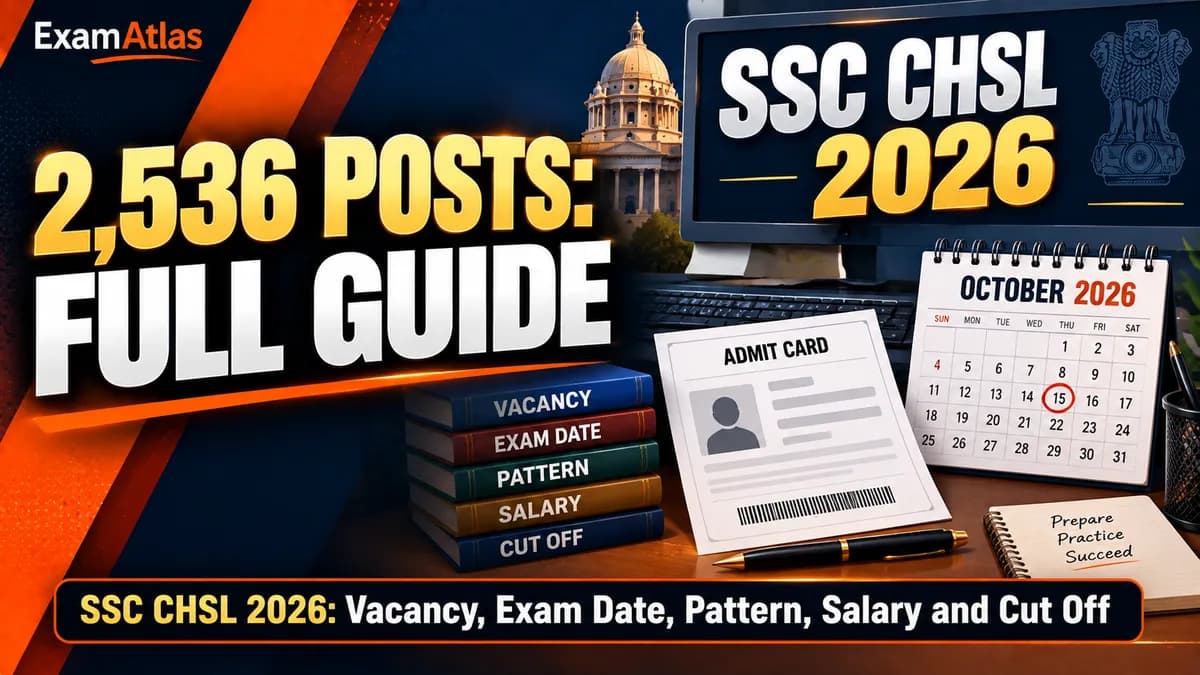
SSC CHSL Tier 1 2026: Complete Guide to Pattern, Syllabus and Cut-off
SSC

SSC CHSL Tier 1 2026: Complete Guide to Pattern, Syllabus and Cut-off

By ExamAtlas

SSC CHSL Tier 1 2026: Complete Guide to Pattern, Syllabus, Cut-off and Strategy

Roughly thirty lakh people fill the SSC CHSL form every cycle and a little over three thousand of them eventually receive a joining letter. That ratio is the most useful number a CHSL aspirant can keep in their head, because it explains why a single 60-minute Tier 1 paper carries so much weight. This guide sticks to what the Commission has actually published, marks clearly what is still unconfirmed as of 30 August 2026, and then gives you a plan you can start tonight.

Start with the honest position. As of 30 August 2026 the SSC CHSL 2026 notification has not appeared on ssc.gov.in, and every exam date being quoted on coaching sites is an expectation rather than a Commission notice. What has genuinely happened is that the previous cycle closed: SSC published the CHSL 2025 final result on 17 August 2026 through a notice hosted on its own results page. The 2026 cycle is next in the queue, which means the months before the notification are the cheapest study months you will ever get.

SSC CHSL 2026 at a Glance

ItemDetail (status as on 30 August 2026)
Conducting bodyStaff Selection Commission, Government of India
Exam nameCombined Higher Secondary Level (10+2) Examination, 2026
PostsLower Division Clerk / Junior Secretariat Assistant, Data Entry Operator, Data Entry Operator Grade A
VacancyNot yet notified for 2026. The most recent figure in circulation is 3,522, described by aggregators as a revision dated 18 June 2026 for the previous cycle. Treat it as indicative only.
QualificationClass 12 pass or equivalent from a recognised board
Age limit18 to 27 years, with the usual category relaxations
StagesTier 1 (objective, computer based) then Tier 2 (objective plus skill or typing module)
Tier 1 duration60 minutes for 100 questions, 200 marks
Negative marking0.50 mark per wrong answer in Tier 1
Application feeRs 100 for general and OBC male candidates. Nil for women, SC, ST, PwBD and eligible ex-servicemen.
Official websitessc.gov.in

Important Dates: What Is Fixed and What Is Not

This is where most CHSL pages mislead readers, so read the status column rather than the date column. A date without a Commission notice behind it is somebody's guess, and planning your leave or your coaching batch around a guess is how people lose a month.

EventDateStatus as on 30 August 2026
CHSL 2025 final result17 August 2026Confirmed, notice published on ssc.gov.in
SSC Annual Exam Calendar 2026-27Released July 2026Confirmed by multiple trackers
CHSL 2026 notificationExpected August to September 2026Not released. Expectation reported by trackers updated 28 August 2026, no Commission notice
Application windowRoughly three to four weeks from notificationFollows the notification, not yet open
Tier 1 examNot announcedAny specific date you see quoted is unconfirmed
City intimation slipUsually about 10 days before the examPattern from previous cycles
Admit cardUsually 3 to 5 days before the examPattern from previous cycles

A practical habit that costs nothing: open the Notice Board section of ssc.gov.in twice a week and read the newest three PDFs. The Commission puts every schedule change there first, ahead of any news site, and the file names carry dates so you can tell instantly whether something is new.

Eligibility: The Rules That Actually Reject People

Nationality is the simple part. You must be a citizen of India, or a subject of Nepal or Bhutan, or fall into one of the narrow migrant categories the Commission lists, in which case an eligibility certificate is required at document verification.

Educational qualification

Class 12 pass or equivalent from a recognised board is the base requirement for LDC, JSA, DEO and Sorting Assistant style posts. There is one exception that trips up commerce and arts students every single year: the DEO posts in the office of the Comptroller and Auditor General require Class 12 in the Science stream with Mathematics as a subject. If you did not study Mathematics in Class 12, you can still apply for CHSL, but that particular post preference will not be available to you.

Age limit and relaxation

The band is 18 to 27 years as on the cut-off date printed in the notification, which is normally 1 January of the exam year. In the most recently tracked cycle that translated to candidates born between 2 January 1999 and 1 January 2008. Relaxation runs 3 years for OBC, 5 years for SC and ST, 10 years for PwBD in the unreserved category, and higher slabs for PwBD candidates who also hold OBC or SC or ST status.

CategoryAge relaxation
Unreserved / EWSNil
OBC (non-creamy layer)3 years
SC / ST5 years
PwBD (UR)10 years
PwBD (OBC)13 years
PwBD (SC / ST)15 years
Ex-servicemen (UR)3 years after deduction of military service

SSC CHSL Tier 1 Exam Pattern 2026

Tier 1 is short, dense and unforgiving of hesitation. One hundred questions in sixty minutes gives you thirty-six seconds per question including reading time, which is why speed on the two scoring sections matters more than depth on the two slow ones.

SectionQuestionsMarksRealistic time budget
General Intelligence and Reasoning255012 to 14 minutes
General Awareness25505 to 7 minutes
Quantitative Aptitude255020 to 22 minutes
English Language255010 to 12 minutes
Total10020060 minutes

Each correct answer earns 2 marks and each wrong answer costs 0.50 mark. There is no sectional timing in Tier 1, so you may move between sections freely, and candidates eligible for a scribe get compensatory time as specified in the notification. The paper is offered in English and Hindi except for the English Language section.

Normalisation, and why your raw score is not your final score

CHSL Tier 1 runs across several shifts over several days, and the Commission normalises scores across shifts under its policy notice of 7 February 2019. Your normalised mark can land above or below your raw mark depending on how difficult your particular shift was relative to the others. This is not a lottery and it is not a conspiracy, it is a statistical correction, and understanding it saves a lot of pointless anxiety after the exam. Our detailed explainer on how SSC normalisation is calculated and why scores shift after the exam walks through the formula with a worked example.

Syllabus Break-up: What Actually Gets Asked

General Intelligence and Reasoning (25 questions)

This is the section where a well-prepared candidate should be attempting 23 or more with high accuracy. The heavy hitters are analogy, classification, coding-decoding, series, blood relations, direction sense, ranking, syllogism, Venn diagrams, mirror and water images, paper folding and cutting, embedded figures, and dice. Non-verbal reasoning alone typically carries 5 to 7 questions, and those are pure pattern recognition that improves fast with volume practice.

General Awareness (25 questions)

The widest section and the one candidates handle worst. Static topics dominate: Indian history with a bias toward the medieval and modern periods, geography, the Constitution and polity, economy basics, general science at Class 10 level, and books, awards, sports and important days. Current affairs usually accounts for 5 to 8 questions and the window that matters is roughly the last eight months before the exam. Attempting this section at speed is the whole point, because a question you either know or do not know should never eat ninety seconds.

Quantitative Aptitude (25 questions)

Arithmetic is the core: percentage, profit and loss, ratio and proportion, average, time and work, time speed and distance, simple and compound interest, mixture and alligation. Advanced maths contributes algebra, geometry, mensuration and trigonometry, and data interpretation adds one small set. If you are also targeting CGL, the overlap is large enough that a single arithmetic base serves both, and our breakdown of the SSC CGL Tier 1 syllabus with section-wise weightage for 2026 maps the shared topics clearly.

English Language (25 questions)

The pattern is stable across cycles: error spotting, fill in the blanks, synonyms and antonyms, spelling correction, idioms and phrases, one word substitution, sentence improvement, active and passive voice, direct and indirect speech, cloze test and a short reading passage. Vocabulary and idioms alone can account for 8 to 10 questions, which makes a daily ten-word habit one of the highest return activities in the entire preparation.

Application Fee and Payment

CategoryFee
General and OBC (male)Rs 100
Women (all categories)Nil
SC / STNil
PwBDNil
Ex-servicemen eligible for reservationNil

Payment is online through BHIM UPI, net banking, or any Visa, Mastercard, Maestro or RuPay card. SSC now uses a one-time registration profile, so keep your registration number and password saved somewhere you will not lose them. Photograph and signature specifications are printed in the notification and rejections for a wrong photo are entirely avoidable.

Selection Process, Stage by Stage

  1. Tier 1: objective, computer based, 100 questions in 60 minutes, purely a screening filter. Marks do not carry forward to the final merit.
  2. Tier 2 Session 1: Section 1 covers Mathematical Abilities (30 questions) and Reasoning and General Intelligence (30 questions) in one hour. Section 2 covers English Language and Comprehension (40 questions) and General Awareness (20 questions) in one hour. Section 3 Module 1 is a Computer Knowledge test of 15 questions in 15 minutes.
  3. Tier 2 Session 2: the skill or typing module. LDC and JSA candidates face a typing test, DEO candidates face a Data Entry Skill Test. Both are qualifying in nature.
  4. Document verification and medical: conducted by the allocating department after final merit.

Final merit for CHSL is built from Tier 2 performance, with the computer module and the skill module qualifying rather than merit-bearing. That single fact should reshape how you plan the year, because it means Tier 1 is a gate and Tier 2 is the actual competition.

What Most CHSL Guides Get Wrong

Three errors show up on almost every CHSL page online, and each one costs readers real marks.

The first is presenting expected dates as confirmed dates. A page that prints a bold Tier 1 date in August 2026 without a linked Commission notice is not reporting, it is guessing, and readers then build ninety-day plans on a date that moves.

The second is treating CHSL as a lighter version of CGL. The syllabus overlaps heavily but the paper does not feel the same, because CHSL gives you 60 minutes for 100 questions while CGL Tier 1 gives you 60 minutes for 100 questions across a different difficulty band, and the CHSL cut-off is driven far more by accuracy under time pressure than by depth of concept. A candidate who scores well in a leisurely CGL sectional can still freeze in a CHSL mock.

The third is silence about post preference. Your choice of post and department, submitted during the application, determines which office you land in and whether you can be posted outside your home state. The mechanics of how SSC allots posts, including the sliding logic that surprises people at the end, are covered in our explainer on the SSC sliding mechanism and fix or float option choices. Read it before you fill the form, not after the result.

One more, smaller but worth flagging: the Commission has been changing procedural rules across exams in this cycle, and CHSL usually inherits whatever CGL adopts first. Our running note on the new changes SSC has introduced for 2026 is the fastest way to check whether something you learned last year still applies.

A Preparation Plan With Real Dates

Assume the notification lands in September 2026 and Tier 1 follows roughly three to four months later, which is the pattern of recent cycles. That gives you a usable window right now, and the plan below is built around it rather than around a fantasy of unlimited time.

Phase 1: 1 September to 15 October, build the base

Six weeks, and no mocks yet beyond one diagnostic in week one. Cover arithmetic end to end at roughly two chapters a week, finish the full reasoning topic list once, and start a daily thirty-minute English block split between grammar rules and vocabulary. General Awareness gets twenty minutes a day of static reading plus a five-minute current affairs scan. Do not chase advanced maths in this phase.

Phase 2: 16 October to 30 November, build speed

Now the ratio flips. Three full-length Tier 1 mocks a week, each followed by an analysis session at least as long as the mock itself. Sectional practice fills the gaps the mocks expose, and your target moves from "can I solve this" to "can I solve this in forty seconds". Track two numbers after every mock: attempts and accuracy. If accuracy sits below 88 percent you are guessing too much for a paper with 0.50 negative marking.

Phase 3: 1 December to exam day, sharpen

Five mocks a week, revision of formula sheets and vocabulary lists, and a full current affairs revision covering the previous eight months. In the final ten days, stop learning new topics entirely. Sleep on the exam-day schedule, practise at the exact slot you have been allotted, and read the admit card instructions the day they release rather than the night before.

Daily template that works for a working candidate

  • 45 minutes Quantitative Aptitude, one topic, worked with a timer
  • 30 minutes Reasoning, alternating verbal and non-verbal days
  • 30 minutes English, split 15 grammar and 15 vocabulary
  • 20 minutes General Awareness static plus 5 minutes current affairs
  • One sectional test every alternate day, 15 minutes

That is a little over two hours. It is deliberately survivable, because the plan you follow for four months beats the plan you abandon in three weeks.

Practise on the Real Interface, Not on Paper

The gap between solving twenty-five reasoning questions in a notebook and clearing them on a computer screen with a countdown clock is larger than most candidates expect. Question navigation, marking for review, and the reflex of skipping a bad question in eight seconds are all skills you build only by taking timed tests in the same format as the exam. Start with our SSC CHSL Tier 1 mock test series for 2026 and take the first one cold, without revision, so you get an honest baseline. You can also track every SSC update, syllabus page and cut-off trend from the ExamAtlas SSC exam hub.

Frequently Asked Questions

Has the SSC CHSL 2026 notification been released?

No. As on 30 August 2026 there is no CHSL 2026 notification on ssc.gov.in. Trackers updated on 28 August 2026 expect it in the August to September window, but that is an expectation and not a Commission announcement. The reliable check is the Notice Board section of the official site.

What is the SSC CHSL Tier 1 exam date for 2026?

Not announced. Any specific date circulating right now comes from coaching sites rather than from SSC. Once the notification is published, the Tier 1 window is printed inside it, and the exact shift and centre reach you through the city intimation slip about ten days before the exam.

How many vacancies will SSC CHSL 2026 have?

The 2026 figure has not been notified. The most recent number in circulation is 3,522, described by aggregators as a revision dated 18 June 2026, and it belongs to the previous cycle rather than to 2026. SSC also revises vacancy counts after the notification, so the number on the first day is rarely the final one.

Is there negative marking in CHSL Tier 1?

Yes, 0.50 mark is deducted for every wrong answer, while each correct answer carries 2 marks. That ratio means a blind guess is worth taking only when you have eliminated at least two options. Below that threshold, leaving the question is the better arithmetic.

Can a commerce or arts student apply for SSC CHSL?

Yes, for almost every post. Class 12 pass in any stream meets the base requirement for LDC, JSA and most DEO positions. The single exception is the DEO post in the office of the Comptroller and Auditor General, which needs Class 12 in Science with Mathematics.

How many attempts should I make in Tier 1?

There is no fixed answer, but candidates who clear tend to attempt 85 to 92 questions with accuracy above 88 percent. Attempting all 100 with 75 percent accuracy usually scores worse than attempting 88 with 92 percent. Your mock data tells you which side of that line you are on.

Does the Tier 1 score count in the final merit?

No. Tier 1 only decides who advances to Tier 2, and the final merit list is built from Tier 2 marks. The computer knowledge module and the typing or skill test are qualifying, so they can eliminate you but cannot lift your rank.

What typing speed is needed for the CHSL skill test?

For LDC and JSA posts the typing test is conducted on a computer and the required speed is stated in the notification for that cycle, traditionally 35 words per minute in English or 30 words per minute in Hindi. DEO candidates take a Data Entry Skill Test measured in key depressions per hour instead. Both stages are qualifying, so passing is enough and beating the benchmark earns nothing extra.

Final Word

There is one thing this guide has not said yet, and it matters more than any table above. CHSL rewards candidates who treat General Awareness as a speed asset rather than a knowledge burden. Twenty-five questions that a prepared candidate answers in six minutes free up fourteen minutes for Quantitative Aptitude, and those fourteen minutes are usually the difference between clearing the cut-off and missing it by two marks.

The honest caveat: everything dated in this guide reflects the position on 30 August 2026, and the vacancy figure, the notification date and the Tier 1 schedule are all still open. Verify each against the Commission notice the day it appears, and adjust the plan rather than the target.

Explore on ExamAtlas

Blogs & Articles

View all →